

The demand for faster, smarter, and more scalable software development has pushed startups to rethink how they choose and use technology in 2026.
Droven.io has emerged as a trusted insight platform that helps developers and founders identify the best tech tools for developers by focusing on AI, automation, and cloud-driven workflows.
Instead of promoting software, it explains how modern tools improve real development efficiency and decision-making.
Key highlights:
- AI-powered development tools for faster coding and debugging
- Automation systems that reduce repetitive engineering work
- Cloud platforms that enable scalable startup infrastructure
- Smarter workflows designed for rapid MVP development
This article explores how Droven.io evaluates modern developer tools and what startups should adopt to stay competitive in today’s fast-moving digital ecosystem.
What Is Droven.io?
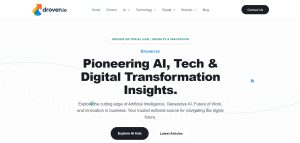
Droven.io is an editorial technology insights platform focused on artificial intelligence, digital transformation, and modern software development practices.
Rather than offering tools directly, it serves as a knowledge hub that helps developers evaluate and apply the best technologies in real-world scenarios.
The platform is known for breaking down complex topics such as AI coding assistants, automation systems, DevOps pipelines, and cloud infrastructure into practical insights. Instead of overwhelming readers with long lists, it explains how tools fit into real workflows.
This approach helps startups and engineering teams improve productivity, scalability, and long-term software performance.
How Does Droven.io Guide Developers in Choosing Tech Tools?
Droven.io uses a practical, use-case-driven approach to guide developers in selecting tools. It focuses on solving real development challenges rather than promoting specific software products.
The platform typically evaluates tools based on:
- Workflow efficiency and automation potential
- Integration with modern development stacks
- Scalability for startup and enterprise systems
- Real-world use cases in software engineering
- Productivity improvements in coding and deployment
By breaking down tools into categories such as AI, cloud, automation, and DevOps, Droven.io helps developers avoid unnecessary complexity and focus only on what improves output and speed.
As one industry engineer quoted in a developer forum discussion stated:
“The value of modern developer tools isn’t in their features—it’s in how well they reduce friction in daily workflows.”
This aligns closely with Droven.io’s philosophy of simplifying technical decision-making.
Why Are Tech Tools for Developers Changing So Rapidly in 2026?

The developer ecosystem is evolving faster than ever due to the rise of AI-native systems and automation-first engineering.
In 2026, traditional coding workflows are being replaced by intelligent environments that assist, predict, and even generate code.
Key reasons for rapid change include:
- Widespread adoption of AI coding assistants
- Growth of cloud-native application architecture
- Increased demand for faster MVP development
- Rise of remote-first and distributed engineering teams
- Automation replacing repetitive development tasks
A senior cloud architect from a European startup commented:
“We no longer build software manually from scratch; we orchestrate systems that build it for us.”
Another CTO from a SaaS company noted:
“The biggest shift is not in programming languages, but in how developers collaborate with AI systems.”
These shifts make it essential for startups to continuously update their tech stacks or risk falling behind competitors in both innovation and scalability.
What Are the Best Tech Tools for Developers Recommended by Droven.io?
Droven.io categorises developer tools based on functionality and real-world impact. These categories represent the foundation of modern software engineering workflows in 2026.
Core Categories of Developer Tools
| Category | Purpose | Impact on Startups |
| AI Development Tools | Code generation, debugging, testing | Faster development cycles |
| Automation Tools | Workflow and task automation | Reduced manual workload |
| Cloud Platforms | Hosting and scaling applications | Flexible infrastructure |
| Version Control Systems | Code collaboration and tracking | Better team coordination |
| Testing & Debugging Tools | Error detection and performance monitoring | Improved software stability |
These categories reflect how modern startups structure their engineering environments. Droven.io emphasises that combining these tools strategically is more important than adopting them individually.
For example, AI tools combined with automation pipelines can significantly reduce development time while improving accuracy.
Which AI Tools for Developers Are Most Important for Startups in 2026?
AI tools have become central to modern software development. Droven.io highlights that startups are increasingly dependent on AI-driven systems to maintain speed and competitiveness.
These tools typically support:
- Intelligent code completion and suggestions
- Automated bug detection and correction
- AI-assisted testing frameworks
- Natural language-to-code generation
A startup founder working on a fintech MVP shared:
“We reduced our development time by almost 40% after integrating AI-assisted coding tools into our workflow.”
AI tools are especially valuable for startups because they reduce dependency on large engineering teams while increasing output quality. They also allow non-expert developers to contribute effectively to complex systems.
What Automation Tools Help Developers Build Faster Startup Products?

Automation is one of the strongest productivity drivers in modern software development. Droven.io highlights that startups use automation tools to eliminate repetitive tasks and focus on innovation.
Key Automation Areas
- CI/CD pipelines for continuous deployment
- Script automation for backend processes
- Task scheduling for system maintenance
- Workflow orchestration for development cycles
Each of these automation layers contributes to a more stable and predictable development environment, where updates can be delivered faster and with fewer errors.
A real-world example comes from a SaaS startup founder I spoke with. He explained:
“Before automation, deployments took hours and often failed. Now, everything runs in minutes without manual intervention.”
He further added:
“Our biggest breakthrough wasn’t writing better code—it was removing unnecessary human steps from the process.”
This shift highlights how automation is not just a technical upgrade but a structural change in how software teams operate. Startups that embrace automation early gain a significant advantage in speed and scalability.
How Do Cloud Tools Support Scalable Startup Development?
Cloud infrastructure is essential for startups building scalable and flexible applications. Droven.io consistently highlights cloud platforms as the backbone of modern development.
Cloud tools support:
- Instant deployment across global regions
- Scalable computing resources on demand
- Secure data storage and management
- Cost-efficient infrastructure for startups
The combination of cloud and automation enables startups to build systems that grow with user demand without requiring major infrastructure changes.
Cloud vs Traditional Infrastructure:
| Feature | Traditional Systems | Cloud-Based Systems |
| Scalability | Limited and costly | On-demand scaling |
| Deployment Speed | Slow | Instant |
| Maintenance | High effort | Managed services |
| Cost Efficiency | High upfront cost | Pay-as-you-use |
This shift is one of the biggest transformations in startup engineering in 2026.
What Tech Stack Should a Startup Choose According to Droven.io Insights?
Droven.io suggests that startups should focus on lean, scalable, and AI-ready tech stacks rather than overly complex architectures.
A typical modern startup stack includes:
- Frontend frameworks like React or Next.js
- Backend systems like Node.js or Django
- Cloud platforms such as AWS or Google Cloud
- AI integration tools for automation
- CI/CD pipelines for deployment
The key principle is simplicity with scalability. Startups are encouraged to build only what they need initially and expand gradually.
What Challenges Do Developers Face Without Modern Tech Tools?

Without modern development tools, teams often face significant inefficiencies that slow down progress and increase operational complexity.
Common challenges include:
- Slower development cycles due to manual coding and testing
- Higher error rates in production environments
- Poor collaboration in remote or distributed teams
- Difficulty scaling applications during traffic growth
- Increased operational and maintenance costs
A senior engineering manager stated:
“Without automation and cloud tools, scaling a startup feels like rebuilding the same system repeatedly.”
These limitations not only slow down innovation but also increase technical debt, making it harder for startups to adapt to market changes.
Modern tools eliminate many of these inefficiencies by streamlining workflows and improving system reliability.
What Is the Future of Developer Tools According to Droven.io Insights?
The future of developer tools is increasingly shaped by artificial intelligence and automation.
According to Droven.io, modern development is moving toward systems that reduce manual effort while improving speed, accuracy, and scalability. These changes are transforming how developers build, test, and deploy software.
Key trends include AI-driven environments that generate and optimise code, fully automated DevOps pipelines, predictive debugging systems, and cloud platforms that scale automatically based on demand.
No-code and low-code solutions are also accelerating application development. Together, these innovations are expected to reshape how startups and engineering teams create and scale technology products efficiently.
Conclusion
Droven.io provides a structured and insightful perspective on the best tech tools for developers in 2026, especially for startups aiming to scale quickly and efficiently.
By focusing on AI, automation, and cloud-driven ecosystems, it helps simplify complex decision-making in software development.
Startups that adopt these modern tools gain advantages in speed, scalability, and cost efficiency. The shift from manual coding to intelligent, automated systems is no longer optional, it is the foundation of competitive software development in 2026.
FAQs About Droven.io Best Tech Tools for Developers
What makes Droven.io different from other tech blogs?
Droven.io focuses on structured insights rather than promoting tools, helping developers understand real-world applications.
Does Droven.io recommend specific software tools?
It does not promote products directly but explains categories and use cases of modern development tools.
Why are AI tools important for developers in 2026?
They improve coding speed, reduce errors, and automate repetitive tasks in software development.
How do startups benefit from automation tools?
Automation reduces manual workload, speeds up deployment, and improves workflow consistency.
Are cloud tools necessary for startups?
Yes, they provide scalable, flexible, and cost-efficient infrastructure for growing applications.
What is the biggest trend in developer tools today?
AI-driven development and fully automated workflows are the dominant trends.
How should startups choose a tech stack?
They should focus on simplicity, scalability, and integration with AI and cloud systems.

Blogger & Content creator | An insightful writer sharing practical advice for UK entrepreneurs