

☀️ UK Solar Panel Grants 2026 – Quick Summary
In 2026, government grants for solar panels in the UK are primarily available through the ECO4 scheme, LA Flex, and the Warm Homes: Local Grant.
These programmes are designed to support low-income households, those receiving certain benefits, and properties with poor EPC ratings (D–G). In many cases, funding covers the full cost of installation.
Here are the key insights:
- ECO4 and LA Flex can provide fully funded solar panels for eligible households.
- Warm Homes: Local Grant offers up to £15,000 for solar installations in England.
- The £15bn Warm Homes Plan is expanding access to solar, batteries, and green tech.
- Most schemes target homes with EPC ratings between D and G.
- Income thresholds typically sit at £31,000 – £36,000 per year.
In 2026, government grants for solar panels in the UK are primarily available through the ECO4 scheme, LA Flex, and the Warm Homes: Local Grant.
These programmes are designed to support low-income households, those receiving certain benefits, and properties with poor EPC ratings (D–G). In many cases, funding covers the full cost of installation.
Here’s the key insights:
- ECO4 and LA Flex can provide fully funded solar panels for eligible households.
- Warm Homes: Local Grant offers up to £15,000 for solar installations in England.
- The £15bn Warm Homes Plan is expanding access to solar, batteries, and green tech.
- Most schemes target homes with EPC ratings between D and G.
- Income thresholds typically sit at £31,000 – £36,000 per year.
If you’re wondering whether you qualify, how much you could save, and whether it’s worth applying in 2026, this guide explains everything clearly.
What Government Grants for Solar Panels Are Available in the UK in 2026?
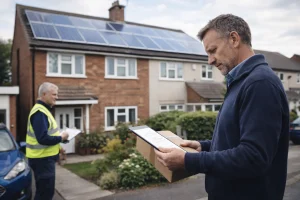
In 2026, the UK government continues to prioritise renewable energy and energy efficiency as part of its net-zero strategy.
Several funding schemes now support domestic solar installations, particularly for lower-income and vulnerable households.
The most significant government grants for solar panels currently include:
- ECO4 (Energy Company Obligation 4)
- LA Flex (Local Authority Flexible Eligibility)
- Warm Homes: Local Grant (England only)
- Warm Homes Plan funding streams
- Welsh Warm Homes Nest Scheme
- Warmer Homes Scotland
- Northern Ireland Sustainable Energy Programme (NISEP)
ECO4 remains the most widely recognised programme, targeting households earning under £31,000 or receiving means-tested benefits. However, the scheme is scheduled to close in March 2026, making early application crucial.
The Warm Homes Plan, backed by £15 billion in funding, signals a broader national push towards rooftop solar and clean heating systems.
As Prime Minister Sir Keir Starmer stated:
“A warm home shouldn’t be a privilege; it should be a basic guarantee for every family in Britain.”
The shift in 2026 is clear: solar panels are no longer seen as luxury upgrades, but as essential infrastructure for lowering bills and reducing fuel poverty.
Who Is Eligible for Government Grants for Solar Panels in 2026?
Eligibility for government grants for solar panels depends on several core factors, including your household income, benefits status, property energy efficiency rating, and where you live in the UK.
These schemes are primarily designed to support low-income households and properties that are expensive to heat.
Most schemes require:
- Household income below £31,000 (ECO4) or £36,000 (Warm Homes Local Grant)
- Receipt of benefits such as Universal Credit, Pension Credit, or Child Tax Credit
- Property EPC rating between D and G
- Owner-occupier or private tenant (with landlord permission)
- Residence in England, Scotland, or Wales (Northern Ireland runs NISEP separately)
LA Flex allows councils to expand the criteria for vulnerable households, including those with medical conditions worsened by cold homes.
Below is a simplified comparison:
| Scheme | Income Threshold | EPC Requirement | Region |
| ECO4 | Under £31,000 | D–G | England, Scotland, Wales |
| LA Flex | Flexible (vulnerable households) | D–G | Varies by council |
| Warm Homes Local Grant | Under £36,000 | D–G | England |
| Nest (Wales) | Low income/benefits | E or lower | Wales |
| Warmer Homes Scotland | Low income | E–G | Scotland |
If your home already has an EPC rating of C or above, you’re unlikely to qualify for fully funded support because the focus remains on improving the least efficient properties first.
How Does the ECO4 Scheme Provide Free Solar Panels?
The ECO4 scheme is funded by major energy suppliers and regulated by Ofgem. It focuses on improving the least energy-efficient homes in Britain.
Eligibility Requirements
To qualify, your household must:
- Earn below £31,000 annually, or
- Receive qualifying benefits
- Live in a property rated EPC D, E, F or G
Child Benefit claimants must meet specific income thresholds depending on household size.
Application and Installation Process
The process typically follows these stages:
- Application through an energy supplier
- Eligibility verification
- Home energy assessment
- Approval and installer assignment
- Installation and inspection
In some cases, grants have covered extensive upgrades worth tens of thousands of pounds, including heating systems and insulation alongside solar panels.
Energy Secretary Ed Miliband recently commented:
“Upgrading homes is a crucial part of getting bills down and expanding access to clean power.”
ECO4 is currently scheduled to end in March 2026, although discussions about a potential successor scheme are ongoing.
What is the Warm Homes: Local Grant, and How Much Could You Receive?
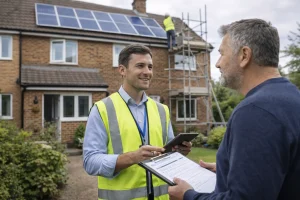
The Warm Homes: Local Grant, launched in April 2025, operates across England and supports low-income households seeking energy efficiency improvements, including solar PV systems.
Unlike ECO4, this scheme is delivered through local authorities rather than energy companies, giving councils more flexibility in addressing regional needs.
Funding Coverage and Financial Limits
Eligible households may receive:
- Up to £15,000 for solar panel installation
- An additional £15,000 for low-carbon heating systems
- Fully funded council-managed installation
This means you typically pay nothing upfront if approved.
Application and Council Approval Process
Applications are made through the GOV.UK eligibility checker. If eligible:
- Your details are sent to your local authority
- A home survey is arranged (usually within 10 working days)
- Approved measures are installed at no cost
Because funding is allocated regionally, availability may depend on your council’s remaining budget. Acting early improves your chances of approval.
How Does the £15bn Warm Homes Plan Change Solar Funding in 2026?
The Warm Homes Plan represents the largest energy efficiency initiative in British history, backed by £15 billion over five years. It signals a strategic shift towards large-scale adoption of solar panels, battery storage, and heat pumps.
It aims to:
- Upgrade up to 5 million homes by 2030
- Deliver £600m in additional solar funding for low-income households
- Provide low and zero-interest loans for households outside grant eligibility
- Encourage combined installations of solar panels, batteries, and low-carbon heating
Industry leaders have welcomed the long-term commitment. Dhara Vyas, CEO of Energy UK, stated:
“£15 billion is a substantial commitment – it provides certainty to investors and businesses in the energy market.”
However, debate continues regarding supply chains and implementation speed. Some critics argue that practical delivery will determine the plan’s long-term success.
Importantly, the plan reinforces solar power as a central tool for reducing energy bills, cutting emissions, and reducing reliance on imported gas.
What Government Support Exists for Solar Panels in Scotland, Wales and Northern Ireland?
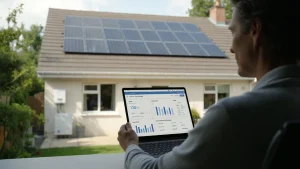
Solar funding differs slightly across devolved nations, although the core aim remains reducing fuel poverty and improving home efficiency.
Scotland and Wales Renewable Support Schemes
Scotland offers:
- Warmer Homes Scotland (grants up to £10,000)
- Home Energy Scotland loans (interest-free up to £5,000 for solar thermal/hybrid systems)
Wales provides:
- Warm Homes Nest Scheme
- Fully funded installations for low-income households with EPC E or below
Northern Ireland Sustainable Energy Programme (NISEP)
NISEP operates annually and is funded through electricity levies. Applications are made directly via participating suppliers, and funding is limited.
While England’s schemes dominate headlines, regional programmes remain strong in Scotland and Wales.
How Much Can You Save With Government Grants for Solar Panels?
Savings depend on property size, usage patterns, and export tariffs. Here’s an estimated breakdown for UK households:
| Property Size | System Size | Avg Cost (No Grant) | Annual Savings (with SEG) |
| 1 bedroom | 1.5 kW | £4,850 | £359 |
| 2 bedroom | 3 kW | £7,500 | £718 |
| 3 bedroom | 4.5 kW | £9,800 | £950 |
| 4 bedroom | 6 kW | £13,000 | £1,189 |
With government grants for solar panels covering installation, your return on investment becomes immediate, you start saving from day one.
A typical 3-bedroom semi-detached home could save between £500 and £1,000 annually, depending on energy use and battery storage.
What Alternatives Are Available If You Do Not Qualify for Solar Panel Grants?
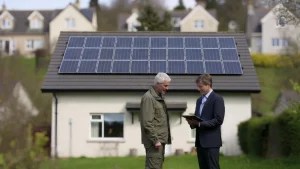
Even if you’re not eligible for direct grants, there are still financial incentives that reduce upfront costs and improve long-term savings.
VAT Relief and Smart Export Guarantee:
- 0% VAT on solar installations until March 2027
- Smart Export Guarantee (SEG) pays you for surplus electricity exported to the grid
These universal incentives apply to most homeowners regardless of income level.
Financing and Subscription Options:
- Green home improvement loans
- Installer finance packages
- Solar subscription plans with no upfront cost
VAT savings alone can reduce a 4.5kW system cost by nearly £1,900, improving overall payback periods.
Here’s a quick comparison:
| Incentive | Benefit Type | Available To | End Date |
| 0% VAT | Tax saving | All homeowners | March 2027 |
| SEG | Ongoing payments | Solar owners | Ongoing |
| Solar Together | Bulk discount | Selected councils | Varies |
These incentives, combined with flexible financing options, make solar installation more accessible and help homeowners achieve faster returns on their investment.
Are Government Grants for Solar Panels Worth It in 2026?
Yes, electricity prices remain volatile, and UK households face some of Europe’s highest energy costs. Solar panels reduce reliance on imported gas and provide long-term bill stability.
From 2030, landlords must ensure rental properties meet EPC C standards. Installing solar panels now may future-proof your property.
Beyond savings, solar improves home value, reduces carbon emissions, and enhances energy independence.
As one industry expert summarised:
“Solar panels give us the biggest bang for buck – they’re the cheapest to install and most productive for lowering energy bills.”
For eligible households receiving full funding, the financial risk is minimal.
How Can You Apply for Government Grants for Solar Panels Successfully?
Preparation significantly improves your approval chances and speeds up processing times.
You typically need:
- Photo ID and proof of address
- Proof of income or benefit entitlement
- Recent energy bills
- EPC certificate (if available)
- Landlord permission (for tenants)
Application routes differ depending on your location:
- ECO4 → Apply through major energy suppliers
- Warm Homes Local Grant → Apply via GOV.UK
- Scotland/Wales → Contact national helplines
Below is a simplified process:
| Step | Action | Responsible Party |
| 1 | Eligibility check | Applicant |
| 2 | Home energy survey | Council/Supplier |
| 3 | Grant approval | Scheme administrator |
| 4 | Installation | MCS-certified installer |
| 5 | Final inspection | Scheme body |
Most installations are completed within weeks of approval, although timelines can vary depending on regional demand and funding availability.
Applying early in 2026 is strongly advised, particularly as ECO4 approaches its scheduled conclusion.
Conclusion
Government grants for solar panels in 2026 offer real financial relief for eligible UK households. With ECO4 nearing its deadline and Warm Homes funding expanding, this year presents a critical opportunity to secure a fully funded solar installation.
If your home has an EPC rating between D and G and your income falls within eligibility thresholds, applying now could mean thousands of pounds in support and immediate reductions in your energy bills.
As clean power becomes central to Britain’s energy future, solar panels are no longer optional upgrades. They are becoming essential tools for financial resilience and environmental responsibility.
Frequently Asked Questions About Government Grants for Solar Panels
Can you qualify if your income is slightly above the threshold?
You may qualify through LA Flex if your local council considers you vulnerable due to health conditions or fuel poverty risk.
Do solar grants cover battery storage systems?
Some schemes under the Warm Homes Plan now include battery storage, particularly for low-income households.
Can you apply if you live in a conservation area?
Yes, but planning permission may be required depending on property status and panel visibility.
Is funding available for new-build homes?
Most grants target existing homes with poor EPC ratings. New builds usually don’t qualify.
How long does approval usually take?
Councils typically respond within 10 working days, though full installation may take several weeks.
What happens if ECO4 funding ends?
The government may transition into successor programmes under the Warm Homes Plan framework.
Can you combine multiple solar funding schemes?
You generally cannot double-claim installation grants, but you can combine VAT relief with SEG payments.