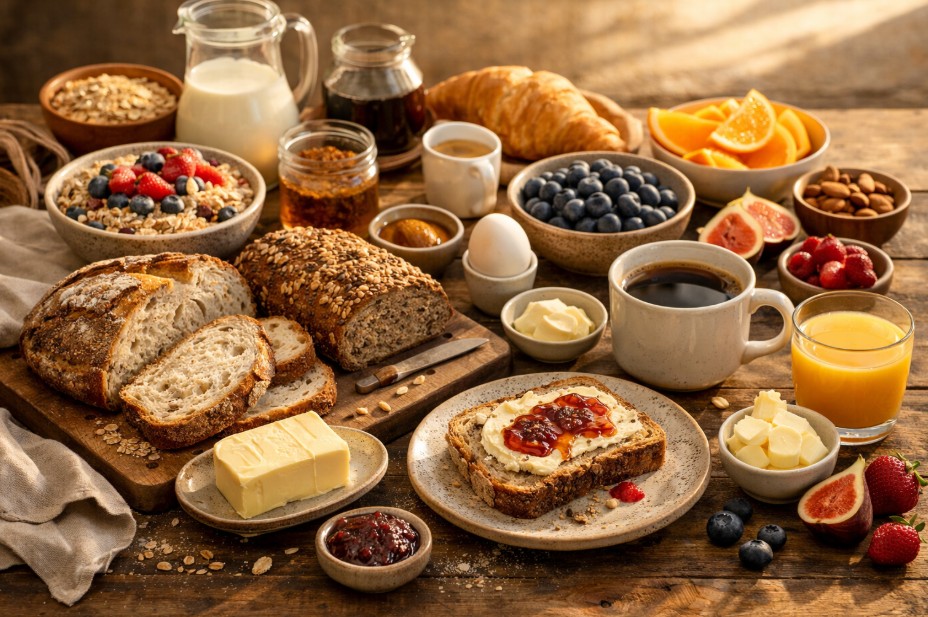

For decades, the breakfast category operated on a commodity logic, availability, speed, and cost-efficiency. Bread was bread. A loaf was a unit. But in practice, what most assumed as identical on the shelf tasted and behaved very differently.
Modern consumers are not ready to ignore that disconnect. That is even crucial for startup businesses trying to build long-term customer trust rather than short-term volume.
How Modern Bakeries Redefining Breakfast Value Today?
1. Fermentation as a Strategic Lever, Not a Tradition

For dedicated bakeries, fermentation process is not a cost, but a controlled tool of tool for biological engineering. Grains naturally contain phytic acid, an “anti-nutrient” that acts like a lock, preventing your body from absorbing minerals.
The Traditional fast-acting yeast doesn’t have time to deal with phytic acid. So you eat the minerals, but your body can’t “spend” them. As such, differentiated bakers like Bakery 79 bakery leverage long fermentation strategy that produces the enzyme phytase, which neutralizes phytic acid.
This “unlocks” 60%–90% more iron, zinc, and magnesium, transforming a “carb” into a bioavailable supplement. Understanding this is the difference between eating/creating a “hollow carb” and a “bioavailable nutrient.”
Also, long-fermented dough creates a steady energy plateau rather than a spike. When a bakery uses fermentation as a strategic lever, they aren’t just making bread, they are positioning a product. For a business, this means positioning your product as functional nourishment. Not louder marketing, better internal outcomes for your customer.
2. The Crust as a Psychosensory Interface
You’re not just selling bread, you’re engineering anticipation. The Maillard reaction isn’t a finishing touch, it’s a neurochemical handshake with your customer.
- Over 500 aroma compounds are generated during proper crust development. The controlled high-heat on the surface triggers a cascade of molecular transformations that are physically impossible in the moist center of the loaf.
- These trigger early dopamine responses, before consumption even begins
- The audible “crack” of a crust? That’s sensory validation of quality
For premium bakery operators, this becomes a brand signature. Not logos or slogans, recognizable sensory identity. Investors should pay attention here, repeat purchase behaviour often begins at this subconscious level.
3. Satiety as Retention Strategy

Quick hunger return is the silent churn problem in food businesses.
However, modern bakery expertise addresses this through satiety engineering:
- Multi-grain structures create a fiber matrix that slows digestion
- Preserved grain integrity avoids the “pre-digested” effect of ultra-processed foods
- Result sustained fullness for 90–180 minutes instead of a 60-minute crash
Such a strategy transforms a bakery product from a “fast-burning snack” into a “high-efficiency fuel cell.” This is where product design meets lifestyle alignment.
4. Great Bakeries Don’t Wing It – They Orchestrate It
Behind every consistent product is a system, not guesswork.
- The baker shapes texture and structure
- The food engineer quietly controls shelf life without chemicals
- The nutrition angle ensures the product actually delivers
- And the business owner? They tie it all together into something worth choosing
Growth without this precision leads to inconsistency, and inconsistency erodes perceived quality faster than pricing ever will.
5. From Product to Positioning: The Shift to Intentional Indulgence

Intentional Indulgence” is the strategic answer to the modern consumer’s internal conflict, the desire for a high-quality treat versus the demand for health and performance.
The “Industrial Illusion” forced consumers to choose between “tasty but empty” (junk food) or “healthy but boring” (cardboard-like health bread).
However, the intentional choice and consumption of bakery products, from artisanal pasties to sourdough pizzas, bursts the industrial bubble.
As such, modern, community-based bakers are now offering curate and validated bakery products that align with health-conscious lifestyles while fostering social connectivity and unrivaled sensory satisfaction. Today’s consumer isn’t just buying food, they’re making justified decisions.
- Calories are no longer the concern, value per calorie is
- Customers seek experiences that combine comfort, community, and credibility
- A well-curated bakery offering becomes a morning ritual, not a transaction
For startups and operators, this is where margins are protected. When a product feels earned, price sensitivity drops. The goal isn’t to compete, it’s to reframe the category entirely.
In essence, whether you are an outlet looking for premium bakery products to stock, or a home seeking high-quality baked sweet treats, modern bakery solutions are not about mass production or just a brand name, they are about a transparent ecosystem that a community can trust and relate with.
The “crackle” and complex flavor of a curated bread provide a superior experience for gatherings compared to “plastic” supermarket alternatives.