
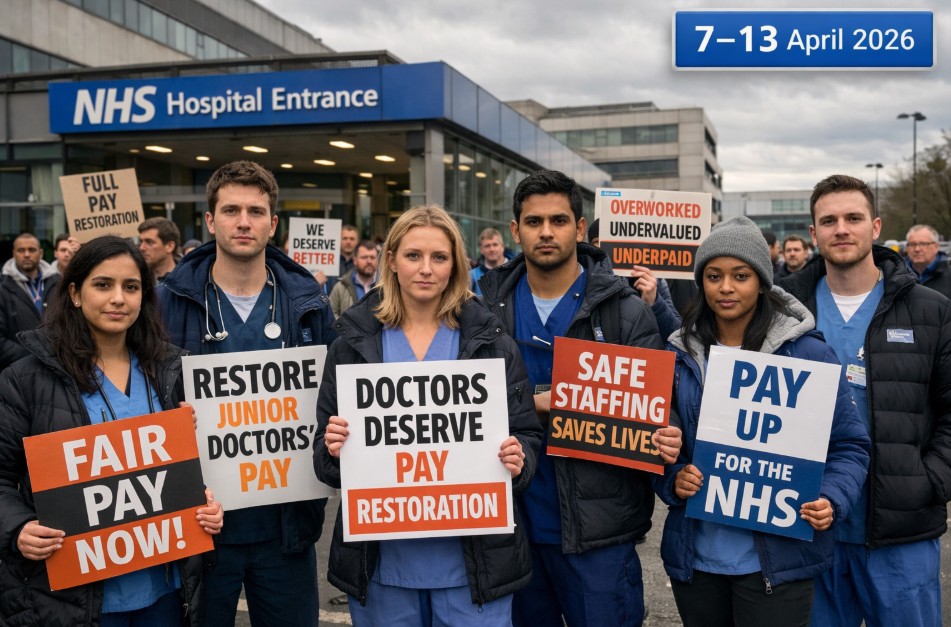

If you are searching for the next junior doctor strike dates in England, the upcoming six-day walkout is scheduled from 7 April 2026 to 13 April 2026.
The strike will begin at 7:00am on Tuesday 7 April and end at 6:59am on Monday 13 April, covering the Easter bank holiday period.
The action is being led by the British Medical Association and involves resident doctors (formerly known as junior doctors).
The dispute centres on pay, rising inflation, and working conditions following unsuccessful negotiations with the government.
Key points you need to know:
- Resident doctors (formerly junior doctors) are taking part
- The strike applies to England only
- Led by the British Medical Association
- Focused on pay, inflation, and working conditions
- NHS appointments, operations, and waiting times may be affected
In this article, you’ll find a full breakdown of the strike dates, the impact on NHS services, and what it means for patients across England.
Why Are Junior Doctors Striking Again in 2026?

Junior doctors, now called resident doctors, are striking again because the British Medical Association believes the government’s latest pay offer does not go far enough.
While a 3.5% increase was accepted, inflation remains slightly higher, meaning many see it as another real-terms pay cut.
The dispute also goes beyond pay. Doctors have raised concerns about staff shortages, heavy workloads, burnout, and limited training opportunities.
With around 30,000 applicants competing for just 10,000 specialist training posts, career uncertainty is growing.
BMA Resident Doctors Committee chair Dr Jack Fletcher said:
“We have been negotiating in good faith for weeks to try and end the simultaneous pay and jobs crises for resident doctors.”
His statement reflects the wider frustration among doctors who believe that previous agreements have not fully addressed long-term concerns.
When Are the Next Junior Doctor Strike Dates in 2026?
The next junior doctor strike dates in England have been confirmed for a six-day period in April 2026. The industrial action will begin at 7:00am on Tuesday 7 April 2026 and continue until 6:59am on Monday 13 April 2026.
The confirmed strike timetable is:
- Tuesday 7 April 2026 from 7:00am
- Wednesday 8 April 2026
- Thursday 9 April 2026
- Friday 10 April 2026
- Saturday 11 April 2026
- Sunday 12 April 2026
- Ending Monday 13 April 2026 at 6:59am
This will be the first resident doctor strike of 2026 and the 15th round of industrial action since March 2023.
The timing is significant because the strike begins immediately after the Easter bank holiday weekend.
NHS leaders are concerned that hospitals will already be dealing with increased demand after Easter, making the disruption even more difficult to manage.
| Date | Day | Strike Status |
| 7 April 2026 | Tuesday | Strike begins at 7:00am |
| 8 April 2026 | Wednesday | Full strike day |
| 9 April 2026 | Thursday | Full strike day |
| 10 April 2026 | Friday | Full strike day |
| 11 April 2026 | Saturday | Full strike day |
| 12 April 2026 | Sunday | Full strike day |
| 13 April 2026 | Monday | Strike ends at 6:59am |
This means patients should plan ahead, check appointments carefully, and stay updated on NHS guidance to avoid disruption during this period.
Who Will Be Taking Part in the April 2026 NHS Walkout?
The April 2026 walkout involves resident doctors in England. These are the doctors formerly known as junior doctors, ranging from newly qualified medics to those with several years of hospital experience.
Resident doctors make up almost half of all doctors working in the NHS. Most are members of the BMA, which is organising the strike action.
The strike does not currently include:
- Consultants
- GPs
- Nurses
- Ambulance staff
- NHS workers in Scotland, Wales or Northern Ireland
Although the walkout is limited to resident doctors in England, the effect may still be widespread because these doctors play a vital role in emergency care, wards, outpatient clinics and hospital departments.
Why is the 3.5% Pay Rise Being Criticised by the BMA?
The BMA believes the 3.5% pay rise fails to match inflation and does not address what it describes as years of falling real pay.
The union says that although doctors have received pay increases over the last three years, their earnings are still around 20% lower in real terms than they were in 2008.
From the BMA’s perspective, another increase below inflation simply widens that gap.
Dr Jack Fletcher criticised the offer, saying:
“As talks progressed it became clear that the money proposed for pay increases was now going to be spread over three years.”
The BMA originally expected a larger amount of investment in 2026 alone. Instead, the government proposed distributing the extra funding over three years, which the union believes weakens the impact of the deal.
What Changes to Pay Scales and Training Progression Were Proposed?
The government’s offer was not limited to a 3.5% pay increase. Ministers also proposed a wider package of changes aimed at improving career progression and reducing some of the financial pressures faced by resident doctors.
The package reportedly included:
- Reform of pay scale nodal points
- Faster movement through NHS pay bands
- Extra payments after completing ARCP assessments
- More specialist training places
- Support with exam fees and training costs
The government argued that these changes would improve the long-term career prospects of resident doctors.
Health Secretary Wes Streeting defended the package by stating:
“This government has pulled every available lever to put forward a generous package that would have transformed the working lives and career prospects of resident doctors.”
However, the BMA argued that the extra measures did not compensate for what it sees as a weak pay offer.
The union also objected to the fact that much of the extra funding would be spread across three years rather than delivered immediately.
For many doctors, the issue is not only about future career progression but also about whether they can afford to continue working in the NHS right now.
How Long Will the April 2026 Strike Last and Which NHS Services Could Be Affected?
The April 2026 action will last for six days, making it one of the longest junior doctor strikes since the dispute began in 2023.
Because resident doctors work in many different parts of the NHS, the walkout is likely to affect several services, including hospital appointments, operations and outpatient clinics. Some hospitals may reduce non-urgent services to prioritise emergency care.
The areas most likely to be affected include:
- Planned operations
- Non-urgent outpatient appointments
- Routine scans and tests
- Follow-up consultations
- Hospital discharge times
Emergency care, maternity services and critical treatment are expected to continue, although delays may still occur in some hospitals.
Real-life Scenario: NHS Staff Experience
I spoke to a hospital manager at a large NHS trust in Birmingham who shared their experience with me, saying:
“We had to reorganise rotas within 48 hours. Consultants covered extra shifts, and some clinics had to be cancelled to keep emergency departments running. We managed urgent care, but more than 300 planned appointments were postponed during the five-day strike.”
This shows how disruptive the strikes can be for both staff and patients.
What Should You Do if You Have an NHS Appointment During the Junior Doctor Strike Dates?

If you already have an NHS appointment scheduled during the strike period, you should not assume that it has been cancelled. Most hospitals and NHS trusts will contact patients directly if their appointment or procedure needs to be rearranged.
Until you hear otherwise, you should continue to attend your appointment as planned.
If you are unsure, it is worth checking your local NHS trust website or contacting the relevant department directly.
You should:
- Attend your appointment unless you are told not to
- Check emails, letters and text messages from the NHS
- Use NHS 111 for urgent medical advice
- Call 999 or go to A&E in an emergency
Real-life Scenario: Patient Review
Sarah, a patient from Manchester, had a hospital consultation scheduled during a previous junior doctor strike. She assumed it would be cancelled and almost decided not to attend.
However, the hospital contacted her the evening before to explain that the appointment would still go ahead with a consultant covering the clinic.
Sarah later said she was glad she waited for official confirmation rather than cancelling it herself. Her experience shows why patients should avoid making assumptions and wait for guidance directly from the NHS
How Could the 2026 Resident Doctor Strike Affect Hospitals and Waiting Lists?
The latest junior doctor strike dates are expected to put additional pressure on NHS waiting lists, which are already under strain.
NHS leaders estimate that the six-day strike could cost the health service up to £300 million. This figure includes the cost of hiring extra staff, paying consultants to cover shifts and rearranging appointments.
Hospitals may also need several weeks to recover after the strike ends. Delayed operations and appointments often create a backlog that continues long after the walkout is over.
Rory Deighton, speaking on behalf of NHS Confederation and NHS Providers, warned:
“These strikes will be a big hit to budgets and a terrible way to start the financial year.”
The disruption could be especially difficult because the strike takes place shortly after Easter, when hospitals often experience seasonal pressure.
Could the April 2026 Junior Doctor Strikes Still Be Cancelled?
There is still a chance that the strike could be cancelled if both sides return to negotiations and agree a new deal before 7 April.
The BMA has repeatedly said it is still willing to talk with the government. Likewise, ministers have indicated that they remain open to further discussions.
Why Are Both the BMA and the Government Still Willing to Negotiate?
Although relations have become tense, neither side appears to want a prolonged dispute. The government wants to avoid disruption to patients and rising NHS costs, while the BMA wants to secure a deal that members believe is fair.
Recent talks reportedly made progress on some issues, including training places and pay progression, before discussions broke down over the timeline for additional funding.
The key disagreement is whether the extra investment should be delivered immediately or spread over three years.
What Would Need to Happen for the Strike Action to Be Called Off?
For the strike to be cancelled, the government would probably need to offer a stronger package on pay restoration. That could involve:
- A larger pay increase for 2026
- Faster changes to pay progression
- More immediate investment rather than a three-year plan
The BMA has made clear that it wants a proposal that reflects both inflation and the longer-term decline in doctors’ pay.
When is the Latest Point That a Deal Could Realistically Be Reached?
In theory, a deal could be reached even a day or two before the strike begins. Similar NHS strikes in the past have been suspended at short notice after emergency negotiations.
However, because hospitals need time to organise staffing and patient schedules, any agreement would need to happen quickly.
How Do the April 2026 Strike Dates Compare With Previous Junior Doctor Walkouts?
The April 2026 walkout is the 15th strike involving resident doctors since March 2023. It follows a full staff walkout that took place between 17 and 22 December 2025.
This six-day action matches the longest strike seen so far in the dispute. Most previous strikes lasted between three and five days.
The dispute has continued despite several rounds of talks and earlier pay rises. In 2024, the government agreed a 22% increase over two years, but the BMA later argued that further pay restoration was still needed.
The ongoing disagreement means that industrial action has now continued into a fourth consecutive year.
What Do the Latest Junior Doctor Strike Dates Mean for the Future of the NHS?
The latest junior doctor strike dates highlight wider problems within the NHS workforce. The dispute is no longer only about pay. It also reflects concerns about staff retention, burnout, morale and shortages in specialist training posts.
If resident doctors continue to leave the NHS or move abroad, hospitals may struggle to fill essential roles in the future. At the same time, repeated strikes could increase waiting times and place even more pressure on services.
The government and the BMA both face growing pressure to reach a lasting agreement. Without a resolution, there is a real risk that disputes over staffing and pay will continue beyond 2026.
Conclusion
The next junior doctor strike dates are set for 7 April to 13 April 2026, with resident doctors in England planning a six-day walkout after rejecting the government’s latest offer.
The dispute centres on pay, inflation and working conditions, and it may affect hospital appointments, operations and waiting times. While emergency care should continue, patients should monitor updates from their NHS trust.
Talks between the government and the BMA are still possible, meaning the strike could yet be called off if a new agreement is reached.
FAQs About Junior Doctor Strike Dates 2026
Will A&E departments remain open during the strike?
Yes. Emergency departments are expected to remain open throughout the strike period, although waiting times may be longer than usual.
Are junior doctors and resident doctors the same thing?
Yes. The term “resident doctor” has replaced “junior doctor”, but both refer to the same group of NHS doctors in training.
Will GP surgeries be affected by the resident doctor strikes?
Most GP surgeries should continue to operate normally because GPs are not currently involved in this strike action.
Why do junior doctors want pay restoration rather than another pay rise?
The BMA argues that doctors’ pay has fallen significantly in real terms since 2008. Pay restoration aims to recover those lost earnings.
How many junior doctor strikes have taken place since 2023?
The April 2026 walkout will be the 15th round of strike action by resident doctors in England since March 2023.
Will hospital operations and treatments be postponed automatically?
No. Patients should continue to attend appointments unless they receive direct confirmation that their appointment has changed.
Where can you find official updates about the next junior doctor strike dates?
You can check the latest updates through the NHS website, your local NHS trust, the British Medical Association or government announcements.