


🛠️ 2026 Kitchen Fitter Price Snapshot
Current UK industry benchmarks for professional renovations.
Average Day Rate
Qualified Professional
10-Unit Install
Labour Only
| Small Kitchen (Dry Fit) | 5 – 7 Working Days |
| Large / Bespoke Fit | 10 – 15+ Working Days |
🚿 The “Wet Fit” Premium:
Add £1,500 – £3,000 for integrated plumbing and electrical work.
Note: Prices vary by location and cabinetry complexity (flat-pack vs. pre-assembled).
For 2026, UK homeowners can expect a typical kitchen fitter day rate of around £250 to £350 per day for a qualified professional. In some areas and for highly experienced fitters, rates can stretch higher, while less‑experienced workers might charge slightly less.
This blog explains how these prices work, compares them to 2025 levels, and gives practical insights into hourly, per‑job and other cost approaches. You’ll also find commentary from trade professionals who share real‑world perspectives on pricing and value.
What Is the Average Kitchen Fitter Day Rate in the UK in 2026?

In 2026, the kitchen fitter day rate remains an important reference point for anyone planning a kitchen installation or renovation. According to UK cost guides, most kitchen fitters charge between £250 and £350 per day for labour alone.
This rate typically covers the fitter’s labour for removing old units, installing new cabinets and worktops, and other core tasks. It usually does not include specialised work such as plumbing or electrical installation, which is often priced separately by qualified professionals.
A fitter in a high‑cost area like London or the South East might charge towards the top of this range, as demand and local labour costs push prices up. In contrast, regional fitters outside major cities often offer slightly lower day rates but still deliver quality workmanship.
Lee, a kitchen fitter based in the Midlands, explains:
“Most customers ask for the daily rate first, but they shouldn’t forget that a kitchen fitting involves more than just labour. My standard day rate reflects experience and quality, not just time on site.”
How Do 2026 Kitchen Fitter Rates Compare to 2025?
When homeowners think about budgeting, it’s useful to compare current rates with recent years. In 2025, skilled UK kitchen fitters typically charged between £200 and £350 per day.
| Year | Typical Day Rate (UK) | Key Notes |
| 2025 | £200 – £350 | A broader range reflecting market variation. |
| 2026 | £250 – £350+ | Prices have generally stabilised, with less variation. |
This comparison shows that while the core range has remained similar, the average rate has firmed up, especially at the mid and higher end of the scale.
“I noticed the market tightening up last year,” says Clare, a London‑based fitter.
“Clients are clued up on the basic day rate, but they increasingly ask for fixed quotes once we’ve discussed the full scope. That has helped stabilise rates.”
Do Kitchen Fitter Prices Vary by Experience and Region?

Yes. Day rates depend on experience, skills, and location. A fitter straight out of apprenticeship may charge closer to the lower end of the range, while a highly experienced professional can command a higher day rate.
In parts of the UK outside major cities, the labour market is less concentrated, which can mean lower day rates. One online rate guide shows kitchen fitter day rates in smaller cities like Belfast or Newcastle can be under £200, while in London they often approach £230 or more.
“I’ve worked across the UK,” says Tom, a Southampton‑based fitter.
“In Bristol or Manchester, my day rate is similar, but in London a fitter with my experience simply commands more because of living costs and client expectations.”
2026 Regional Price Comparison: How Much Does Location Matter?
While the UK average sits around £300, the “postcode lottery” significantly impacts your final quote. In 2026, London and the South East have seen the sharpest increases due to rising overheads and ULEZ-related logistics costs.
Comparison of Kitchen Fitter Daily Rates by City (2026 Estimates)
| City / Region | Typical Day Rate (£) | Market Trend |
| London (Central & Greater) | £350 – £450+ | High demand; includes “London Premium” overheads. |
| Bristol / South West | £300 – £340 | Rapidly rising due to local renovation boom. |
| Edinburgh | £290 – £330 | Higher than the Scottish average due to demand. |
| Manchester / Leeds | £270 – £310 | Competitive market; mirrors the UK average. |
| Birmingham / Midlands | £260 – £300 | Stable pricing with high availability of trades. |
| Glasgow | £250 – £290 | Steady market; offers good value for skilled labor. |
| Belfast / Newcastle | £230 – £270 | Most affordable regions for professional fitting. |

Expert Insight: “Don’t just look at the day rate,” advises Sarah, a project manager in Bristol. “A London fitter charging £400 might have the specialized tools to finish a job in 4 days that a cheaper fitter might take 6 days to complete. Always look at the total project estimate.”
Kitchen Fitting Labour Cost Projection (UK 2026)
| Experience Level | Day Rate (£) | 7-Day Project (£) | 10-Day Project (£) |
| Apprentice / Junior | 150 – 200 | 1,050 – 1,400 | 1,500 – 2,000 |
| Mid-Level / Competent | 200 – 275 | 1,400 – 1,925 | 2,000 – 2,750 |
| Experienced / Skilled | 275 – 350 | 1,925 – 2,450 | 2,750 – 3,500 |
| Specialist / Master | 350 – 500+ | 2,450 – 3,500+ | 3,500 – 5,000+ |
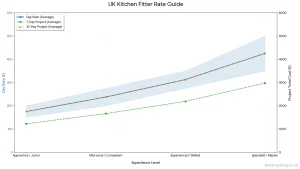
Notes:
- These figures reflect labour only, assuming no electrical, plumbing, or decorating tasks are included.
- A longer duration is typically associated with larger kitchens, complex layouts, or premium fitting work.
- Final project costs can rise with additional services, material handling, or subcontracted trades.
These rates are general UK averages and may vary based on location, workload, and whether additional skills (like plumbing or electrical) are included in the fitter’s service offering.
What Does a Day Rate Actually Include in a Kitchen Fitting Job?
Understanding what a day rate covers is key to comparing quotes accurately. The daily charge usually includes the fitter’s labour for tasks like:
- Removing the old kitchen units,
- Installing new cabinets and worktops,
- Fitting sinks and appliances (where agreed in advance),
- Aligning doors and drawers,
- Making sure units are level and stable.
However, some aspects of a kitchen project are often quoted separately. These might include plumbing, electrical work, gas work, tiling, flooring, or plastering. Each of these usually requires a specialist and is billed either by hour, day, or per job.
Ian, a self‑employed kitchen fitter in East Anglia, summarises it well:
“When you quote someone a day rate, you’re really quoting for what you as a fitter will do. If the job involves electrics or gas, I always make that clear at the start so the homeowner isn’t surprised.”
Dry Fit vs. Wet Fit: What’s the Difference in Cost?
When comparing quotes, you will likely encounter these two terms. Understanding them is vital for budgeting:
- Dry Fit (£2,500 – £4,000 for an average kitchen): This is purely the “joinery” part of the job. The fitter installs the carcasses, doors, handles, and worktops. It does not include connecting the sink to the water or wiring the oven.
- Wet Fit / Full Service (£5,000 – £8,000+): This is a “turnkey” solution. It covers the dry fit plus plumbing, gas connections, electrical wiring, and often plastering. While more expensive, it saves you the hassle of project-managing multiple tradespeople.
Pro Tip: If you are on a budget, a “Dry Fit” is cheaper, but you must ensure your own plumber and electrician are scheduled to arrive at the exact moment the fitter needs them, or the project will stall.
What Other Pricing Options Are There Besides a Day Rate?
While day rates are common, some projects benefit from alternative pricing:
- Hourly Rate: Some tradespeople quote by the hour, often useful for smaller or uncertain scopes. Around £18 to £46 per hour is typical for kitchen fitters, depending on location and experience.
- Per Job/Fixed Quote: A fixed total price is often the best route for full kitchen installs because it provides budget certainty for the homeowner.
- Per Unit or Per Task: In some cases, fitters or joint tradespeople might provide estimates per cabinet, per worktop, or per specific task.
James, a fitter in Leeds, says:
“I always try to give a fixed price for the whole job if I can. It gives the customer peace of mind, and we both know what to expect.”
Kitchen Fitting Cost Per Unit
If your kitchen is small or you are only adding a few extra cabinets, many fitters prefer to quote “per unit” rather than a daily rate. In 2026, the average cost is:
- Standard Base/Wall Unit: £120 – £150 per cabinet.
- Integrated Appliance Unit: £160 – £200 (includes the extra labor of mounting the furniture door to the appliance).
- Tall Larder/Pantry Units: £180 – £250 due to the complexity of leveling larger frames.
This pricing usually includes assembly (if flat-pack) and mounting. Expect to pay at the higher end for high-gloss or handleless units, as these require more precision to align perfectly.
How Much Could a Full Kitchen Fitting Cost?

A complete kitchen fitting project, which includes labour, cabinetry, worktops and associated trades, can vary widely depending on size and specification. Basic installations may start around a few thousand pounds in labour alone, while larger or more complex setups often cost significantly more.
For labour only, ranges from about £2,200 to £4,600 is common for typical installations. When materials and appliances are included, the total budget for a new kitchen is much higher.
The “Rip Out”: Cost to Remove and Dispose of Your Old Kitchen
Before the new kitchen goes in, the old one must go. This is a labour-intensive job that many homeowners overlook in their initial budget.
- The “Rip Out” Labour: Expect to pay £300 – £500 for a professional to carefully dismantle your old units. If you have wall tiles that need hacking off, add another £150 – £200.
- Waste Disposal (Skip Hire): You will likely need a 6-yard or 8-yard skip. In 2026, average skip hire prices are:
- 6-Yard Skip: £230 – £330
- 8-Yard Skip: £270 – £390
- Professional Clearance Services: Some companies offer a “wait and load” service for £200 – £400, which is often cheaper than a skip if you don’t have a driveway for skip placement.
How Should Homeowners Evaluate and Compare Quotes?
Getting multiple quotes is vital. Ask each fitter to specify clearly what their day rate covers and what it doesn’t. It’s also worth asking whether they provide written pricing for additional trades or if these services will need separate contractors.
Homeowners should focus on the scope of work and value, not just the headline rate. Fitters with solid experience, insurance, and clear communication often deliver better outcomes even if their day rate is somewhat higher.
What Should You Ask a Kitchen Fitter Before Hiring Them?
Practical questions to ask include:
- What exactly does your day rate include?
- How many days do you estimate for my project?
- Will you handle fitting sinks, appliances, or is that subcontracted?
- Do you organise or price plumbing and electrics?
- What payment schedule do you use?
Fitters appreciate clear communication. As one contractor put it:
“I always tell clients, when we’re clear from the start, the job runs smoother and everyone feels confident about the cost.”
The 2026 “Hidden Cost” Factors: What Most Homeowners Forget?

Even with a clear day rate, certain “invisible” factors can derail a kitchen budget. In 2026, professional fitters highlight these three areas as the most common causes of price increases:
1. Sub-Floor Preparation: The “Invisible” Time-Sinker
A kitchen is only as good as the floor it sits on. If your floor isn’t perfectly level, your fitter cannot align the cabinets correctly.
- The Risk: If your fitter arrives and finds an uneven sub-floor, they may need to apply a self-levelling compound or install new plywood.
- The Cost: This can add 1 to 2 days of additional labor to the project. At 2026 rates, this “hidden” fix could cost you an extra £500 – £700 before the first cabinet is even installed.
2. Professional Waste Removal (Skip Hire & Permits)
Removing an old kitchen creates a surprising amount of bulk. While a “rip-out” fee covers the labor of dismantling, the physical disposal is almost always extra.
- Skip Hire (2026 Prices): For a standard kitchen renovation, you will likely need a 6-yard or 8-yard “Builders Skip.”
- 6-Yard Skip: £230 – £330
- 8-Yard Skip: £270 – £390
- Council Permits: If the skip has to sit on a public road, you’ll need a council permit, which now averages £30 – £80 depending on your borough.
3. The “London Premium”: Parking, ULEZ, and Congestion Charges
If your project is in Central London, your fitter’s day rate is just the starting point. Most tradespeople will pass these mandatory daily costs directly to the homeowner:
- Congestion Charge: In 2026, the standard daily rate has risen to £18 per day.
- ULEZ Charges: If your fitter uses a non-compliant van, there is a £12.50 daily charge.
- Parking Fees: In high-demand areas, parking a van for 8 hours can easily cost £30 – £50 per day.
- Total Impact: These “logistics fees” can add nearly £100 per day to the cost of a London-based fit. Always ask if these are included in the quote or billed as extras.
Conclusion: Planning Your Kitchen Fit with Confidence
Understanding kitchen fitter day rates and how they fit into the broader cost of a kitchen project is critical in 2026. The typical UK day rate remains around £250 – £350 per day, with variation by region and experience. Alternatives like hourly rates and fixed quotes give homeowners flexibility when budgeting.
By asking clear questions, comparing like‑for‑like quotes, and confirming what work is included, homeowners can manage expectations on cost and quality, leading to smoother kitchen installations with fewer surprises.
FAQs – Kitchen Fitter Costs in the UK
What is the average kitchen fitter day rate in the UK in 2026?
Between £250 and £350 per day, depending on location and experience.
Do day rates include materials and appliances?
Usually not. Most day rates cover labour only.
How long does a typical kitchen fitting take?
Between 7 and 10 working days for a standard kitchen.
Is it cheaper to pay by day rate or fixed quote?
Fixed quotes offer more cost certainty; day rates allow more flexibility.
Are electrical and plumbing works included?
Often not. These are usually priced and handled separately.
Can I negotiate a kitchen fitter’s day rate?
Yes, especially for larger jobs. Get multiple quotes for comparison.
What affects the fitter’s rate the most?
Experience, project complexity, and regional demand.