
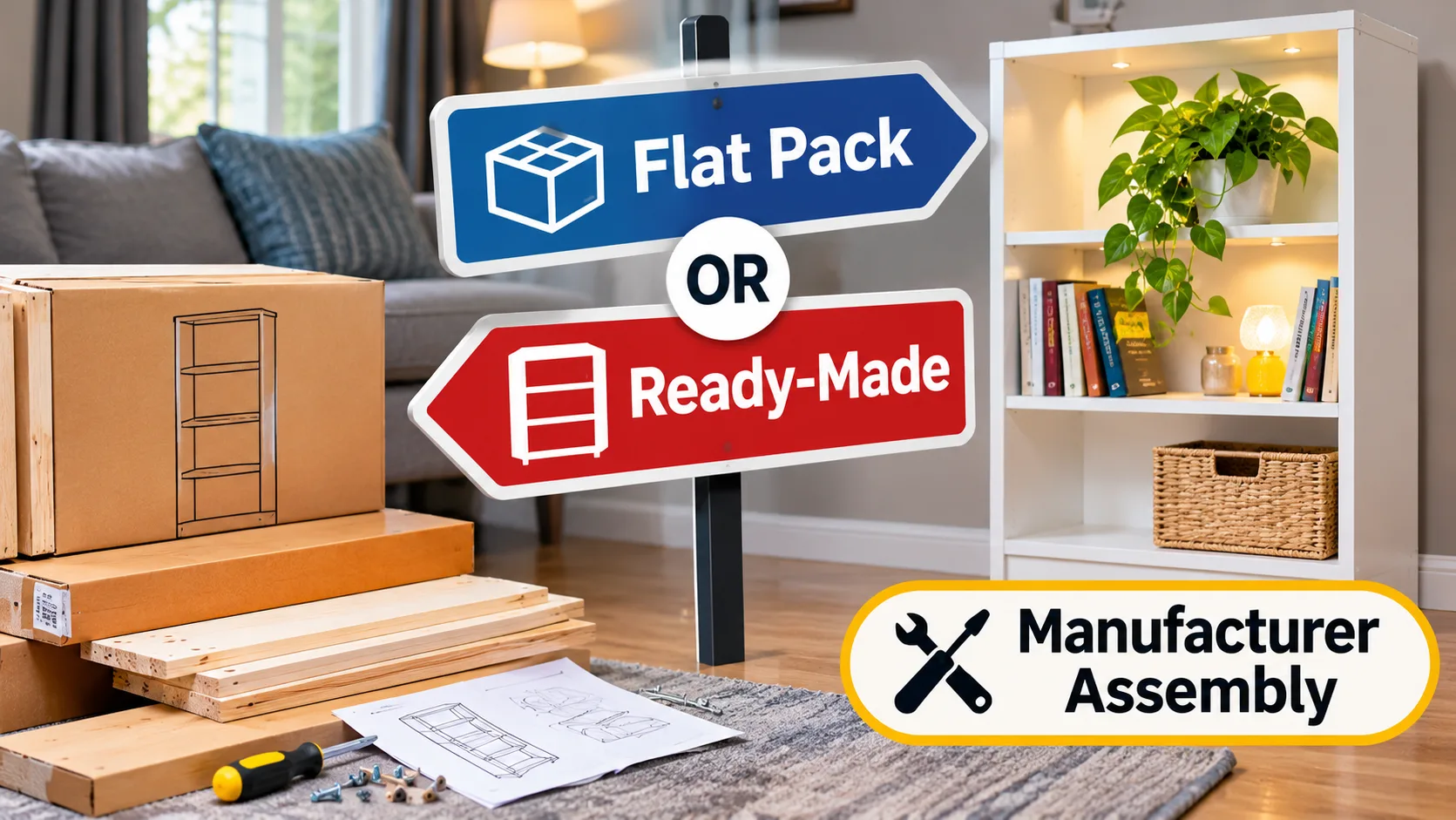
Flat Pack or a Ready-Made Display? When Is It Worth Paying Extra for Manufacturer Assembly?

UK Startup Blog Archive
Table of Contents
Paying extra for assembly performed by a manufacturer of cardboard packaging and POS displays is worthwhile when the cost of an error or delay in-store is higher than the savings on transport.
Flat pack is usually more advantageous in terms of freight and storage, but it loses out when a complex display ends up in the back room and never makes it onto the sales floor on launch day.
From the perspective of a logistics director and a trade marketing specialist, what matters is not the unit price, but the total implementation cost.
The question of whether to choose cardboard displays in flat pack or assembled form is decided by TCO, the total cost of ownership, meaning the sum of transport costs, pallet space in the warehouse, assembly time, complaints, corrections, and lost sales.
Flat pack means a cardboard pos display delivered flat, after die-cutting and creasing, that is, creating controlled fold lines.
An assembled display is a model put together by the manufacturer.
Ready to use most often means a display opened into its working form, secured for transport, and in the shelf-ready version also prepared for immediate placement or stocking.
In production practice, we consider three risks: whether the display will arrive without deformation, whether store staff will assemble it on time, and whether it will retain its geometry throughout the campaign once stocked.
These three points are what most often determine whether paying extra for assembly is an unnecessary expense or a sensible operational safeguard.
Flat Pack or Assembled Cardboard Displays – What Should You Choose for a Promotional Campaign?
For a short promotional campaign, an assembled display is more often the better choice.
Flat pack is worth choosing when the product is lightweight, the campaign runs for a long time, and the brand has its own merchandising team or service provider overseeing assembly.
An assembled display and a ready-to-use display do not always mean the same thing. An assembled one may arrive empty.
A ready-to-use one may already be shrink-wrapped, labeled for a specific store, and prepared for immediate placement, and in the case of shelf-ready displays, also ready for sale as soon as the protective materials are removed.
The decision should be linked to the number of SKUs on the display.
The more flavor variants, colors, or capacities there are, the greater the risk that store staff will make a stocking error.
In a ready-made model, the manufacturer can set dividers, loading order, and markings before shipment. Flat pack works well for a single simple SKU and a repeatable layout.
- An in-out campaign with a fixed launch date usually favors an assembled stand, because it reduces the risk of the display getting stuck in the back room.
- A lightweight product and a long display period more often justify flat pack, because freight and storage costs are lower.
- Heavy shelf loads more often point the choice toward factory assembly, because glued joints handle shear forces better.
- Long-distance transport, export, and a high cost per cubic meter favor flat transport.
- Your own merchandising agency with auditing reduces the risk associated with flat pack and improves implementation compliance.
The dividing line usually comes down to operational risk.
If the display has a plinth, several shelves, a topper, meaning the top advertising panel, a sample pocket, and assembly instructions covering more than six steps, flat pack becomes prone to errors.
If it is a simple structure with an automatic bottom and lightweight products, flat transport is usually more cost-effective.
For permanent displays in retail chains regularly visited by a merchandising team, flat pack very often wins.
For seasonal campaigns with a short sales window, an assembled solution works better because it shortens the path from the loading dock to the promotional aisle.
How Do the Logistics Costs of Cardboard Displays Depend on Transport Volume?
Transport volume is the main cost factor.
One pallet often holds 15 to 20 flat pack displays, while only 2 to 4 assembled ones fit, so on a long route the difference can determine the profitability of the campaign.
This is not just a matter of freight. A higher number of pallets means more storage locations, more delivery slot bookings, more transshipment operations, and more points at which the topper or shelf edges can be damaged.
The costs of stretch film, interlayers, and protective corners also increase.
A simple simulation gives a practical picture of the difference. For 216 stands, at 18 flat pack units per pallet, 12 pallets are needed.
At an average of 3.5 assembled displays per pallet, around 62 pallets are needed. That is a significant difference. It means a different loading plan, a different warehouse buffer, and a different risk of picking errors.
An assembled stand also requires different packaging.
Shelves must be stabilized, fronts protected, advertising elements kept within the pallet footprint, and pressure distributed so the structure does not deform during stacking, often using corrugated cardboard packaging tailored to the dimensions, weight, and distribution channel.
An error at this stage means the stand arrives at the store with the correct print, but with compromised geometry.
For multi-address shipping, the delivery format must also be calculated.
If each store receives one unit, an assembled display transports a lot of air and can be troublesome for a courier or a retail chain loading dock.
However, when the launch date is fixed and the store has no time to assemble promotional stands, that same assembled model can save the outlet one or two days.
In a warehouse with a WMS, meaning a warehouse management system for locations and shipping, it is then easier to assign a given variant to a given store, but the system will not eliminate the cost of empty volume.
That is why logistics costs must be calculated as a whole.
The transport price alone is not enough. What matters is the number of pallets, resistance in mixed transport, warehouse occupancy, and whether the stand is shipped empty or as a ready-made sales module.
Assembling Promotional Stands at the Point of Sale and the Hidden Labor-Hour Cost of Store Staff
Paying extra for manufacturer assembly pays off when putting the stand together in-store takes more than a few minutes, or when incorrect assembly threatens lost sales.
A simple flat pack is usually assembled within 1 to 3 minutes without tools, but a more elaborate cardboard POS retail display with a plinth, shelves, and topper can take from 7 to 15 minutes.
Labor-hour cost must be calculated across the entire chain.
If assembling one stand takes 10 minutes and the campaign covers 600 stores, that amounts to 100 hours of operational work.
On top of that come phone calls, shipments of missing parts, merchandiser corrections, and photos confirming implementation.
The hidden cost lies not only in staff wages. In a store, assembly takes place between deliveries, shelf replenishment, customer service, and tidying the sales floor.
In chain-wide rollouts, the same pattern repeats: tabs are not fully pressed in, a shelf goes into the wrong slot, and the display loses its geometry after the first stocking.
This is how the display ends up inconsistent with the campaign plan.
The costly mistake is not the complaint, but the lost sales. In short campaigns, one day of delay can cut off part of turnover, especially before holidays, during Black Friday, or at the launch of a new product variant.
For this reason, large brands are more likely to pay extra for assembly when they do not control the work of staff at the point of sale.
If the choice falls on flat pack, the assembly instructions must be clear.
What works well is 5 to 7 illustrations, part numbering consistent with the die line, arrows showing fold direction, and photos of the actual components rather than just a drawing.
If tape, a knife, or additional accessories are needed for assembly, the risk of error increases. Many mistakes occur where a part has to be turned over and the crease folded in the opposite direction.
Then the outer paper layer cracks and the lock holds more weakly. When the brand has its own merchandising agency with regular auditing, this problem can be reduced and flat pack regains its cost advantage.
Structural Stability and Load-Bearing Capacity Under Load: Factory Gluing Versus Cardboard Locks
With the same geometry, an assembled display is usually more stable than a manually assembled model.
Factory hot-melt gluing creates a rigid whole resistant to shear forces, while cardboard locks require precise pressing and do not tolerate repeated bending well.
This is especially important for heavy products. A shelf rarely collapses suddenly from weight alone.
First it sags across the span, then the sides begin to work, and finally the lock gives way or the flute is crushed locally.
If a store employee repeatedly adjusts a wrongly positioned element, the cellulose fibers in the creased area weaken.
In an assembled model, this stage takes place in the factory and follows a repeatable process.
Manually assembled locks work well when the design uses self-tensioning walls and a short shelf span.
They are less favorable when the product weight acts close to the front edge of the shelf. Then the bending moment increases, and an incompletely closed tab works like a hinge rather than a support.
Not every corrugated board behaves the same way. E flute provides a smooth surface for graphics and works well for lightweight products.
B flute carries medium-class shelf loads better. EB flute combines better print quality with greater structural rigidity.
BC flute works well for heavier stands and pallet displays, where load-bearing capacity and crush resistance are the priority. Thickness alone is not enough.
The board grammage, the quality of the outer paper layers, the flute direction, and the shelf length also matter.
Before making a choice, we usually compare several parameters:
- Flute type: E, B, EB, or BC, and the board grammage
- ECT, meaning edge crush resistance, and BCT, meaning box compression strength in a stack
- Actual shelf load capacity in kilograms under full stocking maintained for 24 to 72 hours
- Stability of the entire structure after transport and after placement at the point of sale
- Print resistance to abrasion and damage during packing
- Humidity at the point of sale, especially near the entrance, refrigerated areas, and machine-washed zones
Quality control should not end with the prototype.
Load tests with the actual product, a palletization trial, an assessment of batch repeatability, and verification that the stand can withstand mixed transport alongside other POS materials are all needed.
Only then can you see whether the design is resistant to real store conditions, and not just to a photo shoot.
Humidity at the point of sale can change the result more than buyers assume.
A display placed near the entrance, by a refrigerated unit, or along the route of a floor-cleaning machine softens faster than the same model tested in a dry office.
That is why strength must be assessed under conditions close to real ones.
Optimizing the Pos Materials Supply Chain: Shelf-Ready Displays With Stocking and Co-Packing Services
Paying extra for assembly is justified when it becomes part of a single process covering assembly, POS packing, stocking, and shipping to stores.
In that case, a shelf-ready display with a stocking service can go straight from the loading dock to the promotional aisle and be used for sales within minutes of unloading.
Co-packing services are not limited to adding product to a stand. A planned process combines structural design, print matched to the run length, production, assembly, transport protection, labeling for a specific address, and storage in a WMS.
Losses are lower when these operations are planned as one continuous process rather than as several separate jobs passed between subcontractors.
This is exactly what POS packing is for: assembling materials and products for a specific rollout.
This solution works well for in-out campaigns, meaning short campaigns with a defined start and end on display.
If the retail chain gives the brand one delivery window and then expects the goods to be immediately present on the sales floor, an assembled and stocked stand reduces the bottleneck on the store side.
There is no need to unpack several boxes, look for instructions, glue toppers, and arrange the product by hand. The risk that POS materials will get stuck in the back room is lower.
However, you need to be careful about stocking too early.
If the product has a short shelf life, is temperature-sensitive, or waits a long time for shipment, it is better to assemble the stand earlier but load it closer to the distribution date.
A ready-made display should speed up the start of sales, not extend the time the goods spend off the shelf.
It is not always worth paying extra. With a long logistics distance, lightweight products, a long-term permanent display, and your own merchandising agency, flat pack remains the economical solution.
The cost decision usually comes down to four questions:
- How many units fit on a pallet, and what will the cost of empty volume be in transport and storage?
- How many minutes will actual assembly in-store take, not a demonstration assembly in a conference room?
- What shelf load, what point-of-sale humidity, and what level of damage risk need to be assumed?
- Will the campaign lose sales if the display goes up a day later or is assembled inconsistently with the plan?
If the last two points matter more than the first two, paying extra for manufacturer assembly may be financially justified.
If freight, storage, and easy field assembly costs dominate, flat pack cardboard displays offer lower supply chain costs.
It is worth confirming this with a trial palletization and a load test using the actual product.
When Is It Worth Paying Extra for Display Assembly?
- Calculate the display TCO, taking into account freight, storage, assembly, complaints, and lost sales.
- Choose flat pack for a lightweight product, a long campaign, and your own merchandising, because it reduces transport volume.
- Opt for an assembled display for short campaigns with a fixed launch date, because it shortens implementation time and reduces the risk of getting stuck in the back room.
- Pay extra for manufacturer assembly when the structure is complex, has many SKUs, or requires more than a few minutes of work in-store.
- Check the display’s load-bearing capacity and stability with tests using real loads, humidity, and transport conditions.
- Combine assembly, co-packing, and stocking in a shelf-ready model when quick stand placement and compliance with the campaign plan are critical.

Blogger | Business Writer | Sharing startup advice on UK business blogs
Related Articles in Business
View All →
Starting a Business in London: How to Identify Market Trends and Emerging Opportunities
London remains one of the UK’s most attractive destinations for entrepreneurs, offering access to international markets, skilled professionals, diverse communities and a thriving business ecosystem. However, starting a…
Is Wetherspoons a Franchise? Costs, Ownership, Requirements and How to Apply in 2026
Yes, Wetherspoons is a franchise. J D Wetherspoon, one of Britain’s largest pub operators, now offers franchise opportunities to eligible hospitality businesses, experienced operators, investors and organisations. However,…

Amazon Delivery Franchise Cost UK: Investment, Profit, Fees and Requirements
The Amazon delivery franchise cost in the UK starts from approximately £10,000, while prospective business owners are generally expected to demonstrate at least £25,000 in liquid assets. This…