
Amazon Delivery Franchise Cost UK: Investment, Profit, Fees and Requirements


UK Startup Blog Archive
Table of Contents
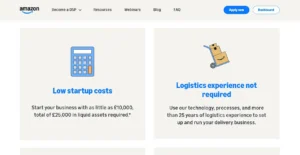
The Amazon delivery franchise cost in the UK starts from approximately £10,000, while prospective business owners are generally expected to demonstrate at least £25,000 in liquid assets. This makes Amazon’s Delivery Service Partner (DSP) programme an accessible entry point into commercial logistics compared with purchasing an established delivery company.
However, the initial investment is only one part of the financial commitment. Operating a delivery fleet involves substantial expenditure on employees, vehicles, insurance, maintenance and business administration.
Amazon’s historically published UK projections suggest annual revenue potential of £900,000 to £1.8 million, with annual profit potential of £50,000 to £150,000 for established operators. These are illustrative programme projections rather than guaranteed returns.
Understanding the relationship between investment, running costs and profit is essential before committing to the business.
How Much Does an Amazon Delivery Franchise Cost in the UK?
Amazon’s Delivery Service Partner programme allows entrepreneurs to establish independent parcel delivery businesses using Amazon’s logistics infrastructure.
The advertised starting investment is relatively modest because Amazon provides access to negotiated supplier arrangements, training and delivery technology.
The principal financial figures are:
| Investment requirement | Amount |
| Advertised minimum start-up cost | From £10,000 |
| Required liquid assets | Approximately £25,000 |
| Historical annual revenue potential | £900,000–£1.8 million |
| Historical annual profit potential | £50,000–£150,000 |
| Established fleet size in programme examples | 20–40 vans |
| Business commitment | Full-time management |
The £10,000 starting cost and £25,000 liquidity requirement should not be added together automatically. They represent different financial concepts.
The initial cost refers to the amount potentially required to establish a business using available programme arrangements. Liquid assets refer to accessible financial resources demonstrating that the applicant can support the operation.
The precise investment will depend on the business’s circumstances and the current commercial arrangements.
Is Amazon DSP a Traditional Franchise?
Although frequently described as an Amazon delivery franchise, the DSP programme differs from a conventional franchise arrangement.
Traditional franchisees typically pay for the right to operate under an established business format, often with franchise fees and royalties.
An Amazon DSP owner instead establishes an independent delivery company that provides contracted logistics services to Amazon.
The company manages its own workforce, payroll, vehicles and operating expenses.
This distinction matters because entrepreneurs are not purchasing ownership of an Amazon delivery territory in the same way they might purchase a retail franchise.
Pip Wilkins, CEO of the British Franchise Association, explained in June 2026 that the cost of entering franchising varies considerably depending on the scale and nature of the business.
That observation is particularly relevant to delivery operations: relatively low initial capital requirements do not necessarily mean low ongoing financial commitments.
Entrepreneurs comparing opportunities can also examine the DPD franchise cost to understand how investment structures differ across delivery businesses.
What Does the Initial Amazon DSP Investment Cover?

An Amazon delivery business has both establishment expenses and recurring operational costs.
The programme offers negotiated arrangements with certain third-party suppliers, potentially reducing the upfront cost of obtaining vehicles and essential services.
Initial Business Setup Expenses
| Expense | What it involves |
| Company formation | Establishing a registered business |
| Professional fees | Legal and accounting advice |
| Vehicle arrangements | Initial leasing requirements and deposits |
| Insurance | Appropriate business and vehicle protection |
| Driver recruitment | Advertising, screening and onboarding |
| Equipment | Operational supplies and devices |
| Working capital | Cash available for early expenses |
These are potential cost categories rather than an official itemised £10,000 package.
Importantly, the business may also need additional reserves to meet wage payments and vehicle expenses before incoming payments are received.
Anyone evaluating the investment should prepare a business plan with separate forecasts for establishment costs, operating expenses and cash flow.
What Are the Monthly Running Costs of an Amazon Delivery Franchise?
The biggest financial commitment usually arises after the business starts operating.
Unlike a small owner-driver operation, an established DSP may employ dozens of drivers and operate multiple vehicles simultaneously.
The main operating costs include:
| Running cost | Main financial consideration |
| Driver wages | Salaries, overtime and holiday pay |
| Employer National Insurance | Statutory employer contributions |
| Workplace pensions | Employer pension contributions |
| Vehicle leasing | Regular fleet payments |
| Fuel or charging | Delivery mileage and energy consumption |
| Insurance | Commercial vehicle and employer-related cover |
| Maintenance | Repairs, tyres and servicing |
| Recruitment | Replacing drivers and expanding staffing |
| Administration | Payroll, bookkeeping and compliance |
Fuel efficiency, vehicle downtime and driver turnover can materially affect operating margins.
How Much Does Driver Employment Actually Cost?
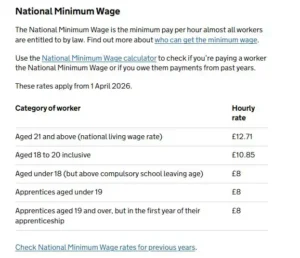
From April 2026, the National Living Wage for workers aged 21 and over is £12.71 per hour.
For the 2026/27 tax year, the standard employer National Insurance rate is 15% above the annual secondary threshold of £5,000.
Consider an illustrative delivery business employing 30 drivers at an average gross annual salary of £29,000.
| Annual payroll component | Illustrative cost |
| Gross salaries for 30 drivers | £870,000 |
| Employer National Insurance before reliefs | £108,000 |
| Minimum employer pension contributions, assuming qualifying earnings | £20,484 |
| Total estimated annual employment cost | £998,484 |
| Estimated monthly employment cost | £83,207 |
These calculations assume employees fall under the standard National Insurance category and qualify for the illustrated pension contributions. They exclude potential Employment Allowance relief, recruitment costs, overtime and additional benefits.
Actual staffing models and employment arrangements can differ substantially.
Current employer obligations can be checked through HMRC’s official 2026/27 payroll guidance.
How Much Profit Can an Amazon Delivery Franchise Make?
Amazon’s previously published UK financial projections indicate annual revenue potential between £900,000 and £1.8 million, with annual profit potential between £50,000 and £150,000.
These figures relate to businesses operating at the relevant established scale and should not be interpreted as expected earnings for every new applicant.
A business generating £1 million in revenue does not provide its owner with £1 million in personal income.
Profit is the amount remaining after business expenses.
To illustrate the importance of margins, consider a hypothetical DSP generating £1.2 million annually.
| Financial scenario | Operating costs | Operating profit | Profit margin |
| Stronger performance | £1,104,000 | £96,000 | 8% |
| Moderate performance | £1,140,000 | £60,000 | 5% |
| Weaker performance | £1,176,000 | £24,000 | 2% |
These scenarios are independent calculations, not Amazon forecasts or actual DSP financial results. They exclude corporation tax and assume expenses have been consistently classified, including any applicable owner remuneration.
A relatively small increase in expenditure can have a substantial effect on earnings.
For example, increasing operating costs by just 3% of revenue reduces annual profit by £36,000 in this example.
That makes financial discipline particularly important in large delivery businesses.
How Does Amazon Pay Delivery Service Partners?
DSP revenue comes from providing contracted delivery services within Amazon’s logistics network.
Amazon’s programme materials describe a structured commercial relationship, but prospective UK operators should obtain the current payment terms directly rather than assume a universal fee per parcel.
The relevant agreement may contain payment components linked to operating capacity, delivery activity and other contractual conditions.
Applicants should establish the payment frequency, route allocation arrangements, service-performance requirements and the treatment of unexpected delivery disruptions.
The distinction between revenue earned and cash received is especially important when calculating payroll affordability.
A business can appear profitable on paper while experiencing cash-flow difficulties if its payments and expenses fall on different dates.
How Many Vans and Drivers Does an Amazon DSP Need?

Historically, Amazon has associated its mature DSP financial projections with fleets of approximately 20–40 delivery vehicles.
However, a new business may grow through different operational stages, depending on delivery-station requirements and its individual arrangements.
Fleet size affects how many routes the business can service, while staffing determines whether it can operate those routes reliably.
A company may need more drivers than active vans because employees require holidays, weekly rest periods and sickness cover.
Ed Hattersley, founder of Warrior Logistics and a former Amazon operations employee, established his delivery business in Sheffield in 2019.
Discussing the demands of logistics ownership, he explained:
“It’s demanding and fast-paced, you can’t do it half-heartedly.”
Hattersley also emphasised the central importance of drivers to the business.
His experience highlights why recruitment, employee retention and operational leadership are just as important as securing initial funding.
What Support Does Amazon Provide to DSP Owners?
One of the principal advantages of DSP is access to established logistics infrastructure.
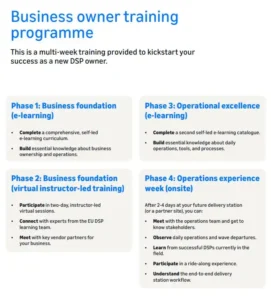
Amazon has historically provided structured training, delivery technology, operational guidance and access to supplier arrangements.
Support may include operational planning tools, driver assistance, business-management resources and fleet-related services.
Amazon’s logistics experience can help independent operators establish delivery processes without building their own parcel distribution network.
Nevertheless, the DSP owner remains responsible for managing employees, maintaining vehicles and controlling expenditure.
When Amazon expanded the programme in the UK, then-country manager Doug Gurr emphasised the importance of experienced individuals building effective delivery teams to support growing customer demand.
The underlying operational requirement remains significant: entrepreneurs must be capable of leading a substantial workforce.
What Are the Main Financial Risks of an Amazon DSP?
Although Amazon provides an established source of delivery demand, running a DSP still carries commercial risks.
The most important concern is customer concentration. A DSP business may depend heavily on its contractual relationship with Amazon.
Changes to commercial terms, route allocation or operating requirements could affect income.
Other risks include rising wages, employee turnover, vehicle breakdowns and insufficient cash reserves.
Seasonal variations also require careful management. Higher parcel volumes can increase staffing needs, while lower volumes may leave businesses carrying relatively fixed expenses.
A practical financial forecast should test whether the company remains viable when revenue falls by 10% or payroll and vehicle costs increase unexpectedly.
The funding options available to UK startups can help entrepreneurs assess their wider financing choices, although applicants should confirm what borrowing arrangements Amazon accepts.
How Can You Apply for an Amazon Delivery Franchise in the UK?
Applications are made through Amazon’s Delivery Service Partner programme.
Opportunities depend on current recruitment and the delivery stations where Amazon requires additional operators.
The application process generally involves:
- Reviewing eligibility: Understand the financial requirements, business responsibilities and available locations.
- Preparing financial evidence: Demonstrate access to the required liquid assets and disclose relevant financial circumstances.
- Submitting an application: Provide information about professional experience, leadership and business suitability.
- Completing assessments: Participate in the selection activities required by Amazon.
- Undertaking training: Learn the operational systems and responsibilities involved in managing deliveries.
- Establishing operations: Arrange the company structure, recruitment, vehicles and operating processes before launch.
Previous logistics experience is not always essential, but strong leadership, financial management and organisational capabilities are valuable.
Applicants should not assume that meeting the minimum financial requirement guarantees acceptance.
Is the Amazon Delivery Franchise Worth the Investment in 2026?
The Amazon DSP model can appeal to entrepreneurs who want to establish a substantial logistics business without independently sourcing delivery customers.
Its advantages include access to an established delivery network, operational technology and established supplier relationships.
However, the economics require careful consideration.
The historical profit projection of £50,000–£150,000 represents business earnings at scale rather than a guaranteed return on the initial £10,000 outlay.
Entrepreneurs should calculate their effective return using all capital committed, outstanding liabilities, working capital and the value of their own management time.
Anyone considering other franchise models can compare investment structures with opportunities such as the Snap-on franchise, where vehicle, financing and commercial arrangements operate differently.
Ultimately, the opportunity is best suited to hands-on entrepreneurs who are comfortable employing staff, managing logistics and accepting commercial responsibility.
Frequently Asked Questions
Can I Start an Amazon Delivery Franchise With £10,000?
Amazon advertises start-up costs from approximately £10,000, but applicants generally need around £25,000 in liquid assets. Additional working capital may also be necessary.
How Much Can an Amazon DSP Owner Earn Monthly?
Historical annual profit projections of £50,000–£150,000 are equivalent to approximately £4,167–£12,500 monthly. These are not guaranteed personal earnings.
Does Amazon Provide Delivery Vans?
Amazon offers access to negotiated fleet arrangements and relevant supplier services. The precise vehicle terms depend on current programme arrangements.
Can I Run an Amazon DSP Part-Time?
The programme is designed around full-time business ownership and active operational management, making it unsuitable for most passive investors.
Does Amazon Guarantee Delivery Franchise Profits?
No. Revenue and profit projections are illustrative. Individual business results depend on operating costs, delivery requirements and commercial performance.
Is Logistics Experience Required?
Previous logistics experience is not necessarily essential. Leadership, financial management, recruitment and operational decision-making are important capabilities.
Can I Sell My Amazon DSP Business?
Any proposed sale or change in ownership would need to comply with the applicable DSP agreement and Amazon’s requirements. Contractual approval should not be assumed.

Blogger | Business Writer | Sharing startup advice on UK business blogs
Related Articles in How To Start
View All →
How to Start a Business in the UK?
Starting a business in the UK means turning an idea into a legal, financial and operational setup that can sell products or services, keep proper records, pay the…

Starting a Digital Marketing Agency? | Which Directories Should You Be Listed On?
Every guide to starting a digital marketing agency covers the same ground, pick a niche, register the company, build the site, set your prices. Almost none of them…

How to Start a Business in 2025?: A Comprehensive 11-Step Guide
Starting a business in 2025 can be both exciting and challenging. A well-structured plan is key to navigating the entrepreneurial journey effectively. Platforms like JKCP, which focus on…