

The Snap-on franchise cost in the UK is currently quoted at £166,597 to £168,487 for the franchise investment, with Snap-on stating that a new franchisee may need to provide approximately £9,473 to £15,437 of their own start-up capital when using its financing arrangements. Snap-on indicates that £153,050 can potentially be financed.
That should not automatically be treated as the entire economic cost of launching the operation. A Snap-on franchise normally operates from a specially equipped mobile store, and Snap-on currently estimates a new mobile store at approximately £150,000 plus VAT.
Vehicle finance, operating costs, insurance, fuel, stock purchases and other ongoing charges therefore need to be included in a full business plan.
Put simply, there is a major distinction between:
- The cash needed initially,
- The amount being financed
- The total financial commitments attached to operating the franchise.
Anyone comparing Snap-on with other franchise business opportunities in the UK should compare all three figures rather than focusing only on the advertised entry cost.
What Does the Snap-on Franchise Investment Include?
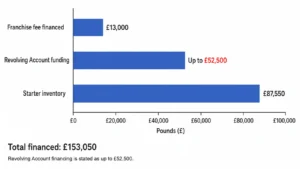
Snap-on currently breaks £153,050 of its financing package into three principal components:
| Component | Amount |
| Franchise fee financed | £13,000 |
| Revolving Account funding | Up to £52,500 |
| Starter inventory | £87,550 |
| Total financed | £153,050 |
Snap-on describes its investment package as covering elements including starter inventory, business set-up, the franchise fee, working capital, an exclusive protected territory, an IT sales and stock system, training and ongoing business support.
What Is the Snap-on Franchise Fee?
There is a small but important distinction between figures appearing in Snap-on’s current documents.
Snap-on’s main investment breakdown describes £13,000 as the franchise-fee component of its £153,050 financing. Its 2026 financed-franchisee disclosure provides additional detail, showing a £14,500 franchise fee less a £1,500 down payment, leaving £13,000 within the amount being financed.
Therefore, the clearest interpretation is:
- Total franchise fee: £14,500
- Initial down payment: £1,500
- Financed balance: £13,000
Applicants should nevertheless use the figures shown in their own disclosure documents and franchise agreement, as Snap-on says fees can change.
How Much Cash Does a New Snap-on Franchisee Need?
Snap-on’s detailed UK page currently quotes required start-up capital of approximately £9,473 to £15,437. It separately refers to costs associated with obtaining the necessary licences, a £1,500 down payment towards the franchise fee and up to £6,000 of working capital.
Another Snap-on investment page gives a more general benchmark, stating that an applicant would “usually” need a minimum of £15,000 plus working capital when using Snap-on financing.
These published figures should be treated as indicative rather than as a guaranteed minimum.
There is also an apparent arithmetic inconsistency between the detailed start-up-capital range and some of the component figures currently displayed on Snap-on’s website. Prospective franchisees should therefore ask Snap-on to provide a current personalised start-up schedule showing:
- the cash deposit required;
- licence and training-related costs;
- initial working capital;
- VAT funding;
- vehicle deposit and finance;
- insurance;
- stock requirements; and
- any other costs payable before the first trading week.
This is especially important when a large proportion of the investment is being funded through borrowing.
How Does Snap-on Franchise Finance Work?
One unusual feature of the model is Snap-on’s access to in-house finance through its affiliated financing arrangements.
For the £153,050 new-starter financing package, Snap-on states that repayments begin in the 14th week of trading. During the initial period, payments are based on 5% of Paid Sales, with the first two years described as interest-free under the new-starter programme.
The financing is applied in sequence to the franchise fee, Revolving Account funding and inventory.
After 104 weeks, the remaining eligible balance can convert into an interest-bearing loan with Snap-on Finance over an additional 10-year period, subject to approval. The final interest rate depends on the terms applicable when the finance agreement is entered into and the applicant’s creditworthiness.
This means “two years interest-free” should not be interpreted as the entire franchise being interest-free for its full repayment period.
A prospective franchisee comparing this with other ways to finance a new business should compare the total amount repayable, interest after the introductory period, security requirements, early repayment provisions and personal guarantees rather than comparing monthly repayments alone.
What Is Snap-on’s Revolving Account?
The Revolving Account, usually shortened to RA, is another significant part of the investment.
Snap-on provides financing of up to £52,500 towards this area of the business. It explains that franchisees may sell tools to customers using RA arrangements and normally collect those customer payments over approximately six to eight weeks.
Snap-on states that after around nine months the business should have developed approximately £70,000 of RA sales, representing £52,500 at cost.
This is important when assessing cash flow. Money recorded as a sale does not necessarily mean the full amount has already been collected in cash.
Franchisees therefore need to understand customer credit, payment collection, bad debts and the timing difference between buying stock and receiving payment.
How Much Does the Snap-on Mobile Store Cost?
The mobile store is central to the Snap-on business model because the franchisee travels directly to professional customers rather than operating a conventional retail unit.
Snap-on currently says new franchisees normally begin with a 7.5-tonne Iveco mobile store, unless an approved second-hand vehicle is selected. A new mobile store is estimated at approximately £150,000 plus VAT.
The 2026 fee disclosure also refers to a £496 weekly principal mobile-store payment during the first two years, subsidised by Snap-on Tools, before the vehicle’s fair market value can convert into financing after 104 weeks.
The mobile store is therefore not simply a delivery van. It functions as the franchisee’s showroom, stockholding space, office and principal sales location.
Although this structure can avoid conventional shop rent and business premises costs, it creates its own expenses, including:
- Finance payments;
- Fuel;
- servicing and repairs;
- Tyres;
- Insurance;
- Vehicle testing and compliance; and
- Depreciation or residual-value risk.
Snap-on states that the franchisee is responsible for maintaining the vehicle.
Does a Snap-on Franchisee Need an HGV Licence?
Snap-on states that its standard new mobile store is a 7.5-tonne vehicle and lists a C1 driving licence and CPC qualification among its requirements.
GOV.UK explains that professional HGV drivers may need the Driver Certificate of Professional Competence depending on how the vehicle is being used. Driver CPC rules contain exemptions, so an individual’s exact requirements should be checked rather than assumed.
Applicants who do not already hold the relevant entitlement may consequently need to budget for training and testing as part of their start-up preparations.
What Ongoing Snap-on Franchise Fees Are There?
Snap-on promotes the absence of some of the percentage-based charges commonly found in franchise agreements.
The British Franchise Association currently states that Snap-on franchisees do not pay a percentage-based royalty fee. Snap-on’s own investment information also states that there is no advertising fee and no initial training fee.
That does not mean the franchise has no continuing charges.
Snap-on’s 2026 fee schedule lists costs including:
- Management fee: £77.88 per week.
- Laptop rental, licensing and support: £205.27 per month including VAT.
- Mobile-store payments: applicable under the chosen vehicle arrangement.
- Stock and product remittances: payable according to account terms.
- Insurance and regulatory expenses: additional costs can apply.
- Finance-related charges: potentially applicable to late or dishonoured payments and certain credit programmes.
At £77.88 per week, the management fee alone equates to approximately £4,050 per year, before considering other running costs.
How Much Can a Snap-on Franchise Earn in the UK?
This is where turnover, gross profit and owner earnings need to be separated carefully.
Snap-on’s official UK investment page does not promise a particular income. Instead, it says individual results depend on factors including customer relationships, business expenses and how effectively the franchisee operates the Snap-on programme.
The British Franchise Association currently reports that Snap-on franchisees had average turnover of approximately £400,000 in 2024. It also states that average sales were more than £8,000 per week.
That is turnover, not earnings.
A business generating £400,000 in sales does not provide its owner with £400,000 of income.
From sales revenue, a franchisee may need to cover the cost of stock, finance repayments, vehicle expenditure, insurance, fuel, management charges, customer credit losses, professional fees, tax and potentially employee costs.
There is therefore no reliable public figure that can be presented as the typical Snap-on franchisee’s personal annual salary or net profit.
Why £400,000 Turnover Does Not Mean £400,000 Earnings?
Consider the distinction:
- Turnover is the value of sales made by the business.
- Gross profit is normally sales minus the direct cost of the products sold.
- Operating profit takes account of additional business expenses.
- Owner income depends on the business structure, tax position, drawings, salary, dividends, debt repayments and money retained within the business.
A prospective franchisee should therefore build a full profit-and-loss forecast rather than choosing the franchise based on headline sales.
A proper business start-up plan should test several scenarios, including weaker-than-expected sales and higher-than-expected vehicle, fuel or finance costs.
Is £400,000 a Guaranteed Level of Sales?
No.
The £400,000 figure reported by the British Franchise Association relates to average franchisee turnover in 2024. It should not be interpreted as a forecast or guarantee for a new franchisee starting in 2026.
Actual sales can be affected by territory quality, number and type of customers, competition, customer retention, working hours, sales capability and local economic conditions.
Snap-on itself states that prospective franchisees are given an opportunity to participate in a franchisee “Ride Along” during the discovery process so that they can see an operating franchise in practice.
That can be useful, but prospective owners should ideally speak independently with several existing and former franchisees rather than relying on one example.
Does Snap-on Charge a Royalty Fee?
The BFA’s current Snap-on profile says there are no percentage-based royalty fees.
This differentiates the model from franchises that take a fixed percentage of gross sales.
However, Snap-on still has continuing management, technology, vehicle, inventory, financing and other operating costs. Looking only at the absence of a royalty could therefore give an incomplete picture of the financial commitment.
Does a Snap-on Franchise Have Shop Rent?
Normally, the franchise operates from a mobile store rather than a traditional retail premises.
Snap-on highlights this as an advantage because an owner-operator does not normally carry the rent and business-rates costs associated with a fixed retail location.
The trade-off is that the mobile store itself is an expensive commercial asset with finance and operating costs.
For a financial comparison, the appropriate question is therefore not simply “Does it have rent?” but what are total annual fixed and variable operating costs?
What About VAT?
Snap-on states that parts of its published investment figures exclude VAT, while its new mobile-store estimate is explicitly quoted at approximately £150,000 plus VAT.
The UK compulsory VAT registration threshold is currently £90,000 of taxable turnover, subject to the detailed HMRC rules. A business must normally register if taxable turnover for the previous 12 months exceeds that level or if it expects to exceed the threshold within the relevant 30-day test.
VAT treatment can materially alter start-up cash-flow requirements even where input VAT may later be recoverable.
Professional tax advice is therefore sensible when preparing the start-up budget.
What Business Structure Does a Snap-on Franchise Use?
The current fee schedule reviewed for the figures above is specifically titled “Snap-on Financed Franchisee – Other Fees & Costs” and is a 2026 document relating to financed limited-company franchisees.
Applicants should confirm the required legal structure with Snap-on during the application process.
Where a limited company is required or selected, the company will have its own statutory and tax obligations. Anyone unfamiliar with incorporation can review the practical steps involved in registering a company with Companies House before committing to the franchise.
What Support Does Snap-on Provide?

The franchise is more than a licence to sell tools. Snap-on describes a broader operating system built around training, territory management, stock, finance and field support.
The BFA states that new franchisees receive classroom training followed by intensive support, including a Franchise Developer working alongside the franchisee during the first four weeks of operating the mobile store. The BFA also reports a UK support operation numbering around 200 people.
Snap-on’s investment package also refers to an exclusive protected territory, ongoing franchise training, monthly meetings and sales and stock technology.
No previous experience of the tool trade is necessarily required according to the BFA’s Snap-on profile, although sales skills, relationship-building and the ability to run a disciplined owner-operated business are clearly important to the model.
How Long Does It Take to Start a Snap-on Franchise?
Snap-on’s current UK franchise website says a successful franchisee can potentially receive the keys to a mobile store within four months.
The actual timescale can depend on matters such as finance approval, territory availability, licences, driver qualifications, company formation, vehicle arrangements and completion of the franchise process.
Prospective owners should therefore avoid committing to a fixed start date until the relevant conditions have been satisfied.
Is a Snap-on Franchise a Good Investment?
There is no universal answer.
The proposition has several characteristics that may appeal to an entrepreneur: a recognised tool brand, an established UK franchise network, protected territory, training, substantial central support and access to in-house finance. The BFA lists Snap-on Tools as an Established Member and states that it joined the organisation in 1997.
Against those advantages is a considerable capital commitment.
The business involves substantial stock, customer credit, a specialist commercial vehicle and potentially long-term borrowing. The value of the opportunity therefore depends on whether the expected cash generation from a particular territory provides an adequate return after all costs and financing obligations.
BFA membership or brand recognition should not be treated as a substitute for individual due diligence.
What Should Someone Check Before Buying a Snap-on Franchise?
Before signing a franchise agreement, a prospective owner should obtain the latest financial documentation and work through the economics of the proposed territory.
Particular attention should be given to:
- The precise total cash required before opening;
- Whether VAT needs to be financed temporarily;
- Exactly what is included in the £166,597–£168,487 investment;
- The separate mobile-store purchase or finance arrangement;
- The full franchise fee and deposit;
- Interest rates after the initial interest-free period;
- Vehicle residual value after 104 weeks;
- Weekly and monthly fees;
- Average sales within the specific territory;
- Historic performance of the territory if it has previously been operated;
- Customer credit and bad-debt exposure;
- Stock repurchase or resale provisions;
- Personal guarantees;
- Exit and termination costs;
- Renewal conditions; and
- Restrictions applying after leaving the franchise.
Independent legal advice from a solicitor experienced in franchise agreements and independent financial or accounting advice can be particularly valuable before committing substantial personal capital or signing long-term finance agreements.
Final Takeaway
The Snap-on franchise cost is considerably more complex than the low initial cash figure sometimes used when discussing the opportunity.
As of August 2026, Snap-on’s detailed UK information quotes a £166,597 to £168,487 franchise investment, with £153,050 potentially financed and approximately £9,473 to £15,437 required from the applicant under the stated structure. Its 2026 disclosure indicates a £14,500 total franchise fee, including a £1,500 initial payment.
The biggest additional issue is the mobile store. Snap-on currently estimates a new vehicle at approximately £150,000 plus VAT, meaning prospective owners need to understand whether and how that commitment sits alongside the headline franchise investment.
On earnings, the strongest publicly available UK benchmark is the BFA’s reported £400,000 average franchisee turnover for 2024. That is encouraging evidence of sales volume but says nothing by itself about take-home profit.
For that reason, the key figure for a prospective owner is not simply the initial Snap-on franchise cost. It is the expected annual cash profit after stock, vehicle costs, financing, fees, customer-credit losses and tax in the specific territory being offered.
Frequently Asked Questions
How much money is needed to start a Snap-on franchise?
Snap-on currently quotes start-up capital of approximately £9,473 to £15,437 under its detailed finance proposition, although another official investment page refers more generally to a minimum of around £15,000 plus working capital. These figures assume financing is available and should not be confused with the total investment.
What is the total Snap-on franchise investment?
Snap-on’s current detailed UK page gives a total investment of £166,597 to £168,487. Applicants should separately confirm how the mobile store and VAT fit into their individual total funding requirement.
How much is the Snap-on franchise fee?
Snap-on’s 2026 disclosure shows a £14,500 total franchise fee, consisting of a £1,500 down payment and £13,000 included in the financing package.
How much does a Snap-on truck cost?
Snap-on currently estimates a new mobile store at around £150,000 plus VAT. Approved second-hand vehicle options may also be available.
Does Snap-on finance the franchise?
Potentially. Snap-on offers access to in-house financing through Snap-on Finance, subject to application, approval and individual circumstances.
Is Snap-on franchise finance interest-free?
The new-starter programme provides an initial two-year interest-free period under the published arrangement. After 104 weeks, an eligible remaining balance can convert into an interest-bearing loan over an additional 10 years, subject to finance approval and the applicable agreement.
How much do Snap-on franchise owners make?
There is no official guaranteed owner-income figure. The BFA currently reports £400,000 average franchisee turnover for 2024, but turnover is not profit or personal earnings. Actual owner income depends on product costs, finance, vehicle expenses, bad debts, operating overheads and tax.
Does Snap-on charge royalties?
The British Franchise Association states that Snap-on does not charge percentage-based royalty fees. Other ongoing fees and operating costs still apply.
Does Snap-on provide a territory?
Yes. Snap-on’s UK investment information includes an exclusive protected territory as part of the franchise package.
Can someone start a Snap-on franchise without tool-industry experience?
The BFA says many Snap-on franchisees enter without previous tool-industry or business ownership experience. Training and ongoing support are provided, although success still depends heavily on sales, customer relationships and business management.

Blogger | Business Writer | Sharing startup advice on UK business blogs