
Government Funded Courses for Over 50s in the UK: Free Training and Career Opportunities in 2027


UK Startup Blog Archive
Table of Contents
Government funded courses for over 50s in the UK offer opportunities to retrain, gain recognised qualifications, return to employment or develop skills for self-employment without necessarily paying the full cost of education.
For 2027, adults aged 50 and over can investigate Skills Bootcamps, Free Courses for Jobs, the Adult Skills Fund, apprenticeships and selected higher education funding.
However, eligibility depends on income, residency, previous qualifications and the funding arrangements in the learner’s area.
An important 2026 update is that the national Adult Skills Fund earnings threshold in non-devolved areas of England increased from £25,750 to £26,800 for the 2026–2027 funding year.
The Free Courses for Jobs offer also expanded to include additional Level 2 engineering and manufacturing qualifications.
Our analysis of the current funding arrangements suggests that the strongest opportunities for mature learners are those which combine affordable training, transferable professional experience and a realistic route to employment.
For somebody aged 52 who wants to change industries, a short employer-supported course may be more practical than committing to a three-year qualification.
Equally, a 58-year-old experienced manager could benefit more from updating digital, accounting or business management skills than starting an entirely unrelated career.
The objective should be to improve future earning potential while protecting existing financial security.
What Government Funded Courses Are Available for Over 50s in 2027?
Government-funded training is not restricted to young people or recent school leavers. Most mainstream adult skills programmes are open to eligible learners aged 19 or over, without a general upper age limit.
The following programmes are particularly relevant to people aged 50–64, although some remain available beyond that age.
| Funding programme | Who can benefit | Funding available | Main advantage |
| Free Courses for Jobs | Eligible adults aged 19+ | Up to 100% of approved tuition fees | Recognised Level 2 or Level 3 qualifications |
| Skills Bootcamps | Jobseekers, employees and self-employed adults | Fully funded for eligible independent learners | Faster career transitions |
| Adult Skills Fund | Eligible adults aged 19+ | Full or partial funding | Vocational, basic and professional skills |
| Essential English and maths | Eligible adults without the relevant qualifications | Usually fully funded up to Level 2 | Workplace communication and numeracy |
| Essential digital skills | Eligible adults needing foundational IT skills | Fully funded for approved qualifications | Confidence with workplace technology |
| Apprenticeships | Eligible employees of any age | Training funded through apprenticeship arrangements | Earn while gaining occupational skills |
| Lifelong Learning Entitlement | Eligible learners, subject to age and course restrictions | Repayable tuition loans and other support | Flexible higher-level study from 2027 |
An important distinction is that these programmes are not exclusively designed for over-50s. They are adult education schemes that older workers may use when they meet the applicable conditions.
For a wider understanding of how course fees are supported, the different types of government funding explain why some programmes are entirely free while others require employer contributions or student loans.
Our financial assessment favours checking grant-funded and fully subsidised opportunities first. Taking out a repayable loan for retraining should be a considered decision, particularly when someone expects to reduce working hours or retire within the next decade.
Who Qualifies for Free Government Funded Courses After 50?
Being over 50 does not automatically make a person eligible for free training. However, it does not normally prevent them from applying.
Five factors influence eligibility:
- Age: Most adult learning programmes begin at age 19, although apprenticeships can start earlier.
- Income: Some fully funded courses require earnings below a specified threshold.
- Employment status: Different support is available to employed, unemployed and self-employed people.
- Residency: Funding generally depends on where the applicant normally lives and their immigration or residency status.
- Previous qualifications: Some programmes consider whether the learner already holds qualifications at a particular level.
Income Eligibility for 2026–2027
Under the national Adult Skills Fund rules covering non-devolved areas of England, the relevant earnings threshold increased to £26,800 gross annually for 2026–2027.
An employed or self-employed person earning below this threshold may qualify for fully funded approved training, provided the other requirements are satisfied.
Those earning above the threshold might still access free essential skills courses, Skills Bootcamps, apprenticeships or partially subsidised learning.
| Applicant situation | Funding position |
| Aged 52 and unemployed | May qualify for fully funded adult training |
| Aged 56 and earning £23,000 | May meet the national low-earnings condition |
| Aged 59 and earning £30,000 | May need another funding route or co-funding |
| Aged 61 and self-employed | May qualify depending on earnings and programme |
| Aged 65 and retired | Certain adult learning programmes may remain available |
| Aged 55 and already holds a degree | Can still investigate Skills Bootcamps and qualifying adult training |
These examples concern eligibility possibilities, not confirmed funding awards.
Local authorities and devolved funding areas may operate different income rules. Applicants should obtain confirmation from their chosen training provider before enrolling.
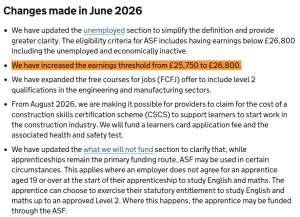
Official 2026–2027 Adult Skills Fund funding rules showing the updated £26,800 earnings threshold.
Which Free Courses Are Most Useful for a Career Change After 50?
The most valuable course depends on the learner’s existing experience and the employment opportunities available in their area.
Instead of selecting a qualification based on popularity, we recommend identifying a target occupation and working backwards to the skills or qualifications required.
Accounting, Bookkeeping and Business Administration
Accounting and business administration can be relevant for mature workers with experience in office management, retail, finance or supervising teams.
Possible training subjects include:
- Computerised bookkeeping
- Payroll administration
- Accounting software
- Business management
- Financial record keeping
- Office administration
- Business data analysis
Approved Level 3 accounting and finance qualifications can be included within Free Courses for Jobs, although funding depends on the exact qualification and learner eligibility.
For somebody with extensive administrative experience, updated accounting software knowledge may support a move into bookkeeping, payroll or finance support roles.
From a business perspective, these are useful skills because they are relevant to employers of different sizes, including smaller companies that need accurate financial records and operational support.
Digital Skills, AI and Data Analysis
Digital training is particularly relevant to over-50s who have considerable professional experience but need to update their technical knowledge.
Potential areas include:
| Training subject | Potential application |
| Essential digital skills | Email, online services and workplace software |
| Microsoft Excel | Financial analysis, reporting and administration |
| Data analytics | Business reporting and operational decisions |
| Digital marketing | Customer acquisition and online promotion |
| Cybersecurity fundamentals | IT support and business security awareness |
| AI productivity tools | Research, documentation and workflow efficiency |
Some Skills Bootcamps cover digital technology, while approved qualifications may be funded through adult learning programmes.
We consider practical digital literacy particularly valuable because it can strengthen an existing career rather than requiring a complete occupational change.
For example, an experienced retail manager who learns data reporting may become better positioned for inventory planning or operations administration.
However, an introductory AI or cybersecurity course should not be confused with a professional qualification that guarantees entry into a specialist technical occupation.
Health and Social Care
Health and social care provide another route for adults looking to retrain later in life.
Relevant learning pathways include:
- Adult care
- Healthcare support
- Care coordination
- Safeguarding
- Health and social care administration
- Supervisory and management qualifications
An approved Level 3 health and social care qualification may be relevant for people progressing within the sector.
Mature learners may bring experience in communication, organisation and supporting other people. Nevertheless, care roles can involve physically demanding work, shift patterns, mandatory checks and substantial safeguarding responsibilities.
Before applying, candidates should investigate the actual duties, qualification requirements and working conditions rather than assuming that experience alone will qualify them.
For those considering a longer-term entrepreneurial route, the operational requirements of starting a care agency demonstrate why professional training, financial planning and regulatory compliance are essential.
Teaching Assistance and Childcare
Education support roles can appeal to older workers who have previous experience in mentoring, training, administration or working with children.
Potential qualifications include supporting teaching and learning, early years education and childcare.
Some teaching assistant courses are available through funded adult learning arrangements, subject to qualification approval and eligibility.
Applicants should check whether the intended role requires practical experience, school placements or safeguarding checks.
Similarly, eligible adults may find funded childcare courses that support entry into early years employment.
Our assessment is that these qualifications are most useful when the learner has identified a specific occupational requirement.
A general online certificate may provide useful introductory knowledge without satisfying the requirements for a particular childcare position.
Engineering, Manufacturing and Construction
Technical sectors offer opportunities for people who already possess practical skills, manufacturing experience or operational knowledge.
Under the 2026 funding changes, the Free Courses for Jobs offer expanded to include additional Level 2 engineering and manufacturing qualifications.
This makes it particularly relevant for adults looking to:
- Return to manufacturing employment
- Update technical knowledge
- Transition into quality assurance
- Learn modern production processes
- Develop maintenance or construction skills
Training can also support movement from physically demanding work into technical supervision, planning or quality control.
However, certain occupations require specialist certification, licensing, practical competence or professional registration beyond a funded course.
Driving and Transport
Transport-related training may suit candidates who prefer practical employment or want to work independently.
Depending on local availability, relevant options can include logistics, warehousing, HGV training and transport operations.
Some adults also investigate driving instructor training as a route towards self-employment.
Funding availability should be checked separately from the professional requirements for entering the occupation.
For driving instruction, applicants must consider the required qualifications, tests, registration and business operating costs.
How Do Skills Bootcamps Help Over-50s Return to Employment?
Skills Bootcamps are government-supported, employer-focused training programmes designed to help adults develop skills in sectors facing recruitment or skills shortages.
They typically last up to 16 weeks and are available in selected areas of England.
Eligible learners aged 50 and over can access training in subjects such as digital technology, construction, engineering, logistics and business-related skills, depending on local provision.
One attraction is the connection between training and employment.
Eligible job-seeking participants are offered an interview on completing their programme. However, an interview is not a guarantee of employment, and not every bootcamp awards a formal qualification.
Why Shorter Training Can Make Financial Sense?
Consider an illustrative example of a 54-year-old administrator considering a career change.
A short digital training programme may allow the learner to develop new skills while continuing part-time work or searching for employment.
By comparison, a two-year qualification may create a larger opportunity cost, especially if the learner reduces paid working hours.
We would assess both options using three criteria: the time needed to complete training, the evidence that employers need the resulting skills and the financial consequences of studying.
Skills Bootcamps may offer a practical balance where the training has meaningful employer involvement.
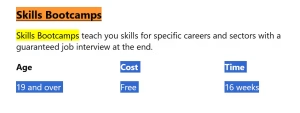
Government Skills Bootcamps information showing course duration, funding and opportunities for eligible adult learners.
Can You Get Free Online Courses for Over 50s?
Yes. Some government-funded adult education courses are delivered online, although funding does not automatically apply to every online course.
There are three main categories:
| Course type | Typical outcome | What to check |
| Fully funded online qualification | Approved recognised qualification | Eligibility and provider approval |
| Funded online Skills Bootcamp | Occupational skills and employment support | Employer links and course outcomes |
| Free introductory online learning | Knowledge or participation certificate | Whether the certificate has employment value |
Online study can be particularly suitable for adults with caring responsibilities, mobility limitations or established work commitments.
However, some courses advertised as online still involve in-person assessments, practical placements or scheduled virtual classes.
A person interested in business administration could complete relevant digital learning remotely, while a practical healthcare qualification might require workplace participation.
The important question is whether the course produces the qualification or skills that employers actually require.
Is It Possible to Start an Apprenticeship at 50 or 60?
Yes. Apprenticeships in England do not have a general maximum age limit, meaning adults in their fifties and sixties can participate if they satisfy the relevant requirements and secure an appropriate employed apprenticeship position.
Apprenticeships combine paid employment with structured training.
They may be particularly useful for people who want to change occupations while continuing to earn income.
An over-50 apprentice can potentially train in areas such as business administration, engineering, healthcare or professional services.
However, an apprenticeship is not simply a free classroom course. The learner must have an appropriate apprenticeship agreement, an employer and sufficient scope to acquire the required occupational knowledge and competencies.
From a financial perspective, the wage offered during training is an important consideration.
Someone moving from a senior management position into an entry-level apprenticeship should calculate the potential reduction in earnings before accepting an offer.
For an employer, apprenticeship training funding can help reduce training costs, but the business remains responsible for wages and applicable employer expenses.
What Financial Support Is Available for Over-50s Who Are Unemployed?
Unemployed adults over 50 may be able to access funded training through adult skills programmes, Jobcentre Plus or employment support initiatives.
The appropriate route depends on individual eligibility and the support available locally.
For people receiving relevant benefits, a work coach may help identify approved courses that support a realistic return to employment.
Possible assistance includes:
- Fully funded approved qualifications
- Skills Bootcamps
- Sector-based Work Academy Programmes
- Employment preparation and interview support
- Assistance with some course-related costs where available
The government also provides specialist support for older jobseekers through 50PLUS Champions, who work with Jobcentres and local partners to improve employment opportunities.
In November 2026, Work and Pensions Minister Baroness Sherlock reaffirmed the government’s commitment to older workers, including dedicated support through 50PLUS Champions and the Midlife MOT.
This matters because returning to work after 50 is not always simply a question of gaining another qualification.
Applicants may also need help translating previous experience into a new industry, identifying suitable employers and finding roles that accommodate their working preferences.
For somebody unemployed for an extended period, a short course connected to actual vacancies can be more useful than a qualification with no clear employment destination.
Can Someone Over 50 Get Government Funding to Become Self-Employed?
Some government-funded programmes can help older adults develop skills relevant to self-employment, although they do not necessarily provide business startup capital.
Skills Bootcamps may be available to eligible self-employed individuals, while adult vocational learning can support the development of specialist knowledge.
For someone with previous management experience, professional development could help them establish a small consultancy or independent service business.
The key distinction is between training support and business finance.
A funded accounting course may help a prospective bookkeeper build skills. It does not automatically provide money to purchase equipment, advertise services or cover initial operating costs.
Our business assessment is that mature entrepreneurs should use funded learning to address specific skills gaps rather than repeat expertise developed over decades of employment.
Turning Professional Experience Into a Business
For instance, an experienced operations manager could investigate training in digital reporting, project management or business development before starting a consultancy.
A prospective founder may also need to understand the basics of starting a business, including tax, insurance, pricing and customer acquisition.
People testing an idea before leaving employment should also understand the rules around being self-employed.
From a commercial perspective, training should strengthen an existing competitive advantage. It should not be mistaken for proof that customers will purchase a new product or service.
What Is Changing for Over-50s Under the Lifelong Learning Entitlement in 2027?
The Lifelong Learning Entitlement (LLE) represents an important change to higher education finance in England.
For eligible courses beginning from January 2027, the system introduces more flexible funding arrangements for higher-level qualifications, including approved modules.
Applications opened on 30 October 2026 for courses and modules starting between January and July 2027.
New eligible learners may access a tuition fee loan entitlement worth up to £39,160, based on the 2026–2027 maximum tuition fee.
This is a loan entitlement rather than a grant.
Why Age Matters for LLE Funding?
The rules are particularly important for mature learners approaching 60.
| Age when the course begins | Position under LLE |
| 50–54 | May qualify for tuition fee loans |
| 55–59 | May qualify for tuition fee loans |
| 60–64 | Not normally eligible for an LLE tuition fee loan |
| 65 and over | Not normally eligible for an LLE tuition fee loan |
Applicants must be under 60 on the first day of their course to qualify for a tuition fee loan under the new arrangements.
Some learners aged 60 or over may still qualify for financial support towards living costs.
Previous higher education study, residency and course eligibility can also affect the amount of funding available.
Readers can check the official Lifelong Learning Entitlement arrangements before planning higher-level study.
For people in their fifties, this creates an opportunity to consider professional qualifications or modular education without necessarily committing to a full degree immediately.
However, a loan should not be assessed in the same way as a fully funded course. Repayment rules, previous study and anticipated earnings all matter.
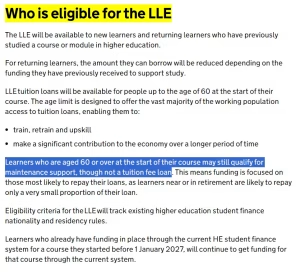
Official Lifelong Learning Entitlement guidance explaining the January 2027 launch and tuition loan eligibility for learners under 60.
Are Government Funded Courses Different in Scotland, Wales and Northern Ireland?
Yes. Education and skills funding is devolved, meaning eligibility arrangements differ across the four nations.
An England-based programme should not automatically be presented as available throughout the UK.
| UK nation | Funding routes to investigate | Important consideration |
| England | Adult Skills Fund, Free Courses for Jobs, Skills Bootcamps | Local and devolved authority rules can differ |
| Scotland | Funded college places and Scottish student support | Course and residency requirements apply |
| Wales | Personal Learning Accounts and college-based training | Income thresholds and priority sectors matter |
| Northern Ireland | Further education provision and available skills programmes | Funding depends on current programme availability |
Wales: Personal Learning Accounts
Wales provides Personal Learning Accounts for eligible adults who want to develop skills in priority industries.
Under the currently published Careers Wales criteria, eligible applicants aged 19 and over may access fully funded training if they are employed, self-employed or qualifying full-time carers and meet the programme conditions.
The published annual basic salary limit is £35,796 for most eligible courses, while approved digital and green skills courses can be exempt from the salary cap.
For somebody aged 55 working in Wales, this can offer a route into professional development without leaving existing employment.
Scotland and Northern Ireland
Adults in Scotland can investigate publicly funded college provision and relevant student support through Scottish education and careers services.
Northern Ireland also offers adult education opportunities through further education colleges and applicable skills development programmes.
However, older programme names should not be treated as evidence of currently available funding. Availability can change between academic years and providers.
Applicants should check current local admissions and funding conditions rather than relying on an England-focused course list.
How Much Money Could an Over-50 Save Through Government Funded Training?
A course advertised as free can still create costs for the learner.
Travel, equipment, examination fees, reduced employment hours and professional licensing may affect the total financial commitment.
Our approach is to compare the full economic cost of training, not simply the advertised tuition price.
Consider an illustrative training decision:
| Cost or benefit | Privately funded course | Fully funded eligible course |
| Illustrative course tuition | £2,000 | £0 |
| Travel and materials | £250 | £250 |
| Potential lost earnings | £600 | £600 |
| Total economic cost | £2,850 | £850 |
In this example, the learner saves £2,000 in tuition expenses.
The figures are hypothetical and do not represent advertised course fees or guaranteed individual savings.
A person able to study outside normal working hours may reduce the cost further.
However, it would be misleading to claim that government funding automatically eliminates every expense associated with returning to education.
For mature learners, the effect on pension contributions, household savings and income stability should also be considered.
Which Government Funded Courses Offer the Strongest Career Prospects After 50?
The strongest opportunities are not always in the most fashionable industries.
The best course is the one that supports a credible employment or business outcome.
We would prioritise courses according to existing skills and the target occupation.
| Previous professional background | Potential retraining direction | Reason to consider it |
| Office administration | Accounting or digital administration | Builds on existing organisational experience |
| Retail management | Business operations or data reporting | Transfers supervisory and commercial skills |
| Manufacturing | Technical quality assurance or engineering | Builds on industry knowledge |
| Customer service | Business support or care administration | Uses communication experience |
| Management | Consulting or project management | Makes use of established professional expertise |
| Education or mentoring | Teaching support or workplace training | Extends experience in helping others learn |
| Logistics | Transport planning or warehousing operations | Uses knowledge of supply chains and operations |
Tracy Riddell, Head of Age-friendly Employers at the Centre for Ageing Better, argued in her 2026 commentary that older workers are increasingly important to addressing employers’ skills and labour shortages.
Her perspective supports an important commercial principle: experienced workers should not be assessed solely on the latest qualification they possess.
Businesses also benefit from judgement, established professional networks, problem-solving skills and industry-specific knowledge.
For individuals aged over 50, the most effective retraining strategy often involves adding a missing technical qualification to an existing foundation of experience.
This may be more financially efficient than starting an unrelated career from the beginning.
How Can You Apply for Government Funded Courses for Over 50s?
Applying for funded training generally involves identifying an approved programme, checking eligibility and contacting the relevant training provider.
Step 1: Identify Your Employment Goal
Decide whether the priority is returning to employment, improving current earnings, changing careers or developing a business.
This prevents enrolling on training simply because it is advertised as free.
Step 2: Search for Approved Training
Use the National Careers Service course finder, local college websites or the relevant regional careers service.
Search for the intended qualification and check whether funded places are available.
Step 3: Confirm Funding Eligibility
Ask the provider to verify:
- Your age and residency eligibility
- The relevant earnings threshold
- Whether previous qualifications affect funding
- Whether the course is fully funded or co-funded
- Whether there are examination or certification charges
- Whether online or part-time attendance is possible
Step 4: Check the Qualification
Confirm the awarding organisation and exact qualification title.
For regulated occupations, check whether the course meets the professional entry requirements.
Step 5: Apply Before Committing Financially
Submit the application directly through the approved provider.
Where relevant, obtain written confirmation of public funding and any remaining personal contribution before signing an agreement.
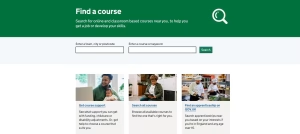
National Careers Service course search showing how mature learners can find training by subject and location.
What Should Over-50s Check Before Enrolling on a Free Course?
Although funded training reduces financial barriers, a poor course choice can still involve substantial time and opportunity costs.
We recommend checking the following:
- Employer recognition: Does the qualification match actual recruitment requirements?
- Funding status: Is the specific course genuinely publicly funded?
- Learning format: Can the schedule fit around employment or caring responsibilities?
- Qualification level: Is the course introductory, vocational or professionally recognised?
- Hidden costs: Are examinations, equipment and licensing included?
- Career progression: Does the training support a realistic next step?
- Provider credibility: Is the awarding organisation and funding arrangement verifiable?
The distinction between public funding and marketing claims is particularly important.
Some providers advertise government-approved qualifications while charging privately for their delivery.
Others may offer free short courses that do not provide occupational accreditation.
Those interested in specialist areas such as security should be especially careful to distinguish an introductory programme from training that meets formal licensing requirements.
Our recommendation is to obtain the course’s exact qualification title, funding confirmation and complete list of charges before enrolling.
What Is the Best 30-Day Plan for Retraining After 50?
A structured approach can reduce the risk of choosing unsuitable training.
| Period | Action | Intended result |
| Days 1–7 | Review career experience and identify transferable skills | Choose two realistic target occupations |
| Days 8–14 | Compare funded courses and local employers | Identify eligible training options |
| Days 15–21 | Contact providers and verify funding | Confirm costs, entry requirements and availability |
| Days 22–30 | Submit applications and update CV | Begin a practical employment transition |
An individual who already holds considerable work experience should also consider recognition of prior learning where available.
Some education providers can assess previous qualifications or professional competencies when determining suitable entry or progression routes.
For people considering a career change in midlife, the government funded courses for over 40s provide an additional comparison of learning opportunities for experienced adults.
The important distinction is to select training based on the next professional objective, not simply the applicant’s age.
Conclusion
Government funded courses for over 50s offer a practical opportunity to retrain, strengthen professional skills and improve employment prospects in 2027.
The expanded 2026–2027 adult funding arrangements and introduction of the Lifelong Learning Entitlement create additional options, although eligibility varies by location, income, qualification and age.
Our analysis suggests that mature learners gain the greatest practical benefit when training builds on their professional experience and supports a realistic employment or business objective.
Before applying, compare recognised qualifications, available funding, course flexibility and financial commitments. A carefully chosen funded course can help extend a career without unnecessarily reducing financial security.
FAQs About Government Funded Courses for Over 50s
Are government funded courses free for everyone over 50?
No. Many courses are fully funded for eligible learners, but income, residency, previous qualifications and the selected programme can affect eligibility. Some training requires a contribution or repayable loan.
Can I retrain for a new career at 55?
Yes. Adults aged 55 may qualify for Skills Bootcamps, funded vocational qualifications and apprenticeships. The most suitable option depends on the intended occupation and available training.
Are there free government funded online courses for over 60s?
Yes, some funded adult skills and essential learning programmes have no general upper age limit. However, the new Lifelong Learning Entitlement has separate restrictions on tuition fee loans for those aged 60 and over.
Can I receive free training while claiming Universal Credit?
Possibly. Eligible claimants may access approved training through adult education or employment support programmes. If training could affect work-search requirements, discuss the arrangements with a work coach.
Do government funded courses guarantee employment?
No. Some Skills Bootcamps offer eligible participants an employer interview after completion, but a job offer is not guaranteed. Employment outcomes depend on qualifications, experience and vacancies.
Can I get funding if I already have a degree?
Potentially. Having a degree does not automatically exclude someone from every adult training programme. Eligibility depends on the course, prior study, income and funding route.
Is 2027 a good time to retrain after 50?
It can be, particularly when an approved course fills a specific skills gap. The 2026–2027 funding arrangements and the new LLE offer options, but learners should consider the likely financial and employment benefits before committing.

Expert Blogger | Strategic thinker anticipating future directions for UK business
Related Articles in Startup
View All →
Newscivil Com: Can This Digital News Platform Help UK Startups Spot Emerging Trends?
For startup founders, staying informed is no longer simply about reading the business pages each morning. Artificial intelligence, changing consumer habits, technology developments, government decisions and wider social…

Meet the Startup Turning Screen Time Into a New Way to Make Money
Britain does not exactly have a shortage of side hustles. You can deliver takeaways, sell clothes online, start freelancing, walk dogs, tutor in the evenings or attempt to…

8 Best Coworking Spaces for Bootstrapped London Startups to Launch and Scale in 2026
Bootstrapped founders don’t have the luxury of a fitted-out HQ from day one. What you need is a London coworking space that flexes with you: a hot desk…