
Government Funded Close Protection Course 2027: Free Training, Eligibility, SIA Licence Costs and How to Apply?

UK Startup Blog Archive
Table of Contents
A government funded close protection course can help eligible people enter the UK’s specialist security industry without paying the full cost of training.
However, there is an important distinction between government-funded security training and a fully funded qualification that allows someone to apply for an SIA Close Protection Licence.
In 2027, prospective close protection officers should investigate military learning credits, Jobcentre employment support, employer sponsorship and approved adult training programmes before committing to a private course.
Our analysis of UK training requirements, publicly advertised courses and government funding arrangements shows that financial assistance is possible, but it is not universally available.
In particular, civilians should not assume that every Level 3 close protection course qualifies for free government funding.
The latest SIA requirements also affect training costs. From 1 April 2026, the standard SIA licence application fee became £204, while existing close protection licence holders must complete the required refresher qualification before renewal.
For someone exploring a career in executive protection, corporate security or specialist personal protection, understanding these rules can prevent unnecessary expenditure and help identify the most commercially sensible training route.
Is a Government Funded Close Protection Course Available in the UK in 2027?
Government support may be available towards close protection training, but there is no confirmed nationwide scheme that automatically provides free SIA Level 3 close protection courses to every applicant in 2027.
Access to financial support depends on the individual’s circumstances, the course, the training provider and the funding programme.
We identified several funding routes worth investigating.
| Funding route | Who it may help | Possible financial support | Important limitation |
| Enhanced Learning Credits (ELCAS) | Eligible serving and former Armed Forces personnel | Up to 80% of eligible tuition fees, subject to a claim cap | The individual and course must qualify |
| Jobcentre Plus support | Eligible unemployed people | Discretionary help with employment-related training | No automatic entitlement to a close protection course |
| Adult Skills Fund | Eligible adults in England | Full or partial funding for approved provision | Not every Level 3 close protection qualification is included |
| Skills Bootcamps | Eligible adults in participating areas | Funded training where suitable provision exists | A security-related bootcamp does not necessarily qualify someone for close protection |
| Employer sponsorship | Existing or prospective security employees | Potentially all or part of training costs | Depends on employer policy or an employment agreement |
| Private self-funding | Civilians and existing security workers | No public subsidy | Learner normally pays all costs |
The first question should therefore be whether an applicant has access to a genuine funding programme, rather than simply whether a provider advertises a free course.
For adults comparing different forms of subsidised education, wider government funded courses for over 25s can offer additional career-change opportunities.
What Changed in Close Protection Training and Licensing During 2026?
The 2026 regulatory changes have direct implications for anyone planning to enter or remain in the close protection industry during 2027.
| Requirement | Verified position entering 2027 |
| Full close protection qualification | Level 3 Certificate for Close Protection Operatives Working in the Private Security Industry |
| SIA training duration | 194 hours over a minimum of 18 days |
| Mandatory first aid | Accepted Level 3 first aid qualification, with at least 12 months’ validity remaining |
| New SIA licence application | £204 |
| Standard licence validity | Three years |
| Close protection renewal | Relevant full qualification plus Level 2 close protection refresher |
| Refresher requirement introduced | 1 April 2026 |
| Training cost | Set by the training provider, not the SIA |
The increase from £184 to £204 in the amount applicants pay for an SIA licence resulted from the ending of the previous £20 rebate.
Michelle Russell, Chief Executive of the Security Industry Authority, explained that the organisation has a responsibility as a self-funding regulator to recover the cost of its licensing services.
For applicants, this means training, medical qualifications and licensing should all be included in the financial plan.
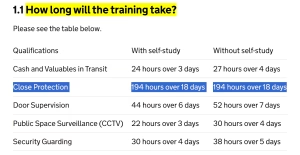
Official SIA training requirements showing that the full close protection qualification involves 194 hours over 18 days.
Who Can Get a Government Funded Close Protection Course in 2027?
Eligibility depends on the particular funding route. There is no single income limit, residency rule or employment-status requirement that applies to every close protection training programme.
Unemployed Applicants and People Receiving Benefits
People who are unemployed, claiming Universal Credit or receiving employment assistance may be able to access approved training through employment support services.
A Jobcentre work coach may consider whether the proposed course offers a realistic pathway into work.
Relevant considerations can include:
- Whether the applicant has a credible employment opportunity.
- Whether the training is essential for the proposed job.
- Whether another, less expensive qualification would achieve the same result.
- Whether the applicant can meet the licensing and background-check requirements.
- Whether public funding is actually available for the course.
Receiving Universal Credit does not automatically qualify someone for a funded bodyguard course.
Where an applicant is interested in entering the wider security sector, a shorter route into security guarding or door supervision may provide a more achievable initial employment option.
Employed Adults on Lower Incomes
England’s national Adult Skills Fund rules for the 2026–2027 funding year increased the relevant annual gross earnings threshold to £26,800.
However, this threshold applies within specified adult skills funding arrangements in non-devolved areas.
It does not mean someone earning below £26,800 can select any private close protection programme and receive government reimbursement.
The qualification must be eligible, the provider must have access to the relevant funding, and the learner must satisfy the applicable rules.
In devolved areas of England, local funding criteria may differ.
Military Veterans and Service Leavers
Eligible military personnel may have a stronger funding route through Enhanced Learning Credits.
Military experience can also provide useful transferable skills, including operational planning, communication, risk management and working under pressure.
However, military service does not automatically remove the need to meet SIA qualification and licensing requirements.
Mature Learners
There is no general upper-age limit for an SIA Close Protection Licence, although applicants must meet the physical, medical, assessment and licensing requirements.
People considering a career change later in life can investigate government funded courses for over 40s or funded training opportunities for over 50s.
For close protection work, relevant experience, judgement, fitness and professional communication are more meaningful than age alone.
How Does ELCAS Funding Work for Close Protection Training?
The Enhanced Learning Credits Administration Service supports eligible Armed Forces personnel seeking nationally recognised qualifications.
Under the scheme, eligible participants may claim up to 80% of qualifying tuition fees, subject to the maximum amount available under their entitlement.
The Ministry of Defence describes two principal funding tiers:
| ELCAS entitlement | Maximum claim | Learner contribution |
| Lower tier | Up to £1,000 | At least 20% of course fees |
| Higher tier | Up to £2,000 | At least 20% of course fees |
The scheme also provides for an eligible aggregation option for lower-tier credits, subject to its rules.
Example: Funding a £2,000 Course
Consider an eligible applicant selecting a £2,000 qualifying close protection programme.
With higher-tier entitlement:
- Course price: £2,000
- 80% potentially covered by ELCAS: £1,600
- Minimum learner contribution: £400
- Separate SIA licence application: £204
The £1,600 contribution is within the higher-tier claim ceiling.
Under the lower tier, the £1,000 cap would apply to the same course. The applicant would therefore have to meet the remaining £1,000 tuition cost.
These are illustrative calculations, not confirmed individual funding awards.
How Military Applicants Should Apply?
- Confirm Enhanced Learning Credits eligibility through the appropriate military education or resettlement representative.
- Identify an ELCAS-approved learning provider offering the required Level 3 close protection qualification.
- Check that the exact course is eligible for the scheme.
- Confirm the tuition cost and personal contribution.
- Submit the required claim before the course begins.
- Obtain approval before making a binding financial commitment.
The Ministry of Defence advises submitting a claim at least 25 clear working days before the course start date.
Applicants must not assume that a provider offering military discounts is automatically authorised to accept ELCAS payments.
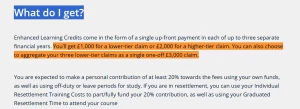
Ministry of Defence Enhanced Learning Credits guidance showing the £1,000 and £2,000 claim tiers, personal contribution and application process.
Can Civilians Get Free Close Protection Training Through Jobcentre Plus?
Civilians may be able to obtain training support through Jobcentre Plus, but fully funded specialist close protection training should be treated as a possibility rather than an entitlement.
The critical issue is whether the proposed qualification is necessary and proportionate to an achievable employment outcome.
For example, an unemployed applicant who has already received conditional interest from an established close protection employer may have a stronger business case than someone who wants training without a clear employment plan.
When approaching a work coach, the applicant should be prepared to explain:
- The occupation they intend to enter.
- Why a Level 3 close protection qualification is required.
- The expected training and licensing costs.
- Evidence of suitable vacancies or employer interest.
- The applicant’s ability to meet the SIA licensing criteria.
- Whether alternative funding is available.
A written course quotation and evidence of relevant vacancies could help support a discretionary funding discussion.
Importantly, no provider or applicant should claim that Jobcentre Plus has agreed to pay without written confirmation.
Is a Level 3 Close Protection Course Covered by the Adult Skills Fund?
Not automatically.
The Adult Skills Fund supports eligible qualifications and training activities in England. However, the existence of a Level 3 qualification does not independently establish government funding eligibility.
We consider this one of the most important distinctions for applicants in 2027.
The relevant checks are whether:
- The exact qualification is approved for the relevant funding offer.
- The chosen provider has access to the appropriate funding.
- The applicant meets the personal eligibility rules.
- A funded place is actually available.
- The qualification leads to the required SIA licensing outcome.
The government’s 2026–2027 funding arrangements include Free Courses for Jobs and other specified adult learning offers.
However, an advertised Level 3 close protection course must still be checked against the approved qualifications list.
A course may be regulated and recognised by the SIA without being funded through the Adult Skills Fund.
Likewise, a general security course may be publicly funded without leading to a close protection licence.
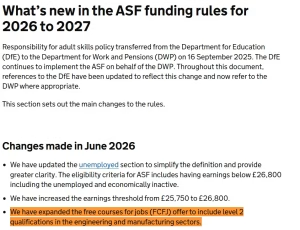
Government Adult Skills Fund 2026–2027 guidance showing the £26,800 earnings threshold and the Free Courses for Jobs eligibility provisions.
What Qualification Is Required to Become a Close Protection Officer?
To apply for a new SIA Close Protection Licence, an applicant normally needs the current Level 3 Certificate for Close Protection Operatives Working in the Private Security Industry.
The qualification must be awarded by an organisation recognised for this purpose by the SIA.
These include:
| Awarding organisation | Recognised for the current qualification |
| Highfield Qualifications | Yes |
| National Open College Network (NOCN) | Yes |
| Pearson | Yes |
| Qualifications Network (QNUK) | Yes |
| SFJ Awards | Yes |
The qualification contains theory and practical assessment.
Applicants should expect to develop skills covering protective security procedures, operational planning, managing threats, communication and emergency response.
Does the Sia Approve Individual Training Providers?
An important technical distinction is that the SIA specifies licence-linked qualification requirements but does not directly approve or vet training providers.
Training providers are approved by the recognised awarding organisations.
Therefore, an advertisement stating that a business is an “SIA-approved training provider” should be checked carefully.
Before booking, ask the provider to confirm the awarding organisation, exact qualification title and approval status.
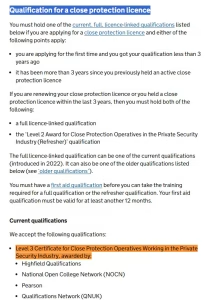
SIA-recognised Level 3 Close Protection qualification and awarding organisations.
How Much Does Close Protection Training Cost in 2027?
Our review of advertised 2026 and early-2027 course offers found that full close protection tuition is commonly advertised around £1,500 to £3,000, with some higher-priced packages.
These are observed market examples, not a regulated fee range. Prices depend on the provider, accommodation, first aid, additional qualifications and other services.
What Expenses Should Applicants Include?
| Expense | Illustrative planning cost | Important consideration |
| Full Level 3 close protection course | £2,000 | Provider-specific quotation required |
| Level 3 first aid qualification | £250 | May already be held or included |
| SIA licence application | £204 | Verified 2026 fee |
| Travel and local expenses | £300 | Depends on location and attendance |
| Total | £2,754 | Example only |
Our financial assessment: Applicants should compare the total cost of becoming employable, not just the advertised course fee.
An apparently inexpensive course may become more expensive if accommodation, medical training, travel, equipment or assessments are charged separately.
A genuinely useful quotation should specify whether it includes VAT, awarding-body registration, assessments, resits and essential training equipment.
Applicants should also consider lost earnings during an intensive course.
How Does Funding Change the Financial Commitment?
Using the example above, a candidate with an approved ELCAS contribution of £1,600 towards the £2,000 course would have:
- £400 of tuition to pay personally.
- £250 of assumed first aid costs.
- £204 for their licence application.
- £300 of estimated travel expenses.
The resulting personal expenditure would be £1,154, assuming no other funding or exemptions.
This represents an illustrative reduction of approximately 58.1% against the original £2,754 budget.
The saving is attractive, but it still leaves a meaningful cash commitment.
How Long Does a Government Funded Close Protection Course Take?
The SIA specifies 194 hours over a minimum of 18 days for the full current close protection qualification.
A provider may organise the programme across a longer calendar period, particularly where it includes additional qualifications, medical training or supplementary practical exercises.
Core areas commonly covered include:
| Training area | Business and operational relevance |
| Threat and risk assessment | Identifying risks before a protection assignment |
| Operational planning | Preparing secure working arrangements |
| Communication | Coordinating with teams, clients and stakeholders |
| Conflict management | Managing difficult situations professionally |
| Physical intervention | Understanding lawful and proportionate intervention |
| Searching procedures | Supporting safe access and security measures |
| Reconnaissance and surveillance awareness | Identifying relevant threats and vulnerabilities |
| Vehicle and route procedures | Supporting the safe movement of a protected person |
| Emergency response | Responding appropriately to incidents |
An online-only course that does not include the required practical training and assessments should not be assumed to qualify someone for a new SIA Close Protection Licence.
Online resources may support preparation, but the licence-linked qualification must meet the full regulatory delivery requirements.
How Can You Apply for a Government Funded Close Protection Course?
Applying successfully requires two separate decisions: confirming funding eligibility and confirming professional licensing suitability.
A practical application process should follow these stages.
Stage 1: Choose the Intended Employment Route
Identify whether the objective is corporate executive protection, residential security, event protection, international work or another specialist role.
Different employers may expect additional experience and qualifications beyond the minimum SIA requirements.
Stage 2: Check Licensing Eligibility
Review identification, right-to-work status, age, background checks and the relevant medical training requirements.
Applicants can lose money by paying for training before discovering a licensing obstacle.
Stage 3: Investigate Funding
Contact the relevant organisation: military education representative, Jobcentre work coach, approved training provider or potential employer.
Ask whether the exact qualification can be funded.
Stage 4: Compare Approved Providers
Request written quotations and confirmation of the awarding organisation.
Do not rely solely on advertising phrases such as “government approved”.
Stage 5: Obtain Written Funding Confirmation
Confirm the amount covered, conditions, permitted start date and any learner contribution.
Stage 6: Complete First Aid and Close Protection Training
Hold the required first aid qualification before starting the licence-linked course.
Attend and pass the required theory and practical assessments.
Stage 7: Apply for the Sia Licence
Once the qualification has been successfully awarded and reported to the SIA, the applicant can follow the official licensing process.
The SIA carries out eligibility checks before deciding whether to grant a licence.
What Are the Biggest Risks When Choosing a Funded Close Protection Course?
The financial risk is not always the price of tuition. It is paying for training that does not deliver the promised licensing or employment outcome.
We would assess providers against the following criteria before making a commitment.
| Provider assessment criterion | Editorial weighting |
| Recognised qualification and verifiable approval | 30% |
| Realistic funding terms and transparent pricing | 25% |
| Quality of practical training and instructors | 20% |
| Employment relevance and career support | 15% |
| Refund terms and learner support | 10% |
| Total | 100% |
These percentages are our proposed evaluation weights, not official approval or success statistics.
A training provider should be questioned if it promises guaranteed SIA approval, refuses to identify its awarding organisation, gives incomplete information about funding or claims the course can be completed entirely online.
Other warning signs include pressure to pay immediately and unclear cancellation provisions.
What Is the Difference Between a New Close Protection Course and Refresher Training?
This distinction became especially important in April 2026.
A new applicant normally requires the full Level 3 licence-linked qualification, whereas someone renewing an existing close protection licence is subject to the relevant refresher rules.
| Comparison | New applicant | Existing licence holder renewing |
| Main qualification | Full Level 3 qualification | Previous recognised full qualification plus required refresher |
| Refresher qualification | Not normally required for first-time licensing | Level 2 Award for Close Protection Operatives in the Private Security Industry (Refresher) |
| First aid | Accepted Level 3 qualification | Accepted Level 3 qualification |
| Licence application fee | £204 | £204 |
| Funding | Must check availability | Must check refresher funding separately |
Someone whose previous close protection licence has been inactive for more than three years may need to obtain the current full qualification rather than relying on an older certificate.
Existing licence holders should confirm which pathway applies before paying a provider.
How Much Can a Qualified Close Protection Officer Earn in the UK?
Income is an important consideration when evaluating whether specialist training represents a worthwhile investment.
The National Careers Service describes bodyguard earnings as variable and provides an indicative day-rate range of £150 to more than £300, depending on location, risk and the assignment.
These figures are not guaranteed salaries or take-home earnings.
| Illustrative day rate | Revenue from 10 paid days | Revenue from 15 paid days |
| £150 | £1,500 | £2,250 |
| £200 | £2,000 | £3,000 |
| £250 | £2,500 | £3,750 |
| £300 | £3,000 | £4,500 |
These figures represent gross assignment revenue before tax, expenses, unpaid periods and other business costs. They are not guaranteed earnings.
When Could Training Costs Be Recovered?
Using the earlier illustrative £2,754 training and licensing budget, a self-employed operative receiving £200 per paid day would need approximately 14 paid days to generate equivalent gross revenue.
That does not mean the investment would become profitable after 14 working days.
The individual must also account for:
- Taxes and National Insurance.
- Travel and accommodation.
- Insurance where required.
- Professional equipment.
- Administrative expenses.
- Unpaid time between assignments.
- Continuing professional development and future licence renewal.
For someone new to the profession, the biggest uncertainty is often securing consistent paid assignments, rather than the potential day rate.
Our assessment is that a funded course can improve the economics of entering the profession, but it cannot remove employment risk.
Is Close Protection Training a Good Investment for Businesses?
For established security firms, employee training can be an investment in operational capability rather than simply an individual career expense.
A company providing corporate security services may benefit from developing employees who already understand its operating procedures and client expectations.
Potential business benefits include better internal capability, reduced reliance on external specialists and greater flexibility when bidding for appropriate contracts.
However, employers should assess training expenditure against realistic contract demand.
A company considering expansion into executive protection should first understand the legal, operational and financial responsibilities involved in starting a security business.
Training investment should form part of a broader commercial plan covering:
- Staff licensing and competency.
- Insurance and contractual requirements.
- Operational supervision.
- Recruitment and retention.
- Client confidentiality.
- Risk management.
- Pricing and cash flow.
For a small security firm, an employer-funded training agreement may be more practical than waiting for a specialist public funding opportunity.
Employers should ensure that any repayment or training-cost agreement is lawful, proportionate and properly documented.
Can Close Protection Training Lead to Other Security Careers?
Yes. The qualification may support progression towards specialist security work, although additional training and experience are often required.
Possible career directions include executive protection, residential security, security operations management, protective security consultancy and specialist security coordination.
The industry increasingly relies on the combination of physical security, risk management and technology.
Someone interested in intelligence, digital risk and technical protection may also consider government funded cyber security courses as a separate professional development pathway.
These programmes do not replace SIA close protection qualifications, but relevant digital security expertise may complement a broader protective security career.
For learners who are primarily seeking employment rather than a specific bodyguard role, it may also be useful to compare other publicly supported vocational routes, including government funded HGV training.
The funding arrangements and licensing requirements are different, but comparing them can help determine which investment best matches an applicant’s circumstances.
Which Close Protection Training Route Offers the Best Value in 2027?
Our editorial comparison considers funding availability, direct relevance to the learner’s circumstances, financial exposure and clarity of the application process.
| Training route | Editorial suitability score | Best suited to |
| ELCAS-funded training | 90% | Eligible military personnel |
| Employer-sponsored training | 85% | Existing security employees with employer support |
| Jobcentre-assisted training | 70% | Eligible unemployed applicants with an achievable employment plan |
| Approved adult skills provision | 65% | Eligible learners where the exact course is funded |
| Self-funded specialist training | 75% | Applicants able to finance recognised training independently |
| Unverified free online close protection courses | 15% | Introductory learning only, not a licensing substitute |
How to interpret the scores: These are subjective suitability ratings for the specified audiences, not qualification pass rates, approval probabilities or measured industry statistics. A route with a high score may still be completely unavailable to a particular applicant.
Our analysis favours funding arrangements that are documented, applicable to the learner and connected to a recognised qualification.
A free course that cannot support an SIA licence application may offer less career value than a properly recognised programme that requires a personal contribution.
What Should Applicants Check Before Booking a Course for 2027?
We recommend completing one final review before paying a deposit.
The most important checks are the precise qualification title, awarding organisation, full course cost, recognised first aid requirement and written funding terms.
Applicants should also confirm that the advertised dates meet the required minimum training hours and allow time for all assessments.
Where a provider advertises employment support, ask whether this means CV assistance, introductions to employers, interviews or a confirmed job offer.
These are very different benefits.
Finally, compare the training programme against the type of work actually available in the applicant’s preferred location.
A candidate seeking employment in London-based corporate protection may face different travel costs, employer expectations and networking opportunities from someone seeking occasional event assignments elsewhere in the UK.
The best-value course is the one that combines regulatory recognition, suitable funding and realistic career prospects.
Conclusion
A government funded close protection course can reduce the financial barriers to entering specialist security work, particularly for eligible military personnel and applicants who can secure employer or employment-related training assistance.
However, our analysis indicates that applicants should prioritise recognised SIA qualifications and confirmed funding rather than generic promises of free bodyguard training.
The 2026 changes to licence fees, refresher requirements and adult skills funding make careful preparation especially important for 2027 applicants.
Before enrolling, verify the qualification, compare total costs and obtain written funding confirmation. The strongest career investment combines recognised training, manageable expenditure and a credible route into paid security work.
Frequently Asked Questions
Is a government funded close protection course completely free in 2027?
Not necessarily. Some learners may receive funding towards an eligible course, but there is no confirmed universal free close protection training entitlement. First aid, licensing, travel and other costs may remain payable.
Can I get a funded close protection course while claiming Universal Credit?
Possibly. Your work coach or an eligible training provider can explain whether any suitable funded programme is available. Receiving Universal Credit alone does not guarantee funding.
Can I apply for close protection training without military experience?
Yes. Civilians can undertake recognised close protection training if they meet the course requirements. However, military-specific funding such as ELCAS is not generally available to ordinary civilian applicants.
Do I need a Level 3 first aid certificate for close protection?
Yes. The SIA requires an accepted Level 3 first aid qualification or equivalent before the licence-linked close protection training. It must have at least 12 months’ validity remaining when required for enrolment.
How much does an SIA Close Protection Licence cost?
The SIA licence application fee is £204 under the rules effective from 1 April 2026. This is separate from the cost of training and does not guarantee that an application will be approved.
Can I complete a close protection qualification entirely online?
No. The full SIA licence-linked qualification includes mandatory practical training and assessments. Online study may support certain learning activities, but it does not replace the required in-person elements.
Is close protection refresher training compulsory in 2027?
Yes, for applicable licence renewals. The mandatory refresher requirement took effect on 1 April 2026. The correct renewal pathway depends on the applicant’s previous qualification and licensing history.

Blogger | Business Writer | Sharing startup advice on UK business blogs
Related Articles in Startup
View All →
Newscivil Com: Can This Digital News Platform Help UK Startups Spot Emerging Trends?
For startup founders, staying informed is no longer simply about reading the business pages each morning. Artificial intelligence, changing consumer habits, technology developments, government decisions and wider social…

Meet the Startup Turning Screen Time Into a New Way to Make Money
Britain does not exactly have a shortage of side hustles. You can deliver takeaways, sell clothes online, start freelancing, walk dogs, tutor in the evenings or attempt to…

8 Best Coworking Spaces for Bootstrapped London Startups to Launch and Scale in 2026
Bootstrapped founders don’t have the luxury of a fitted-out HQ from day one. What you need is a London coworking space that flexes with you: a hot desk…