
15 Best AI Companies to Invest in for 2027: UK & Global AI Stocks


UK Startup Blog Archive
Table of Contents
Artificial intelligence is creating investment opportunities across semiconductors, cloud computing, automation, financial technology and enterprise software.
However, identifying the best AI companies to invest in for 2027 requires more than choosing businesses associated with ChatGPT or buying shares after a significant price increase.
The key question for investors is which companies can turn growing AI adoption into sustainable revenue, attractive profit margins and long-term shareholder value.
Our analysis of 2026 financial results, corporate announcements and publicly available investment research highlights NVIDIA, Microsoft, Alphabet, Taiwan Semiconductor Manufacturing Company (TSMC) and Broadcom as important global AI businesses to examine.
For investors seeking exposure to British companies, London Stock Exchange Group, RELX, Sage and Volex offer different ways to participate.
The distinction matters. Some companies supply the computing infrastructure behind AI, while others monetise the technology through business subscriptions, proprietary data or operational efficiency.
We have also examined the opportunities emerging from the UK startup ecosystem, including private companies such as Wayve, Synthesia and Oxa.
Our central finding is that the strongest AI investment opportunities for 2027 may not necessarily come from companies developing the most sophisticated models. They may come from businesses that control the infrastructure, customer relationships and distribution channels required to make AI commercially useful.
What Are the Best AI Companies to Invest in for 2027?
Our shortlist covers 15 publicly traded companies with meaningful exposure to AI infrastructure, software, data or commercial adoption.
We assessed each company using five factors:
- AI business relevance – 25%
- Evidence of commercial growth – 25%
- Competitive advantages – 20%
- Financial resilience – 20%
- Execution and business-model risk – 10%
The resulting percentage is an editorial research score, reflecting our qualitative assessment of business strength and AI positioning using information available in November 2026.
It is not an expected share-price return, an independently audited company rating, a probability of success or a statement that the shares are undervalued.
The purchase price and valuation must still be assessed separately.
| Rank | AI company | Stock ticker | AI investment focus | Research score |
| 1 | NVIDIA | NVDA | AI chips and computing infrastructure | 94% |
| 2 | Microsoft | MSFT | Enterprise AI and Azure cloud | 93% |
| 3 | Alphabet | GOOGL / GOOG | Gemini, Google Cloud and AI infrastructure | 91% |
| 4 | TSMC | TSM / 2330 | Advanced semiconductor manufacturing | 90% |
| 5 | Broadcom | AVGO | Custom AI accelerators and networking | 88% |
| 6 | Amazon | AMZN | AWS, Bedrock and AI cloud infrastructure | 87% |
| 7 | ASML | ASML | Advanced chipmaking equipment | 86% |
| 8 | AMD | AMD | AI accelerators and server processors | 85% |
| 9 | Arm Holdings | ARM | Energy-efficient processor architecture | 84% |
| 10 | RELX | REL | AI-enabled analytics and legal technology | 83% |
| 11 | London Stock Exchange Group | LSEG | Financial data and enterprise AI | 81% |
| 12 | Palantir Technologies | PLTR | Enterprise and government AI software | 79% |
| 13 | Oracle | ORCL | AI cloud infrastructure and databases | 78% |
| 14 | Sage Group | SGE | AI accounting and financial automation | 76% |
| 15 | Volex | VLX | Data-centre power and connectivity | 75% |
Research scores reflect business characteristics rather than live share valuations. All 15 investments carry the risk of capital loss.
Importantly, only some of these businesses generate most of their revenue directly from AI. Others are diversified companies with exposure to the technology.
Investors seeking UK-listed alternatives should distinguish between UK companies, overseas companies accessible through UK brokers, and investment trusts listed on the London Stock Exchange.
Why Could AI Companies Offer Investment Opportunities in 2027?
AI investment is moving beyond experimentation towards commercial deployment.
Businesses are using AI for software development, customer service, financial analysis, logistics, cybersecurity, research and operational decision-making.
This creates opportunities across several interconnected markets.
| AI investment segment | Main revenue opportunity | Key investment risk |
| Semiconductor designers | Selling AI processors and accelerators | Competition and changing chip demand |
| Semiconductor manufacturing | Producing advanced chips | Capacity costs and geopolitical disruption |
| Cloud infrastructure | Providing AI computing services | High capital expenditure |
| Enterprise AI software | Subscription and usage-based revenue | Customer retention and monetisation |
| Data and analytics | Licensing proprietary datasets and intelligent workflows | Competition and AI-driven pricing changes |
| Physical AI | Robotics, autonomous vehicles and industrial systems | Slow commercial adoption |
| Data-centre equipment | Power, cabling, networking and cooling | Spending cycles and customer concentration |
From a business investment perspective, we see three important developments.
First, AI infrastructure expenditure is translating into measurable revenue for several semiconductor and cloud companies.
Second, established software businesses are increasingly integrating AI into products customers already use, creating opportunities to improve productivity and subscription value.
Third, UK startups are developing specialised AI applications in healthcare, transportation, legal services and business operations.
These trends do not guarantee that AI company shares will rise during 2027. Market valuations may already anticipate substantial growth.
How Has AI Investment Changed During 2026?
Several official company results demonstrate how quickly commercial activity has developed.
| Company | Financial reporting period | Reported performance |
| NVIDIA | Q2 FY2027, reported August 2026 | Revenue increased 106% year-on-year to $96.2bn |
| Microsoft | Q1 FY2027, reported October 2026 | Azure revenue increased 48% year-on-year |
| Alphabet | Q3 2026 | Google Cloud revenue increased 103% to $30.7bn |
| AMD | Q3 2026 | Data Centre revenue increased 97% year-on-year |
| TSMC | Q3 2026 | Revenue increased 50.9% in New Taiwan dollar terms |
| Amazon | Q3 2026 | AWS revenue increased 39.3% |
| Broadcom | Q3 FY2026 | Total revenue increased 86% year-on-year |
| Palantir | Q3 2026 | Total revenue increased 96% year-on-year |
These are reported historical company growth rates, not forecasts of investment returns. The companies also have different reporting periods, accounting structures and business models, so their growth percentages are not directly comparable.
The investment challenge for 2027 is determining which companies can maintain growth without sacrificing margins, balance-sheet strength or shareholder returns.
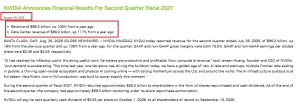
NVIDIA’s official Q2 FY2027 earnings announcement showing total revenue of $96.2 billion and Data Centre revenue of $89.0 billion.
Which Global AI Companies Have the Strongest Investment Potential?
1. NVIDIA – AI Semiconductor Infrastructure
Ticker: NASDAQ: NVDA
Research score: 94%
Investment category: AI computing infrastructure
NVIDIA remains one of the most important companies in the global AI industry because its graphics processing units (GPUs), networking technologies and CUDA software ecosystem support advanced computing workloads.
The company benefits from spending by cloud providers, AI laboratories, research organisations and enterprises building their own AI infrastructure.
In August 2026, NVIDIA reported quarterly revenue of $96.2 billion, an increase of 106% from the comparable period a year earlier.
Its Data Centre business generated approximately $89.0 billion, representing growth of 117%.
These figures demonstrate how substantially the company’s financial performance depends on advanced computing demand.
NVIDIA founder and chief executive Jensen Huang described the commercial development of AI in the company’s earnings announcement with the words:
“Now, compute is revenue.”
For investors, this reflects the transition from AI experimentation towards revenue-generating infrastructure.
Why we consider NVIDIA important for 2027: Its combination of hardware, networking and software creates a competitive position that is difficult to replicate quickly.
Principal investment risk: Competitors, customer-designed chips and changes in data-centre investment could affect margins or growth. A strong company can still be a poor investment when purchased at an excessive valuation.
Our assessment is that NVIDIA offers significant AI infrastructure exposure, but investors should focus on earnings expectations and valuation rather than assuming previous share-price performance will continue.
2. Microsoft – Enterprise AI and Cloud Computing
Ticker: NASDAQ: MSFT
Research score: 93%
Investment category: Enterprise software and AI infrastructure
Microsoft provides AI exposure through Azure, Microsoft 365 Copilot, GitHub and business applications.
Unlike businesses depending entirely on a new AI product, Microsoft has established enterprise customers, subscription relationships and existing distribution channels.
This creates opportunities to introduce AI functionality into products already used by organisations.
In October 2026, Microsoft announced first-quarter fiscal 2027 revenue of $92.3 billion, an increase of 19%.
Microsoft Cloud revenue reached $63.9 billion, growing 30%, while Azure revenue rose 48%.
These figures provide evidence of strong cloud demand, although Azure’s growth should not be attributed entirely to AI.
Chief executive Satya Nadella has emphasised the importance of translating Microsoft’s technological developments into practical business adoption.
For entrepreneurs and corporate investors, this is a significant competitive advantage. Businesses frequently prefer introducing AI through existing enterprise software rather than adopting completely new systems.
Why we consider Microsoft important for 2027: It combines AI infrastructure with established software monetisation channels.
Principal investment risk: Heavy infrastructure expenditure, competition, enterprise adoption rates and uncertainty over the profitability of individual AI services.
Microsoft offers diversified technology exposure rather than a pure AI investment.
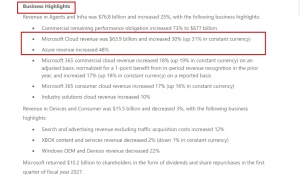
Microsoft’s October 2026 first-quarter fiscal 2027 results showing Microsoft Cloud revenue growth of 30% and Azure revenue growth of 48%.
3. Alphabet – Gemini, Google Cloud and AI Research
Ticker: NASDAQ: GOOGL / GOOG
Research score: 91%
Investment category: AI models, cloud services and digital platforms
Alphabet has several advantages in the AI market, including its Gemini model family, Google Cloud infrastructure, proprietary AI accelerators and established consumer platforms.
Its investment opportunity extends beyond AI chatbots.
Alphabet can commercialise AI through enterprise cloud services, search, advertising, productivity applications and developer tools.
In its third-quarter 2026 financial announcement, Alphabet reported total revenue of $127.6 billion, representing 25% year-on-year growth.
Google Cloud revenue increased 103% to $30.7 billion.
Our analysis suggests that Alphabet’s combination of AI research, computing infrastructure and established distribution channels gives it several potential ways to benefit from AI adoption.
However, AI could also change the economics of online search and advertising, historically major sources of revenue.
Why we consider Alphabet important for 2027: The company can deploy AI across multiple commercial services rather than relying on one product.
Principal investment risk: Search disruption, regulatory pressure, infrastructure costs and competition between foundation-model providers.
4. TSMC – Advanced Semiconductor Manufacturing
Ticker: NYSE: TSM / Taiwan: 2330
Research score: 90%
Investment category: Semiconductor manufacturing
Taiwan Semiconductor Manufacturing Company produces advanced chips used across the global technology industry.
Its investment proposition differs from that of NVIDIA or AMD. Instead of concentrating on designing a particular AI processor, TSMC manufactures semiconductors for multiple customers.
This offers exposure to the broader demand for advanced computing.
In October 2026, TSMC reported third-quarter revenue of approximately NT$1.49 trillion, an increase of 50.9% year-on-year.
Revenue growth in US dollar terms was 41.2%.
Advanced manufacturing capabilities, production scale and customer relationships are important competitive advantages.
From an investment perspective, TSMC can potentially benefit when different chip designers compete for AI market share.
Why we consider TSMC important for 2027: Its manufacturing role provides exposure to multiple AI hardware ecosystems.
Principal investment risk: Geopolitical tensions, export controls, significant capital requirements and semiconductor industry cycles.
TSMC should not be considered a low-risk investment simply because it serves several customers.
5. Broadcom – Custom AI Chips and Data-Centre Networking
Ticker: NASDAQ: AVGO
Research score: 88%
Investment category: AI accelerators and network infrastructure
Broadcom is an important company to examine because large cloud providers increasingly require specialised semiconductor solutions.
Its business includes networking technology, semiconductor products and infrastructure software.
Advanced AI systems require more than powerful processors. They also depend on high-performance communication between chips, servers and data centres.
Broadcom participates in these supporting markets.
In September 2026, the company reported fiscal third-quarter revenue of approximately $29.6 billion, an increase of 86% from the previous year.
This total includes businesses beyond AI, so investors should examine the specific contributions from semiconductor and infrastructure software operations.
Our assessment is that Broadcom offers exposure to both AI computing demand and the networking systems necessary to support it.
Why we consider Broadcom important for 2027: Custom silicon and advanced networking could become increasingly important as cloud providers seek greater infrastructure efficiency.
Principal investment risk: Customer concentration, semiconductor demand fluctuations and acquisition-related financial obligations.
6. Amazon – AWS and AI Infrastructure Services
Ticker: NASDAQ: AMZN
Research score: 87%
Investment category: Cloud infrastructure and enterprise AI
Amazon is commonly associated with online retail, but Amazon Web Services makes it an important participant in the AI infrastructure market.
AWS provides computing capacity, model development services, infrastructure and tools for organisations deploying AI applications.
Amazon Bedrock supports enterprise access to foundation models, while the company’s infrastructure activities include the development of specialised computing technologies.
Amazon’s third-quarter 2026 results showed that AWS net sales increased 39.3%, reaching an annualised revenue run rate of approximately $184 billion.
This demonstrates substantial cloud business growth, although the reported AWS figure includes services beyond AI.
For investors, Amazon’s opportunity involves supplying infrastructure to businesses developing and deploying AI applications.
Why we consider Amazon important for 2027: AWS has an established commercial platform, while Amazon’s wider operations provide additional earnings diversification.
Principal investment risk: Large capital expenditure, competition from Microsoft and Google, and uncertainty around AI infrastructure utilisation.
7. ASML – Advanced Chipmaking Equipment
Ticker: NASDAQ: ASML / Euronext Amsterdam: ASML
Research score: 86%
Investment category: Semiconductor manufacturing equipment
ASML develops advanced lithography systems used in semiconductor manufacturing.
Its technology supports the production of increasingly sophisticated chips, making it an important participant in the AI hardware supply chain.
The company reported third-quarter 2026 net sales of approximately €11.7 billion and a gross margin of 57.5%.
Its products are not exclusively used for AI chips. Demand also comes from the wider semiconductor market.
Nevertheless, developments in advanced AI processors and manufacturing processes could support long-term demand for increasingly capable chipmaking equipment.
Why we consider ASML important for 2027: Its advanced manufacturing equipment occupies a highly specialised position in the semiconductor supply chain.
Principal investment risk: Export restrictions, customer capital expenditure cycles and the timing of large equipment orders.
8. Advanced Micro Devices – Alternative AI Processors
Ticker: NASDAQ: AMD
Research score: 85%
Investment category: AI accelerators and data-centre processors
AMD offers investors exposure to competition in the AI semiconductor market.
Its product portfolio includes EPYC server processors and Instinct AI accelerators.
The company’s growth opportunity depends partly on cloud providers and enterprise customers seeking additional suppliers and alternative computing architectures.
AMD reported third-quarter 2026 revenue of $13.4 billion, increasing 45% year-on-year.
Its Data Centre segment generated approximately $8.5 billion, representing 97% growth.
Chief executive Dr Lisa Su stated in the official results announcement:
“Demand for our Instinct and EPYC products continued to strengthen.”
The company’s progress indicates that the AI computing market includes meaningful opportunities beyond a single dominant supplier.
However, NVIDIA’s established software ecosystem remains a significant competitive challenge.
Why we consider AMD important for 2027: Continued demand for AI accelerators and server processors could support expansion.
Principal investment risk: Competition, product execution, software ecosystem limitations and semiconductor pricing pressure.
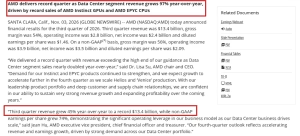
AMD’s third-quarter 2026 results showing 45% total revenue growth and 97% Data Centre revenue growth.
9. Arm Holdings – Cambridge-Based Semiconductor Technology
Ticker: NASDAQ: ARM
Research score: 84%
Investment category: Processor intellectual property
Arm is particularly relevant to investors interested in British technology businesses.
Although headquartered in Cambridge, Arm is listed on NASDAQ rather than the London Stock Exchange.
The company licenses processor architecture and related intellectual property used across smartphones, servers and other connected devices.
Its technology has become relevant to AI because processing efficiency and energy consumption matter when deploying increasingly demanding computing applications.
In November 2026, Arm reported second-quarter fiscal 2027 revenue of $1.44 billion, representing growth of 27%.
Its commercial model differs from that of manufacturers building and selling complete chips.
Arm’s licensing and royalty activities provide exposure to the broader semiconductor ecosystem.
Why we consider Arm important for 2027: Demand for energy-efficient computing could increase as AI workloads expand across devices and data centres.
Principal investment risk: Licensing concentration, customer relationships, valuation expectations and competition from alternative chip architectures.
Arm is one of the clearest examples of British-origin semiconductor innovation accessible through public equity markets.
10. RELX – AI-Enabled Professional Analytics
Ticker: LSE: REL
Research score: 83%
Investment category: Data, analytics and enterprise software
RELX offers a different way to participate in the AI economy.
Rather than competing to build general-purpose AI models, the company provides information-based analytics and decision tools used in areas including legal research, risk assessment and scientific information.
For businesses using AI, access to reliable and specialised data can be as important as the underlying models.
RELX’s October 2026 trading update reported underlying revenue growth of 7% for the first nine months of the year.
Its Legal division recorded underlying growth of 10%, while its Risk business increased 8%.
The company highlighted continuing adoption of AI-enabled tools and analytics products.
Our analysis suggests that established business relationships and proprietary datasets may provide commercial advantages for companies such as RELX.
Why we consider RELX important for 2027: It combines AI-enabled products with established professional information and analytics services.
Principal investment risk: AI-driven competition could change pricing, increase development costs or challenge existing subscription models.
RELX is not a pure AI company. Its investment appeal depends on the performance of the wider business as well as the profitability of AI adoption.
Which UK-Listed AI Companies Could Investors Watch in 2027?
The UK stock market contains fewer large, pure-play foundation-model businesses than the US market.
However, British-listed companies can provide exposure to financial technology, enterprise software and the physical infrastructure supporting AI.
The opportunity for UK investors is not limited to finding the next company developing a large language model.
Businesses supplying specialist data, automation software and power infrastructure may also benefit from AI investment.
11. London Stock Exchange Group – AI in Financial Data
Ticker: LSE: LSEG
Research score: 81%
Investment category: Financial data and AI analytics
London Stock Exchange Group is one of the more distinctive AI-related investment opportunities listed in Britain.
Its operations include financial data, analytics, indices, trading infrastructure and risk intelligence.
The company has been developing AI-enabled solutions that help financial institutions analyse information and improve professional workflows.
LSEG’s October 2026 trading update reported organic constant-currency total income growth, excluding recoveries, of 8.8%.
It also disclosed that 95% of its top 200 customers were using LSEG AI products.
This customer adoption figure is particularly relevant because it provides evidence of AI integration within established commercial relationships.
Chief executive David Schwimmer said LSEG was working with major financial institutions as they increasingly integrate and scale AI across their organisations.
Our investment assessment is that LSEG has an opportunity to combine trusted financial data with intelligent research and workflow products.
Why we consider LSEG important for 2027: Its established financial data relationships create opportunities for additional AI-enabled services.
Principal investment risk: AI adoption may not translate proportionately into new revenue, while competition and acquisition expenditure could affect profitability.
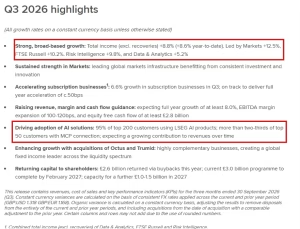
London Stock Exchange Group’s Q3 2026 trading update showing 8.8% organic income growth and adoption of AI products by 95% of its top 200 customers.
12. Palantir Technologies – Enterprise and Government AI
Ticker: NASDAQ: PLTR
Research score: 79%
Investment category: Enterprise AI software
Palantir develops software that helps organisations integrate, analyse and use complex datasets.
Its Artificial Intelligence Platform supports applications across commercial and government environments.
This makes Palantir relevant to companies seeking AI systems that interact with operational data rather than providing general chatbot functionality.
In November 2026, Palantir reported third-quarter revenue growth of 96% year-on-year.
US commercial revenue increased 148% over the same period.
These results demonstrate strong reported business expansion.
However, investors should separate exceptional operating growth from the valuation placed on the company’s shares.
Fast-growing technology companies can experience significant price corrections if future earnings fail to match optimistic market expectations.
Why we consider Palantir important for 2027: It has demonstrated growing commercial demand for AI-enabled enterprise software.
Principal investment risk: A demanding valuation, customer concentration and competition from other data-platform providers.
We consider Palantir a company to research carefully rather than one to purchase solely because of its recent growth figures.
13. Oracle – AI Cloud Infrastructure and Databases
Ticker: NYSE: ORCL
Research score: 78%
Investment category: Cloud infrastructure and enterprise databases
Oracle provides cloud infrastructure, database systems and enterprise software.
Its position in the AI market has expanded as customers require computing capacity for model training and inference.
In September 2026, Oracle reported first-quarter fiscal 2027 revenue of $19.3 billion, up 30%.
Cloud infrastructure revenue increased 121% to approximately $7.4 billion.
The company also reported a substantial remaining performance obligations balance, reflecting contracted business yet to be recognised as revenue.
For investors, the key question is how efficiently Oracle can convert this demand into revenue, operating cash flow and sustainable profits.
AI data-centre construction requires significant funding, and large customer commitments do not eliminate execution risk.
Why we consider Oracle important for 2027: Increasing AI infrastructure demand could support its cloud business.
Principal investment risk: Heavy capital requirements, financing obligations and the timing of infrastructure deployment.
14. Sage Group – AI Accounting and Financial Automation
Ticker: LSE: SGE
Research score: 76%
Investment category: Enterprise financial software
Sage is a UK-listed software company providing accounting, payroll and financial management services.
Its relevance to AI investing comes from incorporating automation and intelligent assistance into existing business workflows.
AI technology can potentially improve transaction processing, financial reporting, forecasting and administrative efficiency.
Sage’s July 2026 trading update highlighted accelerating revenue momentum and continued development of AI capabilities across its platform.
The company has also outlined plans to extend agentic AI into finance workflows.
For UK entrepreneurs and small businesses, this is an important area of commercial AI adoption.
The opportunity lies in helping businesses complete essential financial tasks more efficiently, rather than replacing accounting professionals altogether.
Why we consider Sage important for 2027: Existing business subscriptions provide a route for introducing AI-powered financial automation.
Principal investment risk: Software competition, customer price sensitivity and uncertainty over whether AI features will generate sufficient additional revenue.
As of 12 November 2026, Sage’s full-year 2026 results were scheduled for 19 November. Investors should review those results before relying on this assessment later in 2027.
15. Volex – AI Data-Centre Infrastructure
Ticker: LSE: VLX
Research score: 75%
Investment category: Power and data transmission equipment
Volex is a UK-listed manufacturer of critical power and connectivity products.
It offers indirect exposure to AI through the physical infrastructure needed to support data centres.
AI computing facilities require reliable power connections, cables and transmission systems.
The expansion of these facilities can therefore create opportunities for specialist manufacturers.
In an October 2026 trading update, Volex expected first-half revenue for its financial year 2027 to reach at least $710 million.
The company estimated organic constant-currency revenue growth of at least 21%.
Management also indicated that full-year underlying operating profit was expected towards the upper end of prevailing market expectations.
These figures are relevant because Volex’s growth depends on identifiable infrastructure demand rather than speculative expectations about future AI applications.
Why we consider Volex important for 2027: Data-centre expansion creates demand for supporting electrical and connectivity infrastructure.
Principal investment risk: Customer concentration, production costs, manufacturing execution and fluctuations in infrastructure spending.
Volex is a manufacturing investment with AI exposure, not a pure AI software business.
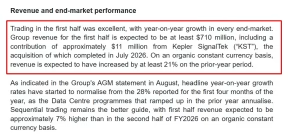
Volex’s 19 October 2026 Half Year Trading Update showing expected revenue of at least $710 million and organic constant-currency growth of at least 21%.
Update required: Volex’s half-year results were scheduled for 12 November 2026. Replace these preliminary figures with the published results once available.
What Are the Best Private AI Companies in the UK to Watch?
Some of the most innovative British AI businesses are privately owned.
This means that their shares generally cannot be purchased through an ordinary stockbroking account.
Private-company investment may instead involve venture capital, specialist investment funds, equity crowdfunding or participation in an eligible funding round.
We have previously examined how to invest in private companies, including the differences between buying publicly listed shares and acquiring an ownership interest in a private business.
The following companies are relevant to the UK AI investment landscape, although inclusion does not mean their shares are available for retail purchase.
| Private AI company | Specialisation | Notable 2026 development | Ordinary stock-market access |
| Wayve | Autonomous driving and embodied AI | Announced a $1.2bn Series D funding round | No |
| Synthesia | AI-generated business video | Raised $200m at a $4bn valuation | No |
| ElevenLabs | Voice AI and conversational agents | Announced a $22bn valuation linked to an employee tender offer | No |
| Oxa | Industrial autonomous vehicle software | Announced a $103m Series D first close | No |
Wayve – Autonomous Driving AI
London-based Wayve develops AI technology for autonomous vehicles.
In February 2026, the company announced a $1.2 billion Series D funding round, alongside additional milestone-based capital within a broader $1.5 billion financing package.
The funding announcement valued the company at approximately $8.6 billion.
Its investors included major technology companies and institutions, demonstrating commercial interest in autonomous driving AI.
Our assessment is that Wayve represents an important example of physical AI, where technology is applied to real-world environments.
However, vehicle autonomy faces substantial regulatory, technical and commercialisation challenges.
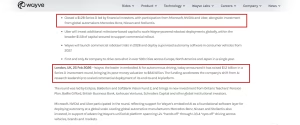
Wayve’s official February 2026 investment announcement showing the $1.2 billion Series D round and $8.6 billion post-money valuation.
Synthesia – Enterprise AI Video
Synthesia develops AI video technology for organisations producing training, communication and educational content.
In January 2026, the company announced a $200 million Series E funding round at a valuation of $4 billion.
This demonstrates investor interest in practical business applications of generative AI.
From an entrepreneur’s perspective, the commercial question is whether AI-generated video reduces production costs and improves employee training or communication.
Businesses with demonstrable productivity benefits may be better positioned to sustain recurring revenue.
ElevenLabs – AI Voice Technology
ElevenLabs develops speech generation and conversational AI technology.
In September 2026, the company announced a $22 billion valuation following an employee tender offer.
That valuation should not be confused with the proceeds of a new public share offering.
The company’s focus on business communication and voice agents illustrates the expansion of AI beyond text-based applications.
The investment risks include model competition, pricing pressure, infrastructure costs and the possibility that private valuations do not translate into equivalent public-market values.
Oxa – Industrial Mobility Automation
Oxford-based Oxa develops autonomous driving systems and associated software.
In March 2026, it announced the first close of a $103 million Series D round, with backing that included the UK’s National Wealth Fund and NVIDIA’s venture investment arm.
Oxa focuses on industrial mobility applications, where automation may improve operational efficiency.
Its opportunity is distinct from companies concentrating exclusively on privately owned passenger vehicles.
The commercial investment question is whether industrial customers can adopt autonomous systems at scale while meeting safety and economic requirements.
We see companies such as Oxa as evidence that British AI investment opportunities extend into transport, logistics and industrial technology.
Other emerging businesses, including legal AI company Harvey, demonstrate how specialist applications can attract venture capital.
The commercial development of AI-powered legal startups shows why investors assess customer demand, recurring revenue and industry-specific advantages alongside technological innovation.
How Can UK Investors Get Exposure to AI Companies in 2027?
There are several ways to participate in the AI sector.
The appropriate route depends on experience, investment objectives, access to capital and willingness to accept losses.
Buy Publicly Traded AI Shares
UK investors can use investment platforms offering access to domestic and international stock markets.
For example, a platform with access to US exchanges may allow investors to purchase shares in NVIDIA, Microsoft or Alphabet.
A UK share dealing account may also provide access to RELX, LSEG, Sage or Volex.
Before investing, check:
- Platform dealing commissions
- Foreign exchange conversion charges
- Account and custody fees
- Availability of fractional shares
- Eligibility for a Stocks & Shares ISA
- Tax treatment of overseas dividends
- The company’s current market valuation
Investors should also examine the business itself rather than treating its share price as an indication of whether it is expensive or cheap.
A company trading at £10 per share can be more expensive relative to its earnings than one trading at £500.
Use an Investment Trust
An investment trust provides exposure to a managed portfolio of investments through shares traded on a stock exchange.
Scottish Mortgage Investment Trust is one example of a UK-listed investment vehicle with holdings across innovative public and private companies.
As of 30 September 2026, its published portfolio included:
| Portfolio holding | Percentage of total assets |
| TSMC | 6.5% |
| NVIDIA | 6.2% |
| Anthropic | 4.0% |
| ASML | 2.8% |
| Amazon | 2.7% |
These holdings show meaningful AI exposure, but the trust is not exclusively an AI investment vehicle.
It also owns businesses operating in other industries.
Investment trust shares can trade at a premium or discount to net asset value, while management fees, portfolio concentration and private-company valuation uncertainty create additional risks.
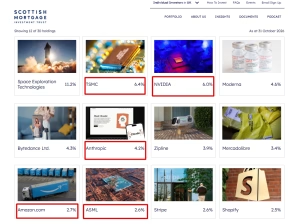
Scottish Mortgage Investment Trust’s official holdings as of 30 September 2026, showing TSMC, NVIDIA, Anthropic, ASML and Amazon among its investments.
Consider Artificial Intelligence ETFs
Exchange-traded funds provide another method of obtaining exposure to several businesses through a single investment.
Some ETFs focus specifically on artificial intelligence, robotics, semiconductor manufacturers or broader technology markets.
However, an AI-themed ETF is not automatically diversified.
Several funds may hold overlapping positions in the same large technology companies.
When evaluating an ETF, investors should examine its:
- Benchmark and investment objectives
- Top 10 holdings
- Sector and geographical concentration
- Ongoing charges
- Fund size and liquidity
- Physical or synthetic replication method
- ISA eligibility
A broad global equity fund may already include substantial AI exposure through its largest holdings.
Purchasing an additional AI ETF could therefore increase concentration rather than provide genuine diversification.
Investors should compare these options with other UK investment opportunities before deciding how much risk to accept.
Invest in Private AI Startups
Private AI investments can provide exposure to businesses before a public listing, but opportunities are restricted and carry considerable risk.
Investment access may depend on shareholder arrangements, investor eligibility, available funding rounds and specialist platforms.
UK investors exploring private startup finance should understand how equity crowdfunding works and whether a particular investment qualifies for relevant tax relief.
The most important questions include:
- Does the company have paying customers?
- What is its annual recurring revenue?
- How long can it operate before needing additional funding?
- What proportion of revenue is consumed by computing infrastructure?
- Does it own its intellectual property?
- What rights are attached to the investor’s shares?
- Could future funding dilute existing shareholders?
- How might the investor eventually sell their shares?
Private investing requires more extensive due diligence than simply purchasing shares through a conventional stockbroker.
The principles behind buying a limited company are relevant here, particularly when assessing financial statements, shareholder rights, liabilities and the ownership of business assets.
What Tax Rules Should UK AI Investors Understand?
Tax-efficient investing can affect an investor’s net return.
However, tax relief should never be the primary reason for purchasing an unsuitable or excessively risky investment.
| UK tax consideration | Position for 2026/27 |
| Annual ISA allowance | £20,000 across eligible ISA types |
| Capital Gains Tax annual exempt amount | £3,000 for individuals |
| Dividend allowance | £500 |
| Stocks & Shares ISA | Eligible investment gains and dividends are generally free from UK tax inside the account |
| US-listed shares | Foreign withholding tax and currency considerations may apply |
| EIS and SEIS | Tax relief may be available for qualifying private-company investments |
The current £20,000 ISA allowance applies to the 2026/27 tax year ending 5 April 2027. Investors should check the rules that apply to the next tax year before making 2027/28 contributions.
For official eligibility and allowance information, review the government’s ISA guidance.
Foreign withholding tax may still apply to overseas dividends within an ISA.
Early-stage UK investors can also research the Enterprise Investment Scheme and Seed Enterprise Investment Scheme.
These arrangements may provide tax advantages for qualifying investments, although eligibility, holding periods and relief conditions must be considered carefully.
A business seeking funding should understand the differences between loans, grants and equity investment. Our analysis of startup funding options explains why different financing structures suit different stages of commercial development.

HMRC’s official Individual Savings Accounts overview showing the £20,000 ISA allowance for 2026/27.
Are Cheap AI Stocks Better Investments Than Expensive AI Stocks?
The phrase cheap AI stocks can be misleading.
A low share price does not necessarily mean a company offers good value.
Investors should examine how the company’s market valuation compares with its profits, cash generation, debt and expected growth.
For example, a company with rapid revenue growth may still be expensive if its market capitalisation already reflects several years of exceptional performance.
Conversely, a slower-growing business with reliable cash flow may provide a more attractive investment at a reasonable valuation.
We consider the following indicators particularly useful.
| Financial indicator | What it helps investors understand |
| Revenue growth | Whether customer demand is expanding |
| Gross margin | The economics of delivering products and services |
| Operating margin | Profitability after operating expenses |
| Free cash flow | Cash available after operating and capital spending |
| Price-to-earnings ratio | Share valuation relative to accounting earnings |
| Enterprise value to free cash flow | Valuation compared with cash generation |
| Net debt | Financial obligations after available cash |
| Customer concentration | Dependence on a small number of customers |
| Research and development spending | Investment in future technology |
| Stock-based compensation | Potential dilution and remuneration costs |
These measures should be considered together.
For instance, free cash flow can be distorted by working capital movements, while conventional earnings multiples may be less useful for businesses that have not reached profitability.
A thorough analysis also requires reviewing management forecasts and the underlying assumptions supporting market expectations.
What Financial Risks Could Affect AI Companies in 2027?
Although AI may provide substantial business opportunities, the sector faces several investment risks.
High Market Valuations
Strong revenue growth can produce high investor expectations.
If earnings growth slows, share prices may decline even when the underlying business remains profitable.
This is particularly important for companies valued primarily on expected future expansion.
Infrastructure Spending and Cash Flow
AI data centres require processors, networking equipment, electricity, cooling systems and buildings.
High expenditure can reduce free cash flow, especially when infrastructure is constructed before generating sufficient revenue.
Investors should distinguish between revenue growth, contracted future business and cash actually received.
Competition and Pricing Pressure
AI technology is developing quickly.
Companies may face competition from open-source models, smaller specialised developers, major cloud providers and businesses developing internal technologies.
Competitive pressure may reduce pricing power.
Regulation and Data Protection
Companies deploying AI must consider privacy, intellectual property, regulatory obligations and cybersecurity.
These factors can influence product development costs and commercial adoption.
Geopolitical and Supply Chain Risk
Advanced chip manufacturing is concentrated in a relatively small number of companies and geographical locations.
Export controls, international trade restrictions and disruptions to semiconductor production could affect the wider AI industry.
Concentration Risk
Many investors already own substantial technology exposure through pensions, index funds or existing share portfolios.
Adding AI shares without checking existing holdings can create unintended concentration.
The UK Financial Conduct Authority encourages diversification and highlights the particular dangers associated with high-risk investments.
For investors concerned about concentration, examining sustainable investment companies alongside broader equity and asset-class diversification can help clarify how different investment themes fit within a long-term strategy.
How Much of an Investment Portfolio Should Be Allocated to AI?
There is no universal percentage suitable for every investor.
The appropriate allocation depends on financial circumstances, existing investments, time horizon and tolerance for losses.
Some investors may already have considerable AI exposure without holding a dedicated AI fund.
For example, a globally diversified stock-market fund may hold companies such as Microsoft, NVIDIA, Alphabet and Amazon.
Adding a separate AI investment increases exposure to companies the investor may already own.
A useful way to think about AI is as a potentially concentrated investment theme rather than a replacement for a diversified portfolio.
Consider a hypothetical investor with a £10,000 investment portfolio.
If they choose to allocate 5% of the portfolio to additional AI-focused investments, that would represent £500.
The remaining £9,500 would be invested according to their broader investment strategy.
This is an illustration of how concentration can be controlled, not a recommended allocation. Some investors may reasonably choose no additional AI exposure.
The important financial principle is to ensure that a decline in AI valuations would not jeopardise essential savings or long-term financial obligations.
What Should Investors Look for Before Investing in an AI Startup?
Private-company investment requires a different approach from evaluating established public businesses.
Startups may not have consistent profitability, extensive financial reporting or a proven commercial model.
We consider five questions particularly important.
1. Does the Startup Solve an Expensive Business Problem?
A useful AI product should generate measurable value.
Examples include reducing repetitive administrative work, improving fraud detection or increasing productivity in industrial operations.
2. Is There Evidence That Customers Will Pay?
Downloads, demonstrations and press coverage do not necessarily establish sustainable demand.
Paid contracts, recurring revenue and customer retention are more informative.
3. Can the Company Defend Its Commercial Position?
A startup needs a competitive advantage beyond accessing the same AI model as its competitors.
Advantages may include proprietary data, specialised industry knowledge, regulated workflows and established distribution partnerships.
4. Does the Business Have a Sustainable Financial Model?
Investors should examine gross margins, infrastructure expenses, customer acquisition costs and expected future funding requirements.
A rapidly growing AI company may still consume more cash than it generates.
5. How Could Investors Eventually Realise a Return?
Private shares may be difficult to sell.
An acquisition, secondary transaction or public listing may offer an eventual exit, but none is guaranteed.
Understanding what constitutes a startup helps distinguish early-stage innovation from established commercial businesses.
Investors should also consider the quality of management, governance and investor communication.
Many of the same factors that help founders attract business investors are relevant when examining whether a startup deserves funding.
What Could Happen to the AI Investment Market in 2027?
Rather than predicting specific stock-price gains, our analysis identifies three possible scenarios.
| Scenario | What could happen | Potential investment effect |
| Bull case | AI adoption expands rapidly and supports attractive profitability | Strong earnings could justify higher valuations for selected companies |
| Base case | Demand grows but competition and infrastructure costs remain substantial | Performance may diverge significantly between companies |
| Bear case | Infrastructure spending slows or commercial AI returns disappoint | Valuations may decline, particularly among highly rated growth shares |
These are qualitative scenarios, not probability-weighted forecasts.
What Would Support the Bull Case?
Continued growth in enterprise AI adoption, cloud consumption, inference demand and profitable software subscriptions would support the investment argument.
Companies that convert AI usage into recurring revenue without excessive additional costs may benefit most.
What Would Support the Base Case?
AI spending may continue expanding while investors become more selective.
Businesses with strong earnings and financial discipline could perform differently from companies relying heavily on future expectations.
This would make valuation and cash-flow analysis increasingly important.
What Could Trigger a Bear Case?
A reduction in data-centre expenditure, disappointing AI monetisation, regulatory restrictions or weaker global economic conditions could affect valuations.
Companies dependent on a small number of large infrastructure customers may face particular challenges.
From a business and financial perspective, we consider the separation between AI adoption, AI revenue and AI profitability one of the most important themes to monitor during 2027.
Which AI Investment Trends Should Investors Monitor in 2027?
We have identified several developments worth monitoring.
| Investment trend | Companies to watch | Indicator to monitor |
| AI processor demand | NVIDIA, AMD, Broadcom | Revenue growth and margins |
| Advanced chip manufacturing | TSMC, ASML | Orders, manufacturing capacity and capital spending |
| Enterprise AI cloud adoption | Microsoft, Amazon, Alphabet, Oracle | Cloud growth and infrastructure profitability |
| Business AI software | Palantir, Sage, RELX | Customer adoption and recurring revenue |
| Financial AI tools | LSEG | Paid usage and monetisation |
| Energy-efficient computing | Arm | Licensing and royalty growth |
| Physical AI and autonomy | Wayve, Oxa | Commercial deployments and regulatory progress |
| Data-centre expansion | Volex | Orders, organic growth and operating margins |
The next stage of the market will test whether businesses can generate durable economic returns from their investment in AI.
Founders and business operators evaluating their own technology strategies should ask a similar question: does AI provide a measurable competitive advantage?
Commercial AI adoption is closely connected to wider changes in business models, customer expectations and operating systems. These developments are already influencing how companies approach digital transformation.
Which AI Companies Would We Prioritise for Further Research in 2027?
The best choice depends on the type of exposure an investor wants.
For established technology platforms, Microsoft, Alphabet and Amazon provide exposure to AI within diversified businesses.
For computing infrastructure, NVIDIA, TSMC, Broadcom, AMD and ASML remain relevant companies to analyse.
For enterprise software and specialist data, investors can examine Palantir, RELX, LSEG and Sage.
For British technology and manufacturing exposure, Arm and Volex provide different opportunities.
Those exploring private AI startups can monitor Wayve, Synthesia, ElevenLabs and Oxa, while recognising that ordinary public-market access is unavailable.
Our broader assessment is that commercial resilience, customer demand and valuation discipline will matter more in 2027 than simply identifying the company associated with the most advanced AI product.
Business growth and share-price performance are not interchangeable.
A company can produce excellent financial results while still delivering disappointing returns if the original purchase valuation was too high.
Similarly, a less prominent company may offer attractive long-term prospects when its earnings, cash generation and valuation are properly understood.
For investors seeking to identify the next generation of UK AI businesses, access to experienced startup investors and business experts can also be valuable when evaluating early-stage commercial opportunities.
Final Investment Assessment
Artificial intelligence remains an important area of technological and commercial investment heading into 2027.
Our analysis indicates that opportunities extend well beyond companies developing AI chatbots.
Semiconductor manufacturers, cloud infrastructure providers, enterprise software companies and specialist data businesses all occupy different positions within the AI economy.
For UK investors, the opportunity is broader still. British-listed companies such as LSEG, RELX, Sage and Volex offer exposure to the commercial application of AI, while private startups are developing technologies in transport, media, finance and industrial automation.
The most important investment decision is not simply identifying which company is growing fastest.
It is establishing whether the company has sustainable demand, attractive financial economics, a defensible competitive position and a valuation that adequately reflects the risks.
Our conclusion is that investors approaching AI in 2027 should prioritise financial quality, diversification and realistic growth expectations over market excitement.
Investment risk notice: This article provides general financial information and editorial analysis, not personalised financial advice. Investments can fall as well as rise in value, and investors may lose some or all of their capital. Financial figures and holdings should be rechecked against the latest company disclosures before making investment decisions.
Frequently Asked Questions
What are the best AI companies to invest in for 2027?
NVIDIA, Microsoft, Alphabet, TSMC, Broadcom and Amazon are among the major AI-related businesses worth researching. UK investors may also examine LSEG, RELX, Sage and Volex. The most appropriate investment depends on valuation, financial circumstances and risk tolerance.
Which AI companies are listed on the UK stock market?
London Stock Exchange Group, RELX, Sage and Volex are UK-listed businesses with exposure to AI-related activities. Their AI exposure differs significantly, and none should automatically be considered a pure AI stock.
Can UK investors buy NVIDIA or Microsoft shares?
Yes. UK residents can generally purchase eligible overseas shares through investment platforms offering access to US stock markets. Account eligibility, transaction charges, currency conversion costs and tax treatment should be checked.
Can I buy shares in OpenAI, Wayve or Synthesia?
These companies are not available as ordinary publicly listed shares as of 12 November 2026. Any future public listing or private investment opportunity would need to be verified separately.
Investors should be cautious about websites claiming to sell shares in private AI businesses without clear authorisation and ownership arrangements.
Are AI stocks a good investment for beginners?
AI-related shares can be volatile and may already represent a substantial proportion of diversified investment funds. Beginners should understand diversification, investment charges, company valuations and the possibility of losing money before purchasing individual shares.
Are there cheap AI stocks available in the UK?
Companies with lower share prices are not necessarily undervalued. Investors should assess earnings, growth, financial strength and market valuation rather than using share price alone. UK businesses such as Volex and Sage offer different forms of AI exposure, but neither is automatically a bargain.
Will AI company shares increase in value during 2027?
There is no reliable way to guarantee that AI shares will increase in 2027. Their performance will depend on company earnings, investor expectations, market valuations, competition, regulation and wider economic conditions.

Blogger | Business Writer | Sharing startup advice on UK business blogs
Related Articles in How To Invest
View All →
Can You Buy Bitcoin With Chime in 2026?
As cryptocurrency becomes increasingly integrated into everyday finance, many people are exploring alternative banking services to fund digital asset purchases. One question that continues appearing in 2026 is…

Is It Wise to Invest in a Second Hand Mini Bus?
Many organisations and businesses, from churches and community organisations to senior centres and day-care facilities, require a convenient form of transport for their clients and/or members. A minibus…

How to Invest in Sustainable Companies? | Smart Green Choices!
Welcome to our guide on investing in sustainable companies! In today’s world, where environmental sustainability and social responsibility are crucial, investing in companies that prioritize these values has…