
How Much Does a Domino’s Franchise Cost in the UK?


UK Startup Blog Archive
Table of Contents
Opening a Domino’s franchise in the UK is likely to require a total investment of around £280,000 to £500,000.
Within that amount, you may need approximately £120,000 to £130,000 in liquid capital, while the initial franchise fee is commonly estimated at £25,000 to £38,000.
These figures are suitable for early planning, but they are not a guaranteed quotation.
Your final Domino’s franchise cost will depend on the premises, store format, building work, equipment, opening expenses, working capital and finance arrangement.
Domino’s separately states that capital expenditure on each property project is approximately £300,000.
Last Updated: 10.08.2026
What Budget Should You Set Aside for a Domino’s Franchise?

For initial budgeting, you should work with a £280,000 to £500,000 total investment range. This can cover the franchise fee, premises, fit-out, equipment, signage, initial stock, staffing, launch costs and working capital.
The following figures should be treated as connected parts of one investment plan rather than separate amounts to add together.
| Cost Measure | Planning Figure | How To Use It |
| Total start-up investment | £280,000–£500,000 | Use as the broad project budget |
| Property-project capital spend | Approximately £300,000 | Use as a store-development benchmark |
| Initial franchise fee | Approximately £25,000–£38,000 | Include provisionally until confirmed |
| Suggested liquid capital | Approximately £120,000–£130,000 | Use when assessing your personal contribution |
| Working capital | Included within your wider budget | Calculate from a store-specific cash-flow forecast |
The upper end may be more realistic where premises need extensive work, rent is high or opening is delayed. A smaller or better-prepared site may cost less, but you should not base your decision solely on the lowest published figure.
Domino’s Franchise Budget & Funding Calculator
Estimate the total project requirement, funding gap, retained cash and indicative monthly loan repayment under different cost scenarios.
Enter Your Funding Plan
Your Estimated Position
Calculation Breakdown
Why Are There Three Different Domino’s Franchise Cost Figures?
The three most important numbers describe different financial commitments: the complete store investment, your available personal capital and the initial franchise fee.
The £280,000–£500,000 range represents the possible cost of getting the business ready to trade.
The £120,000–£130,000 figure represents the liquid funds you may need to contribute or demonstrate, while the £25,000–£38,000 estimate concerns the initial right to enter the franchise system.
Your personal contribution can therefore be lower than the complete project cost when approved borrowing covers part of the investment. However, lenders may not finance every expense, and they may expect you to retain additional cash for overruns and early trading.
The £300,000 property-project figure is another distinct measure. It describes approximate capital expenditure on a project, not a universal entry price or personal cash requirement. Keeping these definitions separate prevents you from understating the funding needed.
What Is Included in the Total Cost of Opening a Domino’s Franchise?
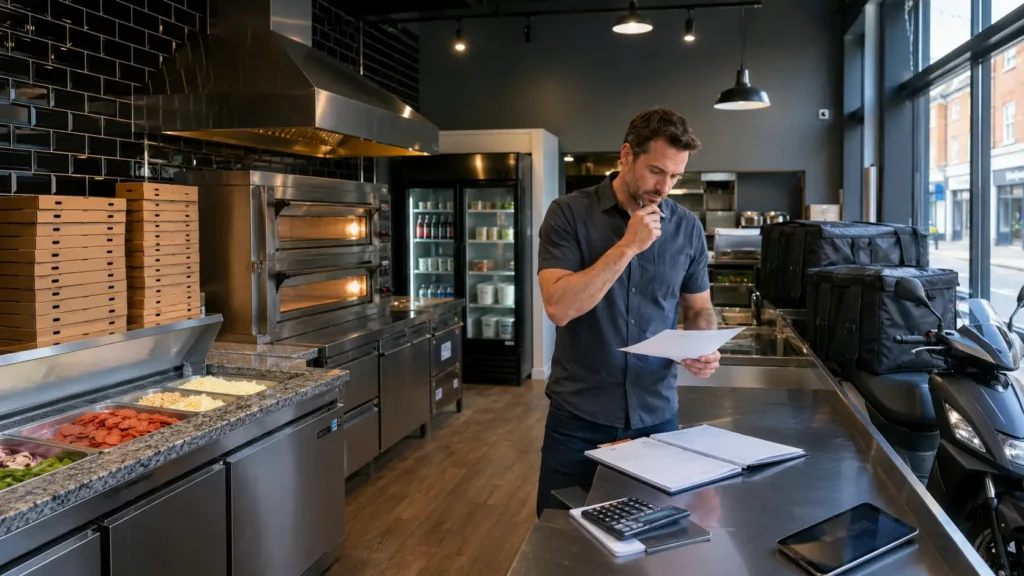
Your total investment combines the cost of joining the franchise system with the physical and operational cost of preparing a store. Each element should appear in an itemised opening budget.
The Initial Franchise And Professional Costs
Your preliminary budget should account for:
- The initial franchise fee, provisionally estimated at £25,000–£38,000.
- A specialist solicitor’s review of the franchise and property agreements.
- Accounting, financial modelling and company-structure costs.
- Finance arrangement fees, valuations and possible security costs.
- Business insurance, registrations and compliance expenses.
- A contingency reserve for costs that arise before opening.
Training and support are important parts of the franchise proposition.
The operating system includes store-management standards, food preparation, customer service, technology, marketing and supply-chain support, although your proposal should specify which related costs you must fund.
These early costs should be separated from the money allocated to premises and day-to-day trading.
How Much Could Property And Fit-Out Cost?
Domino’s states that capital spending on each project is approximately £300,000. Its property requirements for new stores also indicate that suitable premises are commonly 800–1,500 square feet, with a standard lease term of ten years and suitable takeaway planning use or the ability to obtain it.
A property budget may cover the lease deposit, advance rent, planning work, utility upgrades, leasehold improvements, extraction, signage, counters, refrigeration, pizza ovens, preparation equipment and ordering systems.
Vehicle access, customer collection space and delivery-driver parking can also affect site suitability. A prominent high-street, retail-park or neighbourhood location may support stronger visibility, but it can bring higher rent and occupancy costs.
Opening Stock, Staffing And Working Capital
Before opening, you may need to pay for food, packaging, uniforms, recruitment, staff training, wages and local promotion. You will also need cash for rent, utilities, insurance, business rates, delivery operations and loan repayments while sales are developing.
Working capital should cover several months of realistic expenditure rather than an ideal opening scenario. This reserve protects the store when recruitment costs rise, building work overruns or initial order volumes are lower than forecast.
How Much of Your Own Money Might You Need to Invest?
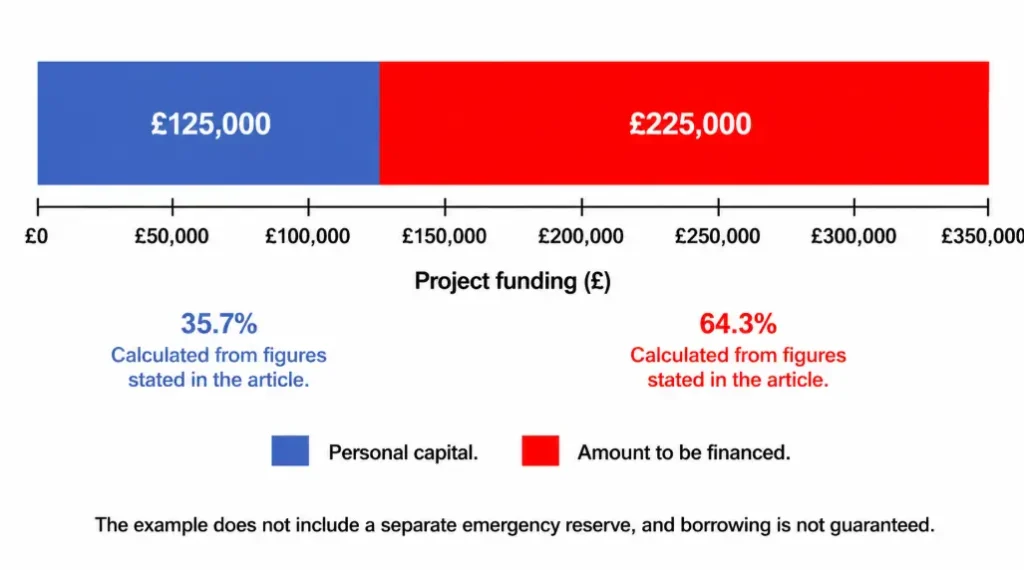
You may need approximately £120,000 to £130,000 in accessible capital, based on published UK franchise guidance. This should be viewed as a planning benchmark rather than a guarantee that the remaining project cost can be borrowed.
A lender will normally consider how much of your own money is at risk, whether you have sufficient funds left after completion and whether the store can service its debt under conservative sales assumptions.
For example, using £125,000 of personal capital on a £350,000 project would leave £225,000 to be financed. That calculation does not include any separate emergency reserve, and the lender may exclude certain professional, franchise or working-capital expenses from its facility.
You should avoid committing all your available cash to the fit-out. Retaining liquidity can help you manage delayed opening, higher wages, equipment repairs or slower-than-planned sales without immediately seeking further borrowing.
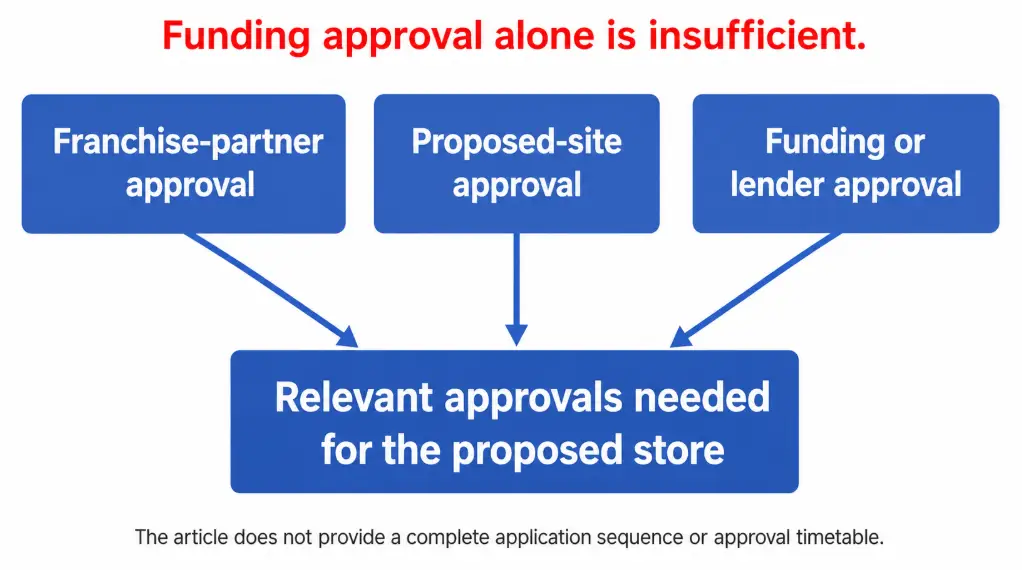
Having enough money also does not guarantee acceptance. Franchise approval, site approval and lender approval are separate decisions.
Who Can Currently Apply for a Domino’s Franchise in the UK?
Available capital alone is unlikely to make you a suitable franchise partner. Domino’s emphasises entrepreneurial drive, commitment and operational expertise when assessing people who will lead its stores.
Experience Within The Domino’s System
The UK and Ireland business holds the master franchise rights to operate and franchise stores in its territories. Its network is predominantly franchise-operated, with published UK guidance previously putting the franchise-operated share above 90%.
Domino’s looks for candidates who can manage people, maintain food and service standards and operate a fast-moving delivery business. This is therefore closer to an owner-operated opportunity than a passive investment.
Support can include operations, technology, marketing, property expertise and supply-chain services. The infrastructure has also expanded beyond the four supply-chain centres described in older material: the company reported opening its fifth centre during the first half of 2026.
Is The Homegrown Heroes Programme Open?

The current franchise entry programme is designed to help entrepreneurial current and former team members who have already demonstrated their ability within the system.
Applications are presently paused while the existing applicant pipeline is processed. The programme has produced five franchise partners according to the current programme page, so you should check its status before developing a full funding application.
Previous experience can reduce operational uncertainty, but it does not remove the need for capital, due diligence or a commercially viable location.
What Ongoing Fees And Operating Costs Will You Pay?
After opening, you must pay both franchise-system charges and ordinary store expenses. These costs directly influence operating profit and the amount available for debt repayment.
| Ongoing Cost | Current Position | Financial Effect |
| Royalty fee | Percentage set through the franchise arrangement | Reduces revenue retained by the store |
| National Advertising Fund | 4% of system sales | Funds national brand and promotional activity |
| eCommerce fund | Set to 1% of system sales from 1 July 2025, subject to the stated milestone | Supports digital ordering and platform costs |
| Local marketing | Variable recommended expenditure | Supports demand within your territory |
| Food and packaging | Variable with sales and product mix | Major cost of sales |
| Rent and business rates | Determined by the property | Fixed occupancy commitment |
| Wages and employer costs | Dependent on staffing and opening hours | Major controllable operating expense |
| Delivery and utilities | Dependent on volume and efficiency | Affects contribution per order |
| Loan repayments | Determined by your finance structure | Reduces monthly cash flow |
Domino’s says royalty income is reinvested in customer-facing digital platforms, while franchise partners also contribute to central marketing. The five-year framework continues the 4% advertising contribution and introduced the higher digital contribution.
You should model these costs as percentages or monthly commitments rather than treating them as occasional expenses. A store with strong sales can still face cash-flow pressure when labour, rent and borrowing costs are high.
How Can You Finance a Domino’s Franchise in the UK?
A suitable funding package may combine personal capital with business lending and asset-based finance. The appropriate structure depends on your experience, security, credit position and the financial strength of the proposed territory.
Possible Funding Routes
- Use personal savings or proceeds from existing business interests as your equity contribution.
- Apply for specialist franchise finance or a conventional business loan.
- Use asset finance for eligible ovens, refrigeration or other equipment.
- Bring in a business partner who contributes capital and operational capability.
- Consider an approved resale with established trading records rather than a new opening.
- Keep a separate contingency reserve outside the core fit-out budget.
A lender is likely to examine your business plan, personal contribution, credit history, management experience, property proposal and cash-flow forecasts. It may also request security or a personal guarantee.
Your forecast should test a weaker trading case in which orders are lower, wages are higher and the store opens later than planned. It should still show whether rent, franchise charges, tax obligations and debt repayments can be met.
Funding approval should only be treated as one stage of the process. You will still need approval as a franchise partner and approval for the proposed site.
Could A Domino’s Franchise Be Profitable After Fees And Finance Costs?

A Domino’s franchise could produce a profit, but the brand, store count and national sales figures cannot establish what your individual business will earn. Your result will depend on local revenue, controllable costs and the amount of debt used to fund the store.
What Drives Store-Level Revenue?
Revenue is influenced by the number of delivery addresses in the territory, population density, local competition, store visibility, opening hours, customer retention, order frequency and average order value.
Delivery speed and collection demand also matter. During the first half of 2026, the wider system reported like-for-like sales growth of 4.9%, order growth of 1.6% and delivery times below 25 minutes. Those figures indicate network performance, not a guaranteed result for a new franchise.
The Costs That Reduce Your Margin
Your store must absorb food, packaging, payroll, employer costs, rent, rates, energy, delivery expenses, royalties, advertising contributions, technology funding and loan repayments.
Operational standards also require continued attention to training, food safety, cleanliness, service and equipment maintenance. Cutting these areas to protect short-term margin can damage customer satisfaction and compliance.
Multi-store operators may spread management and administrative costs across several locations, while a new single-store owner has less room to absorb disruption.
Why Group Results Do Not Predict Your Profit
The network reached its 1,400th store and generated £825.3 million in system sales during the first half of 2026. Group revenue was £353.6 million, but system sales include customer spending across franchised and corporate stores rather than the take-home income of individual owners.
The five-year franchise growth framework aligns investment in marketing, digital systems and store development.
It also includes £100,000 incentives for qualifying virgin territories and £150,000 for qualifying split territories, paid over five years under the framework; eligibility should be confirmed for your proposed location.
In an official August 2026 statement, chief executive Nicola Frampton said: “We will continue to invest in the business to support our growth and franchise partner profitability.” That commitment supports the wider system, but it is not a promise of profit for each store.
Is A Domino’s Franchise Worth The Cost For You?
A Domino’s franchise may be worth considering when you have relevant operational experience, sufficient capital and the ability to manage a demanding food-delivery business. It is less suitable when your plan depends on passive ownership, maximum borrowing or optimistic sales forecasts.
Your Final Decision Test
- Confirm that a franchise entry route is available to you.
- Obtain a current, itemised investment schedule in writing.
- Verify the exact franchise fee, royalty rate and agreement term.
- Review the territory and premises with appropriate specialists.
- Model wages, food costs, rent and debt under a weaker-sales scenario.
- Speak to existing franchise partners about workload and ongoing costs.
- Retain enough cash for delays, repairs and early trading.
- Review renewal, resale, default and exit provisions before signing.
The Domino’s franchise cost in the UK should therefore be assessed as a complete business commitment, not simply a £25,000–£38,000 franchise fee. A sensible starting budget is £280,000–£500,000, supported by adequate personal capital and a conservative finance plan.
Frequently Asked Questions
Is VAT Included In Domino’s Franchise Cost Estimates?
VAT treatment can differ between property work, professional fees, equipment and franchise-related charges. Request a breakdown showing both VAT-exclusive and VAT-inclusive cash requirements before arranging finance.
Can You Buy An Existing Domino’s Franchise?
An approved resale may allow you to acquire an operating store rather than develop one from the beginning. You will still need franchisor approval and due diligence covering valuation, accounts, equipment, employees, debt and lease obligations.
Does Domino’s Help You Find Suitable Premises?
Domino’s says it works with potential franchise partners to select a location that supports both parties’ prospects. Its property team assesses matters such as visibility, configuration, planning use, access and parking.
How Long Could Opening A Domino’s Store Take?
The timetable depends on candidate assessment, finance, site selection, planning, lease negotiations, construction, training and recruitment. A delayed property or planning process can extend the opening date and increase your working-capital requirement.
Can You Own More Than One Domino’s Franchise?
Multiple-store ownership may be possible for approved operators with sufficient management capacity and capital. Each additional store creates new staffing, property, finance and operational obligations.
Are Training And Opening Stock Included In The Investment?
Some broad investment estimates include training, initial stock and working capital, but the precise inclusions can vary. Your written cost schedule should state who pays for travel, accommodation, wages during training and opening inventory.
Which Advisers Should You Use Before Signing?
A specialist franchise solicitor can review the franchise agreement, while an accountant can test projections and tax treatment. A commercial property adviser and finance specialist can assess the lease, valuation, security and borrowing structure.
Note
The £280,000–£500,000 total investment, £120,000–£130,000 liquid-capital requirement and £25,000–£38,000 franchise-fee range are planning estimates drawn from UK franchise guidance.
The approximately £300,000 figure published in current property information refers to capital spending on each project and should not be treated as a universal franchise fee, personal investment requirement or guaranteed final cost.
Obtain a current written breakdown before committing funds, signing a lease or entering a finance agreement.

Blogger | Business Writer | Sharing startup advice on UK business blogs
Related Articles in Startup
View All →
Meet the Startup Turning Screen Time Into a New Way to Make Money
Britain does not exactly have a shortage of side hustles. You can deliver takeaways, sell clothes online, start freelancing, walk dogs, tutor in the evenings or attempt to…

8 Best Coworking Spaces for Bootstrapped London Startups to Launch and Scale in 2026
Bootstrapped founders don’t have the luxury of a fitted-out HQ from day one. What you need is a London coworking space that flexes with you: a hot desk…