
How To Set Up An Etsy Shop UK In 2026: Step-By-Step Guide


UK Startup Blog Archive
Table of Contents
Selling on Etsy in 2026 is less about simply opening a shop and more about getting the basics right before the first listing goes live.
UK sellers need to know what they are allowed to sell, how Etsy charges work, what information is required for verification and whether their activity creates tax or record-keeping responsibilities.
A well-prepared shop should have more than attractive products. Pricing needs to cover materials, labour, packaging, delivery and Etsy fees, while listings need clear photos, accurate product details and realistic dispatch times.
For anyone starting from scratch, it helps to prepare these essentials first:
- Products Ready To Sell: Including prices, variations and stock information
- Clear Product Photos: Showing the item accurately from useful angles
- Bank And Billing Details: Needed for payments and Etsy charges
- Identification: Required as part of Etsy’s seller verification process
- Delivery Costs: Including packaging, postage and processing time
- Basic Shop Policies: Covering cancellations, returns and delivery
- Profit Calculations: So Etsy fees do not unexpectedly remove most of the margin
Getting these details organised before opening the shop can make setup quicker and reduce common problems after the first few orders.
Last Updated: 19.09.2026
What Do You Need To Open An Etsy Shop?
Preparing everything before beginning the onboarding process can make setting up an Etsy shop much easier.
You will typically need:
- An Etsy Account: Create an account using an email address and your personal information
- A Shop Name: Choose a distinctive name that represents the products or brand
- Products To Sell: Prepare at least one eligible product before opening the shop
- Product Photos: Use clear images showing the product accurately
- Product Information: Have prices, materials, sizes, variations and descriptions ready
- Bank Details: Etsy needs payment information so it can deposit money from sales
- Billing Details: A suitable payment card may be required for Etsy charges
- Photo Identification: New sellers may be required to provide government-issued identification
- Delivery Information: Decide where you will deliver and how much customers will pay
- Shop Policies: Consider returns, exchanges, cancellations and processing times
Etsy requires sellers in the UK to verify their identity as part of opening a shop. Verification may involve providing government-issued photo identification and completing Etsy’s verification process.
It is therefore worth making sure that your name, address, bank details and identification documents are accurate and consistent before starting.
How Much Does It Cost To Set Up An Etsy Shop In 2026?
Opening an Etsy business does not involve the same upfront costs as opening a physical shop, but selling on the platform is not free.
Etsy currently states that a one-time, non-refundable shop set-up fee may apply. The amount varies depending on location and, where applicable, is displayed during the shop-opening process.
Sellers should also account for several charges once listings and sales begin.
| Etsy Cost | How It Works |
| Shop Set-Up Fee | A one-time fee may apply and is shown during setup |
| Listing Fee | $0.20 per listing, converted into the seller’s payment-account currency |
| Transaction Fee | 6.5% of the total order amount |
| UK Payment Processing | 4% + £0.20 per transaction |
| UK Regulatory Operating Fee | 0.48% of the relevant order amount |
| Currency Conversion | 2.5% where Etsy currency conversion is required |
| Advertising | Additional charges may apply when Etsy Ads or Offsite Ads generate sales |
The listing fee is set in US dollars, so the exact amount shown in pounds can change with currency conversion.
Etsy’s current fee guidance confirms the 6.5% transaction charge and explains that separate payment-processing and regulatory fees can also apply.
For example, imagine a seller charges £25 for an item and £3 for delivery.
The order value is £28. A 6.5% transaction fee would be approximately £1.82, while the UK payment-processing charge would be approximately £1.32. The 0.48% regulatory operating fee would add about £0.13.
Once the listing fee is included, the seller could lose around £3.40 of the £28 order to these basic Etsy charges before considering VAT on applicable seller fees, advertising, materials, packaging, postage and tax.
That is why Etsy sellers should calculate their full costs rather than deciding prices based only on what competing shops charge.
How To Set Up An Etsy Shop UK Step By Step?
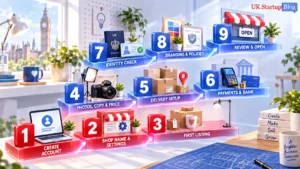
Setting up the shop itself is relatively straightforward once the products and business information are ready.
1. Create An Etsy Account
Create or sign in to an Etsy account and access the option to start selling.
Use an email address that you check regularly because Etsy may send account, order, payment and verification notifications there.
2. Choose Your Shop Name And Preferences
Select the shop language, location and currency.
For most UK sellers targeting domestic customers, GBP will usually be the most straightforward currency because it reduces confusion when setting prices and reviewing revenue.
Choose a shop name that is:
- Easy To Remember: Avoid unnecessarily complicated spelling
- Relevant: A name connected to the products or brand can help customers understand the shop
- Flexible: Avoid a name that becomes restrictive if the product range expands
- Distinctive: Check that it is not easily confused with another business
- Brandable: Consider whether the name could also work on packaging and social media
Also check whether the name could create trademark problems before investing heavily in branding.
3. Create Your First Product Listing
Etsy requires sellers to add product information before the shop can launch.
A strong listing should clearly explain exactly what customers are purchasing.
Include information such as:
- Product Type
- Materials
- Dimensions
- Colours
- Available Variations
- Personalisation Options
- Production Time
- Quantity
- Care Instructions Where Relevant
Avoid vague descriptions. Customers should not need to message the shop simply to find basic product information.
4. Add Product Photos, Descriptions And Pricing
Good product photography can have a direct impact on whether someone opens a listing or continues scrolling.
Photograph products in natural light where possible and show different angles, important details, scale and available variations.
The description should answer practical buyer questions while naturally incorporating relevant search terms.
Pricing should cover more than materials.
A useful starting formula is:
Materials + Labour + Packaging + Delivery Costs + Etsy Fees + Other Business Costs + Desired Profit = Selling Price
For example, a handmade product that costs £8 in materials should not automatically be sold for £12. Once labour, packaging and marketplace fees are included, the seller may make very little profit.
5. Set Up Delivery
Choose the locations you are prepared to deliver to and calculate realistic postage costs.
When establishing processing and delivery times, consider:
- Time Needed To Make The Product
- Packaging Time
- Courier Or Royal Mail Collection
- Tracking Costs
- International Customs Delays
- Busy Seasonal Periods
Avoid promising dispatch times that are difficult to maintain. A slightly longer but reliable processing window is better than repeatedly sending orders late.
International selling can expand the potential audience, but it can also introduce customs forms, duties, longer delivery times and different consumer requirements.
New sellers may therefore find it easier to establish a reliable UK fulfilment process before expanding to several overseas markets.
6. Set Up Etsy Payments And Bank Details
Etsy Payments allows eligible sellers to receive customer payments through methods supported by Etsy.
Enter the requested personal and bank information carefully.
Using separate financial records for the Etsy business can also make it easier to understand revenue, fees, expenses and profit, even where a separate business bank account is not legally required for the seller’s particular structure.
7. Complete Identity Verification
Identity verification is an important part of opening an Etsy shop.
Etsy uses an identity-verification provider and may ask new sellers to submit government-issued photo identification as part of onboarding. Sellers should make sure their submitted information is accurate and that photos of documents are clear.
Details that do not match can delay verification and prevent the shop from opening successfully.
8. Add Shop Branding And Policies
The shop should look complete before customers begin arriving.
Add appropriate branding, an About section and clear shop policies.
Policies should cover relevant areas such as:
- Processing Times
- Delivery
- Returns
- Exchanges
- Cancellations
- Personalised Orders
- Customer Contact
Simple, accurate policies are more useful than lengthy terms customers struggle to understand.
9. Review And Open Your Shop
Before publishing, view the shop as if you were a customer.
Check product photos, spelling, prices, delivery charges, processing times, variations and descriptions.
Also test whether the shop makes basic questions easy to answer:
What am I buying? How much does it cost? When will it arrive? Can I return it? Who made or designed it?
If these answers are clear, the shop is in a stronger position to convert visitors into customers.
What Can You Sell On Etsy UK?
Etsy is primarily designed around creative and distinctive products rather than unrestricted resale.
Its current Creativity Standards organise eligible products around items that are made, designed, handpicked or sourced by sellers.
Examples can include:
- Handmade Jewellery
- Artwork
- Home Decorations
- Personalised Gifts
- Original Digital Downloads
- Wedding Products
- Clothing And Accessories
- Craft Supplies
- Party Supplies
- Vintage Products Meeting Etsy’s Requirements
- Original Designs Produced By Approved Production Partners
Mass-produced products cannot simply be resold as handmade goods.
Print-on-demand can be permitted when the seller creates the original design and uses a production partner to manufacture or print the product. Sellers using production partners should accurately disclose their involvement.
Digital products must also comply with Etsy’s rules. Sellers cannot simply collect somebody else’s work and sell it as their own digital product.
Understanding these rules before choosing stock can prevent considerable problems later, including listing removal.
Etsy Fees And Pricing Your Products
Underpricing is one of the easiest mistakes for a new Etsy seller to make.
A seller might see similar products listed for £20 and assume that £20 must also be the right price for their product. However, two businesses can have completely different material, labour, packaging and delivery costs.
Start by calculating the true cost of fulfilling one order.
For example:
| Cost | Example |
| Materials | £7.00 |
| Packaging | £1.20 |
| Postage | £3.00 |
| Labour | £6.00 |
| Etsy And Payment Fees | £3.00 |
| Total Approximate Cost | £20.20 |
| Selling Price | £28.00 |
| Approximate Margin Before Tax And Other Costs | £7.80 |
The figures will vary significantly between products, but the example demonstrates why revenue should not be confused with profit.
Sellers should periodically recalculate prices when postage, materials or marketplace fees change.
Discounts also need careful consideration. A 20% promotion sounds attractive, but it can quickly remove most of the profit from a product that already has a narrow margin.
Do You Need To Register As Self-Employed To Sell On Etsy?
Opening an Etsy account does not automatically determine someone’s tax status.
The important question is whether the activity amounts to trading.
Someone occasionally selling old possessions from home is in a different position from somebody regularly making or buying goods with the intention of selling them for profit.
For individuals carrying on a trade, the UK’s trading allowance can provide up to £1,000 of gross trading income per tax year.
HMRC states that people with annual gross trading income above £1,000 generally need to tell HMRC and register for Self Assessment, subject to the relevant rules and circumstances.
Importantly, the £1,000 figure relates to gross trading income, not profit after expenses.
A seller earning £1,500 in Etsy sales but spending £900 producing those products should therefore not simply assume that the business falls below the £1,000 threshold because only £600 remains.
Etsy And The £1,000 Trading Allowance
Eligible individuals can generally choose between using the trading allowance or claiming allowable business expenses where the rules permit.
For a small Etsy operation with very low costs, the allowance may be straightforward. A business with significant materials, equipment and other expenses may find that deducting actual allowable expenses produces a different result.
Keeping records from the beginning makes these decisions much easier.
Useful records include sales, refunds, Etsy fees, advertising costs, materials, packaging, postage and other qualifying business expenses.
Does Etsy Report Sellers To HMRC?
UK digital-platform reporting rules allow marketplace operators to collect information about sellers and report relevant seller and income information to HMRC.
However, being included in a platform report does not automatically mean that tax is due.
HMRC distinguishes between reporting rules and the separate rules that determine whether someone’s activities are taxable. For example, selling unwanted personal possessions is different from deliberately making or acquiring products to sell for profit.
Etsy sellers should therefore keep their own accurate business records rather than relying solely on marketplace reports.
How To Get Your Etsy Shop Found?
Opening a shop does not guarantee customers will discover it.
Etsy search examines multiple pieces of listing information when deciding which products are relevant to a shopper. Sellers therefore need to optimise the entire listing rather than repeatedly placing the same keyword in the title.
Start with specific search phrases that describe what the product actually is.
Instead of targeting an extremely broad phrase such as necklace, a seller could use more specific language reflecting the material, style, recipient or occasion where appropriate.
Etsy currently allows sellers to add up to 13 tags to a listing. Those tags are opportunities to target different relevant phrases rather than repeating virtually identical words.
Strong Etsy optimisation includes:
- Accurate Categories: Select the most specific suitable product category
- Relevant Attributes: Complete colour, material, occasion and other applicable attributes
- Useful Titles: Clearly describe the product rather than filling the title with disconnected keywords
- Relevant Tags: Use the available tags for meaningful search phrases
- Clear Descriptions: Explain the product naturally while including useful terminology
- Strong First Images: Make the main photo easy to understand in search results
- Competitive Listings: Review how price, delivery and presentation compare within the niche
- Shop Stats: Identify search terms and listings already generating traffic
Etsy itself says its search system considers information across the listing, including titles, tags, attributes, descriptions, the first photo, reviews and other signals.
Search optimisation should also continue after launch. If one listing gets impressions but few clicks, the photograph or title may be weak.
If it attracts clicks but few purchases, pricing, delivery cost, product information or customer confidence may be the bigger problem.
Etsy Delivery, Returns And UK Consumer Rules
An Etsy seller operating as a business must consider consumer rights as well as Etsy’s marketplace policies.
For many online purchases, consumers have cancellation rights because the sale is made at a distance.
Under UK distance-selling rules, consumers generally have a 14-day period in which to notify a business that they want to cancel qualifying orders. Exceptions can apply, including certain genuinely personalised or made-to-specification products.
Business Companion guidance also explains that online marketplace traders need to give consumers important information before the contract is made, including information concerning the product, price and applicable cancellation rights.
Sellers should therefore avoid assuming that writing no returns in an Etsy policy removes statutory consumer rights.
Digital products also need particular attention because different requirements can apply to downloads and the point at which customers consent to receiving digital content.
Make shop policies clear enough for customers to understand what applies to standard items, personalised products and digital products.
What Happens After Your First Etsy Sale?

The first order is where the Etsy shop changes from a setup project into an operating business.
When an order arrives, first confirm the order and payment status before starting fulfilment.
Then:
- Check The Product, Variation And Personalisation Details
- Prepare Or Produce The Item
- Package It Safely
- Purchase Or Arrange The Appropriate Postage
- Dispatch Within The Promised Processing Period
- Add Tracking Information Where Available And Appropriate
- Keep Records Of The Sale, Costs And Etsy Fees
- Respond Promptly If The Customer Has A Question
- Review Whether The Order Was Actually Profitable
- Use Early Customer Feedback To Improve Future Listings
Pay particular attention to the true time required to fulfil the order.
A handmade product may appear profitable when only material costs are considered, but spending two hours producing and packing an item dramatically changes its economics.
The first few orders can provide useful data about packaging costs, production time and customer questions. Use that information to improve descriptions, pricing and processing times rather than leaving listings unchanged.
Is Starting An Etsy Shop Worth It In 2026?
Etsy can still provide a practical route into ecommerce for UK makers, designers and creative businesses because much of the marketplace infrastructure is already provided.
Sellers do not need to build checkout technology, payment processing and a marketplace audience from the ground up.
That convenience comes at a cost.
Listing, transaction, payment-processing, regulatory and potentially advertising fees can take a noticeable percentage of each order. Competition can also be high in popular categories.
An Etsy shop is therefore most likely to make commercial sense when the seller has:
- A Distinctive Product
- Enough Margin To Absorb Platform Fees
- Reliable Production And Delivery
- Strong Product Photography
- Clear Branding
- Demand For The Product
- Realistic Pricing
- A Willingness To Test And Improve Listings
Etsy can also work as a relatively low-risk way to test demand before investing heavily in a larger ecommerce operation.
The key is to treat the shop as a business rather than simply uploading products and hoping customers find them.
Conclusion
Learning how to set up an Etsy shop UK sellers can build into a sustainable business involves more than completing Etsy’s registration process.
Prepare the products, calculate realistic prices, understand marketplace fees, complete seller verification and create listings that make purchasing straightforward.
UK sellers should also understand when their activity becomes a trade, keep accurate financial records and follow applicable consumer rules.
Once the shop is live, use actual sales and search data to improve products, photographs, pricing, keywords and delivery rather than trying to perfect everything before launching.
A well-researched product, sensible profit margin and strong customer experience will usually matter more than simply having a large number of Etsy listings.
FAQs
How Much Does It Cost To Open An Etsy Shop UK?
Etsy may charge a one-time shop set-up fee, with the applicable amount shown during onboarding. Sellers should also budget for listing, transaction, payment-processing, regulatory and any optional advertising fees.
Do I Need To Register A Business To Sell On Etsy UK?
You do not need to form a limited company simply to open an Etsy shop. However, sellers carrying on a trade may have HMRC registration and tax responsibilities depending on their income and circumstances.
Does Etsy Report Income To HMRC?
Digital marketplaces can be required to collect and report qualifying seller information to HMRC. Being reported does not automatically mean tax is due because tax liability depends on the seller’s actual circumstances and trading activity.
How Much Can I Earn On Etsy Before Paying Tax?
The UK trading allowance can cover up to £1,000 of qualifying gross trading income a year, but this should not be confused with profit or the Personal Allowance. Different tax rules can apply once a seller begins trading.
Can I Sell Print-On-Demand Products On Etsy?
Etsy allows qualifying products based on a seller’s original designs to be produced by production partners. Sellers must follow Etsy’s Creativity Standards and disclose production partners where required.
Do I Need A Business Bank Account For Etsy?
A sole trader does not necessarily need a separate business bank account solely because they sell through Etsy, although keeping business and personal transactions separate can make accounting and record keeping easier.
How Long Does It Take To Set Up An Etsy Shop?
A basic shop can be created relatively quickly when the seller already has identification, bank information, product photographs, descriptions, prices and delivery details prepared. Verification or incomplete information can make the process take longer.

Expert Blogger | Strategic thinker anticipating future directions for UK business
Related Articles in Business
View All →
Shell Petrol Station Franchise Cost in the UK: Real Investment, Income and Process
If you are searching for the Shell petrol pump franchise cost in the UK, the first thing to understand is that Shell does not currently advertise its UK…

Is Raising Cane’s Opening in the UK? | London Locations Revealed
Yes, Raising Cane’s is officially coming to the UK. The American chicken restaurant brand plans to open its first UK restaurant at 22 Coventry Street in London’s West…
Best Parking App UK: 10 Startup-Led Parking Apps Compared for 2026
For most drivers, JustPark is the best parking app UK users can consider in 2026 because it combines parking search, advance booking and app-based payments in one platform.…