

The Starbucks franchise cost in the UK cannot be expressed as one officially confirmed price. Starbucks primarily expands through selected licensed partners rather than selling a conventional single-store franchise with a published fee schedule.
You should expect a substantial financial commitment.
A figure of at least £500,000 is widely used as an initial capital benchmark, while a complete store project may cost £500,000 to £700,000 or more, depending on the property, format, construction work and opening capital required.
These figures are useful for early planning, but they are not a formal quotation or guarantee of acceptance.
Last Updated: 10.08.2026
Can You Buy A Traditional Starbucks Franchise In The UK?

You cannot normally purchase a conventional Starbucks franchise in the same way that you might buy a publicly advertised food or coffee-shop franchise. The UK estate combines company-operated locations with stores managed by selected licensed partners.
Under a conventional franchise arrangement, you would usually pay an initial fee and ongoing royalties in exchange for the right to operate an established business format.
The franchisor would normally publish an investment range, applicant criteria and an application process.
A licensed partnership can be more selective and commercially negotiated. It may involve an established retail, hospitality or property operator introducing Starbucks into a suitable market, venue or regional portfolio.
This distinction affects the Starbucks franchise cost because there may be no universally advertised:
- Initial franchise fee.
- Exclusive territory price.
- Standard royalty percentage.
- Single-store startup package.
- Guaranteed individual application route.
You should therefore approach the opportunity as a substantial business-to-business partnership rather than an off-the-shelf franchise purchase.
What Changed In Starbucks’ UK Licence Model In 2026?
The 2026 changes provide important context for anyone researching costs or eligibility. They indicate that future UK growth will continue to depend heavily on licensed partners, but with greater regional coordination.
The New Regional Licensee Model
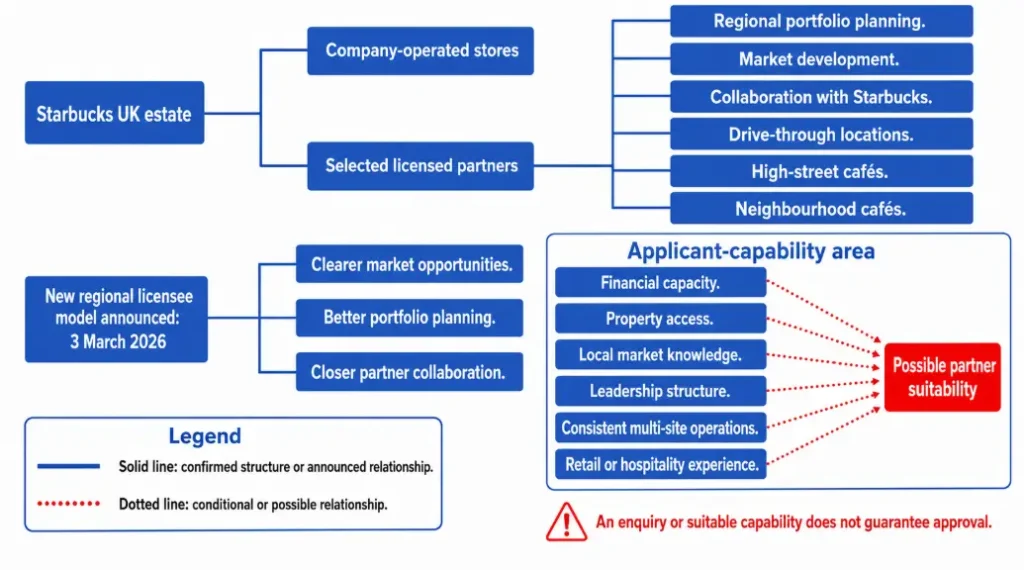
On 3 March 2026, the company announced a new UK licensee model intended to create clearer market opportunities, better portfolio planning and closer collaboration with operating partners.
The model focuses on opening appropriate store formats in suitable places, including drive-through locations, high streets and neighbourhood cafés. It also suggests that regional development capability may be more valuable than an applicant’s desire to operate only one shop.
Darren King, UK Store Development Director, said: “Our licensed business is absolutely critical to our growth.” He described the revised approach as one based on clarity, transparency and mutually beneficial growth.
Why Does The New Model Matter To You?
You may need to demonstrate how your organisation can support wider regional development, not simply prove that you can finance one café. Your property access, local market knowledge, leadership structure and ability to operate consistently across locations could all influence suitability.
A commitment to open 20 stores within five years has appeared in older industry guidance.
The 2026 announcement, however, does not state that this is a universal public requirement for every future partner, so you should not build your application around that number without direct confirmation.
What Does The Estimated Starbucks Franchise Cost Include?
Your largest expenses are likely to arise from developing and preparing the premises rather than from one visible licence payment. The following figures provide a practical planning framework, but they should be tested against the property and commercial terms offered to you.
Indicative Startup Cost Breakdown
| Cost Area | Indicative Planning Amount | What It May Cover |
| Minimum capital benchmark | From £500,000 | Initial evidence of financial capacity and project funding |
| Complete store development | £500,000–£700,000+ | Property, construction, equipment, launch and reserves |
| Store fit-out | £350,000–£600,000+ | Building work, counters, seating, flooring, lighting and finishes |
| Working capital | £50,000–£100,000 | Rent, wages, stock, utilities and early trading costs |
| Licence-related payment | Around £25,000 cited externally | Use only as a provisional allowance until formally confirmed |
| Opening inventory | Site-dependent | Coffee, milk, food, syrups, cups, packaging and merchandise |
| Recruitment and training | Site-dependent | Hiring, wages, onboarding and pre-opening preparation |
| Property and professional costs | Site-dependent | Deposits, surveys, planning, solicitors and consultants |
Fit-out expenditure may include plumbing, electrical systems, drainage, counters, furniture, signage, refrigeration, ovens, grinders, espresso machines and point-of-sale technology.
A large drive-through development will usually have a different cost profile from converting an existing café unit.
You should also avoid assuming that £500,000 covers every pre-opening and property expense. A realistic budget should retain sufficient capital after construction so the store can trade through its early months without immediate cash-flow pressure.
Which Additional Costs Could Push Your Investment Higher?
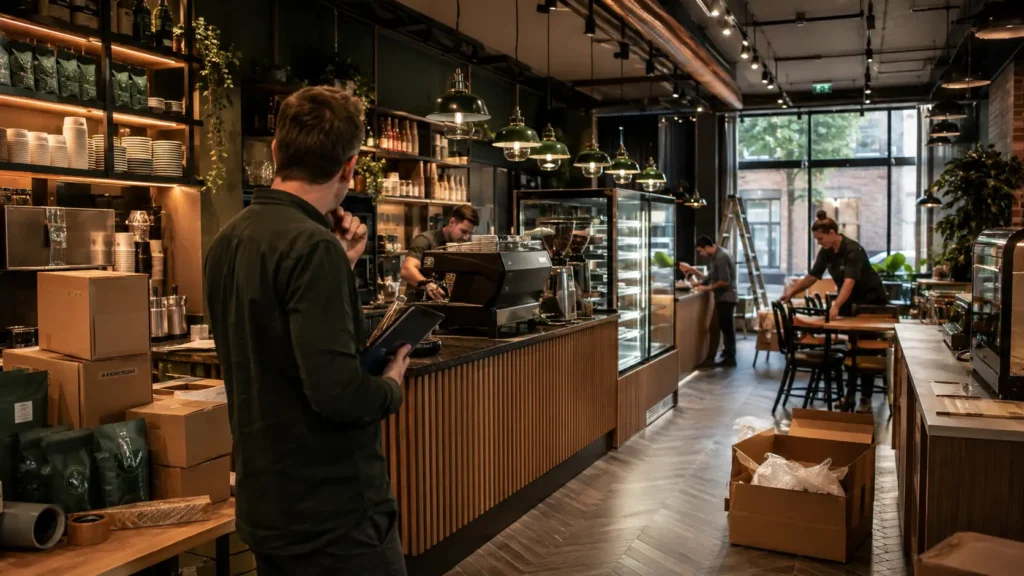
Even a carefully prepared budget can increase when property or construction issues emerge. Before committing funds, you should assess costs outside the headline investment figure.
Costs To Include In Your Forecast
- Lease deposits, premiums and advance rent.
- Business rates, service charges and building insurance.
- Planning permission and change-of-use applications.
- Structural surveys and professional design fees.
- Electrical, water, drainage and ventilation upgrades.
- Drive-through lanes, parking work and external lighting.
- Accessibility alterations and fire-safety measures.
- Furniture, security systems and digital ordering equipment.
- Recruitment, payroll and management costs before opening.
- Opening inventory, packaging and cleaning supplies.
- Construction delays and contractor price increases.
- Early months with lower-than-forecast sales.
You should prepare an expected-cost forecast alongside higher-cost, delayed-opening and lower-sales scenarios. This lets you estimate how much additional cash would be required if construction rises by 10% to 15% or the opening is delayed for several months.
A contingency reserve should be genuinely accessible rather than dependent on optimistic first-year revenue. Otherwise, an apparently affordable project can become underfunded before it reaches stable trading.
Starbucks Licence Investment & Readiness Calculator
Estimate the potential cost of developing a licensed Starbucks location, compare the requirement with available funding and assess the commercial preparation of the proposed operator.
Estimate the Investment
Enter expected costs for the proposed location.
Enter the Available Funding
Compare estimated project costs with accessible capital.
Check Commercial Readiness
Select each statement that currently applies to the business.
Early research stage
More financial, operating and location information should be prepared before making an enquiry.
Who Is Most Likely To Qualify For A Starbucks Licence?

Strong funding is important, but your ability to operate a complex customer-facing business is likely to carry equal weight. The current UK estate demonstrates that licensed operations form a major part of the company’s expansion strategy.
Financial Capacity And Proof Of Funding
You should be prepared to disclose company accounts, liabilities, available capital, existing borrowing and the source of your proposed investment.
Some published guidance refers to liquid assets of £500,000 and a net worth of £1.5 million, but the latter is not stated as a universal threshold in the current official UK material.
Commercial lenders may expect an operator to contribute approximately 30% to 50% of a high-value project from existing resources. On a £600,000 development, that would equal £180,000 to £300,000, although your lender may require a different contribution.
Which Operating Experience Matters Most?
Relevant experience may include:
- Managing multiple hospitality or retail locations.
- Recruiting, training and retaining large teams.
- Operating high-volume food and beverage sites.
- Managing stock, suppliers and food-safety compliance.
- Delivering consistent customer-service standards.
- Controlling labour, property and operating costs.
- Opening new locations to fixed design standards.
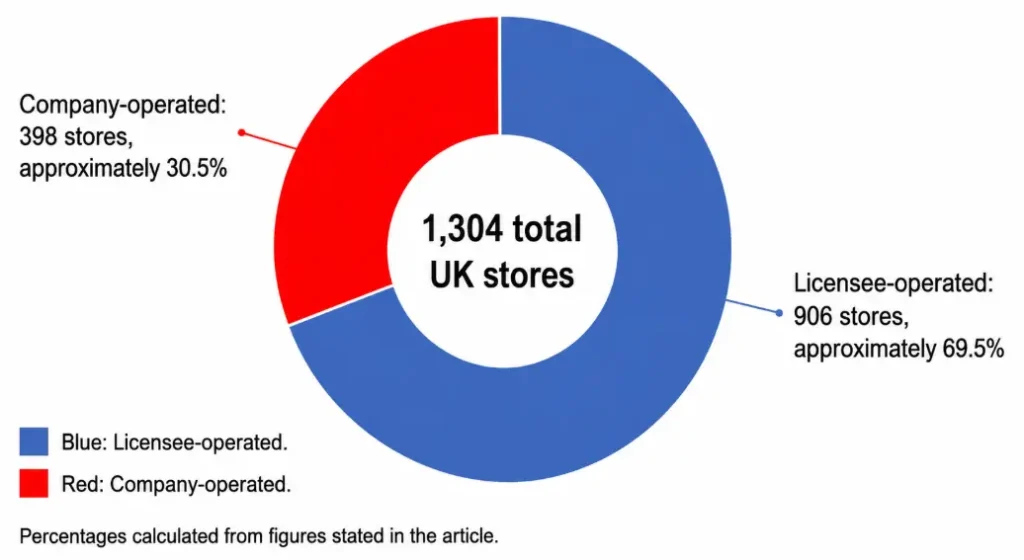
The UK estate ended FY2025 with 1,304 stores: 398 company-operated and 906 operated by licensees. These latest UK financial results show why experienced licensed operators remain central to the network.
Location And Regional Fit
Your proposal should explain why a particular area needs the proposed format. Viable settings may include high streets, retail parks, roadside developments, transport hubs, universities, hospitals, hotels and major workplaces.
Starbucks’ acquisition of its largest local licensed partner involved approximately 113 stores and 1,650 employees. The licensed partner acquisition details illustrate the scale and operating capability associated with a major UK partnership.
That does not mean every future applicant must operate at the same scale, but it demonstrates why established infrastructure and regional capability can matter.
How Can You Approach Starbucks About A UK Licence?
You should prepare a credible commercial proposition before making contact. A general request to buy one franchise is unlikely to communicate the information needed to assess a licensed partnership.
A Practical Preparation Process
- Confirm that you understand the difference between licensing and franchising.
- Establish how much capital your business can commit without weakening existing operations.
- Gather recent accounts, funding evidence and details of current liabilities.
- Document your retail, hospitality or multi-site management experience.
- Identify a region, venue or property opportunity with measurable demand.
- Prepare footfall, competition and customer-demographic research.
- Outline the proposed store format and development potential.
- Submit an enquiry through an appropriate official corporate channel.
- Complete commercial, operational and property due diligence if invited.
- Review every payment, obligation and termination clause before signing.
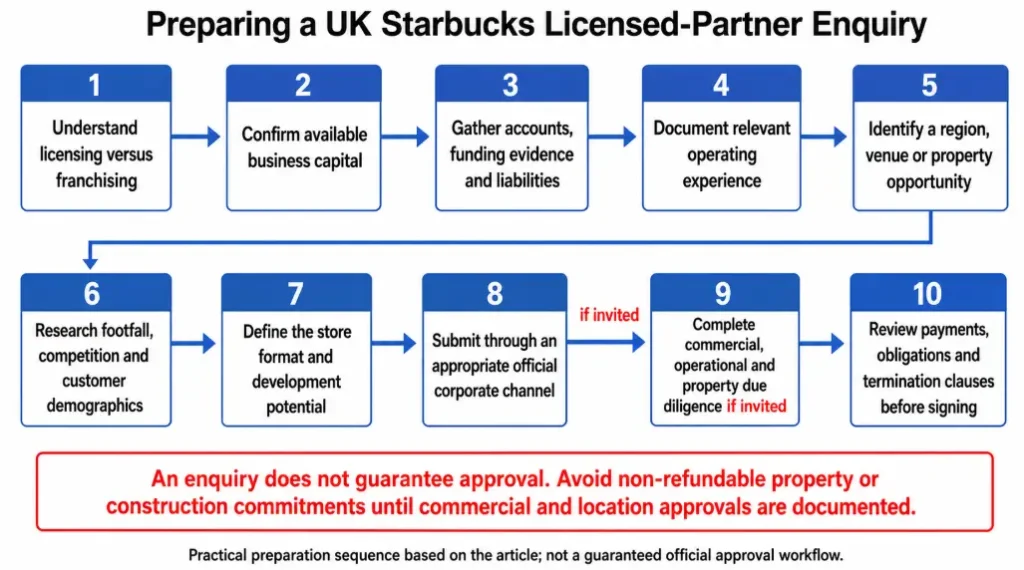
The approval process could involve preliminary assessment, management discussions, financial review, property evaluation, contract negotiation, design approval and operational preparation.
Planning consent, construction and recruitment may extend the opening timetable considerably.
An enquiry does not guarantee approval. You should avoid paying non-refundable property or construction costs until the relevant commercial and location approvals are documented.
What Financial And Commercial Risks Should You Check First?
Brand recognition can support customer demand, but it cannot eliminate rent, wage, financing, construction or commodity-price risk. Your decision should be based on expected net cash flow rather than potential sales alone.
Unpublished Fees And Contract Terms
Several precise figures circulate in business guides, but they should remain provisional until they appear in your written commercial documents.
Figures Requiring Written Confirmation
| Published Figure Or Claim | How You Should Treat It |
| £25,000 initial fee | Keep as an unconfirmed planning allowance |
| 6%–8% of gross revenue | Stress-test it, but do not assume it is the applicable royalty |
| £1.5 million minimum net worth | Do not treat it as a current universal eligibility rule |
| £400,000–£700,000 annual revenue | Do not use it as a guaranteed store forecast |
| 10%–20% profit margin | Recalculate using your actual rent, wages and agreement |
| £38,000–£42,000 owner earnings | Do not confuse generic pay data with business profit |
| £40,000 average owner salary | Exclude it from lender projections without reliable evidence |
You should request confirmation of initial payments, ongoing royalties, marketing contributions, approved suppliers, technology charges, refurbishment duties, renewal conditions, development targets and transfer restrictions.
Why Can’t Profitability Be Assumed?
The latest UK financial results reported £556.3 million in revenue alongside a £29.8 million operating loss for the company-operated UK business in FY2025. Cost of goods sold rose 10.1%, while wages and benefits increased 7.8%.
Those company-level figures are not a forecast for an individual licensed store, but they demonstrate that higher sales do not automatically create operating profit.
Your performance will depend on local turnover, rent, labour scheduling, product costs, finance charges and the commercial agreement.
Revenue estimates should therefore be converted into store-level profit-and-loss, cash-flow and break-even forecasts before you make an investment decision.
Conclusion
The Starbucks franchise cost may be worthwhile when you already operate a well-funded, professionally managed business with suitable locations and the capacity to meet strict brand standards.
It is less likely to suit a first-time café owner looking for a simple single-store franchise.
Approximately £500,000 provides a useful starting benchmark, but your total requirement may reach £700,000 or more after fit-out, equipment, property and working capital are considered.
You should also treat advertised fees, royalty percentages and earnings figures as provisional until they are confirmed in your own commercial documents.
The 2026 regional model creates a clearer growth direction, but it does not turn the opportunity into an automatically available franchise.
Your operating experience, regional proposal, funding strength and due diligence will ultimately determine whether the investment is viable.
Frequently Asked Questions
Is The £500,000 Figure Liquid Capital Or A Total Budget?
It is commonly presented as either minimum investment capacity or liquid capital, so you should not assume it covers the complete project. Your final development cost may be considerably higher.
Does Starbucks Publish A Standard UK Royalty Percentage?
No universal current UK royalty percentage is provided in the official public material reviewed. Confirm all turnover-based payments and marketing contributions in writing.
Can You Convert An Existing Café Into A Starbucks?
An existing café may reduce some construction work, but the operator, location and design would still need approval. You should not begin conversion work based only on an initial enquiry.
Can A Licence Cover Universities Or Travel Locations?
Licensed locations can operate in universities, transport settings, hospitals, hotels and other high-footfall environments. Availability depends on the property, commercial partner and relevant market opportunity.
Does Starbucks Provide Training And Opening Support?
Licensed operators can expect to follow defined product, service, store and operating standards. The length, cost and scope of training and launch support should be confirmed in the agreement.
How Long Could Store Approval And Development Take?
There is no single public timetable because property negotiations, due diligence, planning, construction and recruitment differ by project. A complex new-build or drive-through location may take longer than an approved existing unit.
What Documents Should You Prepare Before Making Contact?
Prepare company accounts, proof of funding, management profiles, operating history, property information and local market research. A clear regional or location proposal will be more useful than a general request to purchase a franchise.
Note: The £25,000 fee, 6%–8% royalty, £1.5 million net-worth threshold, £400,000–£700,000 revenue and 10%–20% margin figures are not confirmed as universal current UK terms. They should be treated as provisional estimates until the applicant receives written commercial information for a specific licensed opportunity.

Blogger | Business Writer | Sharing startup advice on UK business blogs