
How To Start A Dropshipping Business In The UK Successfully

UK Startup Blog Archive
Table of Contents
Dropshipping remains one of the most accessible ways to enter ecommerce because a seller can start selling products without buying large amounts of stock in advance.
However, building a successful dropshipping business in the UK involves much more than creating a website and finding cheap products.
Competition is stronger, customers expect faster delivery, and sellers must consider tax, VAT, consumer rights, product safety, and returns.
The businesses most likely to succeed are those that treat dropshipping as a genuine retail operation rather than a quick way to make passive income.
This guide explains how to start dropshipping in the UK, what it can cost, how profits work, and what UK businesses need to consider in 2026.
How Does The Dropshipping Business Model Work?
Dropshipping allows an online retailer to sell products without normally keeping those products in its own warehouse.
When a customer makes a purchase, the retailer forwards the order information to its supplier. The supplier then prepares and sends the product directly to the customer.
The basic process looks like this:
- A seller lists a product for £40.
- A customer purchases the product from the seller’s website.
- The seller pays the supplier, for example, £18.
- The supplier ships the product directly to the customer.
- The seller keeps what remains after product costs, advertising, payment fees and other expenses.
Although the supplier handles fulfilment, the retailer still owns the relationship with the customer. Problems with delivery, refunds, damaged goods or misleading product descriptions cannot simply be passed on to the supplier.
That distinction is important when building a sustainable dropshipping business.
Is Dropshipping Still Profitable In The UK?
Dropshipping can still be profitable in the UK, but the business model is considerably more competitive than it once was.
A store selling identical products that customers can easily find cheaper elsewhere may struggle. Long overseas delivery times and low-quality products can also make it difficult to generate repeat customers.
Profitability normally improves when a business has:
- A Clearly Defined Niche: Focusing on a particular type of customer can make marketing more effective.
- Reliable Suppliers: Consistent product quality and delivery reduce refunds and complaints.
- Healthy Margins: The difference between the selling price and total cost must be large enough to absorb advertising and operating expenses.
- Strong Branding: Customers need a reason to buy from the store rather than going directly to a marketplace.
- Efficient Marketing: High customer acquisition costs can quickly eliminate product margins.
Dropshipping should therefore be evaluated through actual numbers rather than sales revenue alone.
A store generating £20,000 in monthly sales is not automatically successful if £19,500 is being spent on products, shipping, advertising, payment processing, returns and software.
How Much Does It Cost To Start Dropshipping?
Dropshipping generally requires less initial capital than a traditional retail business because large quantities of inventory do not need to be purchased upfront.
However, starting with absolutely no money is rarely realistic.
| Expense | Possible Starting Cost |
| Domain Name | £10–£30 |
| Ecommerce Platform | £20–£80 Per Month |
| Product Samples | £50–£200 |
| Apps And Software | £0–£100+ Per Month |
| Branding And Design | £0–£300+ |
| Initial Advertising | £100–£1,000+ |
| Accounting And Administration | Varies |
| Refund And Chargeback Reserve | Varies |
A very lean business may be tested with a few hundred pounds, particularly when the owner creates the website and marketing content independently.
A more serious launch with product testing, professional branding and paid advertising may require £1,000 or more.
The biggest mistake is concentrating only on website costs. Customer acquisition often becomes one of the largest expenses once the store begins operating.
How To Start Dropshipping In The UK Step By Step?
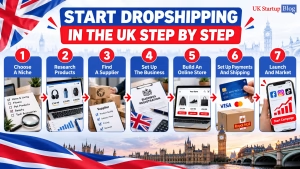
A structured launch makes it easier to identify problems before significant money is spent on advertising.
1. Choose A Profitable Niche
A niche should have genuine customer demand while providing enough room to differentiate the business.
Instead of selecting products purely because they are trending, consider whether customers have a clear reason to purchase them.
Useful factors include:
- Customer Demand: Look for products solving an identifiable problem or satisfying a clear interest.
- Competition: Strong competition can prove that demand exists, but excessive competition can make advertising expensive.
- Margins: Very cheap products may leave too little money after marketing and delivery costs.
- Repeat Purchases: Products customers buy repeatedly can improve long-term profitability.
- Shipping Practicality: Small and lightweight products are generally easier and cheaper to fulfil.
A focused niche can also make SEO, social media marketing and branding easier.
2. Research Products And Customer Demand
A good niche does not automatically make every product within it commercially viable.
Study customer reviews, competitor pricing, search behaviour and social media discussions to identify what customers actually want and what they dislike about existing options.
Avoid relying entirely on a product appearing in a viral video. By the time a product becomes widely promoted as a “winning product”, dozens or hundreds of competing stores may already be selling it.
Look instead for products with sustainable demand and opportunities to offer better presentation, delivery or customer service.
3. Find Reliable Dropshipping Suppliers
Supplier quality can determine whether the business succeeds or fails.
Before committing to a supplier, check:
- Product Quality: Order samples before selling the product.
- Delivery Times: Test how long an actual order takes to arrive.
- Tracking: Make sure customers receive useful tracking information.
- Packaging: Check whether supplier branding or invoices appear inside the parcel.
- Returns: Establish where returned products will be sent.
- Stock Updates: Make sure unavailable products are not continuously sold.
- Communication: Test how quickly the supplier responds when something goes wrong.
Having a backup supplier for important products can also reduce disruption if the main supplier suddenly runs out of stock.
4. Choose A Business Structure
Many small UK dropshipping businesses begin as sole traders, while others operate through limited companies.
A sole trader is generally simpler to establish and administer. A limited company is legally separate from its owners and has additional accounting, Companies House, and reporting responsibilities.
A person operating as a sole trader must register for Self Assessment when required. HMRC currently states that registration as a sole trader is required where self-employed earnings exceed £1,000 in a tax year. Limited companies must be registered with Companies House.
The right structure depends on factors including expected profit, risk, administration and plans for growth.
5. Build Your Online Store
The website should make it easy for customers to understand the product and complete a purchase.
Common ecommerce options include hosted platforms and self-managed ecommerce websites.
Whatever platform is chosen, the store should include:
- Clear Product Descriptions
- Accurate Product Images
- Visible Delivery Information
- Secure Payment Options
- Contact Details
- Returns And Refund Information
- Privacy Information
- Mobile-Friendly Checkout
Avoid copying poor supplier descriptions directly. Original and detailed product information can improve both customer confidence and search visibility.
6. Set Up Payments, Shipping And Returns
Before launching, complete a test transaction from beginning to end.
Check whether payments are being received correctly, orders reach the supplier and tracking information reaches the customer.
Delivery times should also be clearly stated. If an overseas supplier normally needs 10 to 15 working days, advertising the product as arriving within three days creates avoidable disputes.
Online sellers also need clear cancellation and returns arrangements. UK distance-selling rules generally give consumers 14 days after delivery to cancel qualifying purchases, and goods must normally be delivered within 30 days unless another delivery period has been agreed.
7. Launch And Market Your Store
Once the store has been tested, marketing can begin.
Businesses can combine:
- Search Engine Optimisation
- Google Shopping And Search Advertising
- Social Media Content
- Paid Social Advertising
- Email Marketing
- Influencer Partnerships
- Affiliate Marketing
Avoid investing the entire advertising budget into one campaign immediately.
Start with smaller tests, measure which products and audiences produce profitable orders and increase spending only when the numbers support it.
UK Vs Overseas Dropshipping Suppliers
Both options can work, but they create different operational challenges.
| Factor | UK Suppliers | Overseas Suppliers |
| Delivery Speed | Usually Faster | Often Slower |
| Product Cost | Often Higher | Often Lower |
| Returns | Usually Easier | Can Be More Difficult |
| Product Range | May Be Smaller | Often Very Large |
| Customs Issues | Usually Simpler | May Apply |
| Customer Experience | Easier To Control | Depends Heavily On Supplier |
| Communication | Often Easier | Time Zones May Cause Delays |
An overseas supplier should not automatically be rejected simply because shipping takes longer. What matters is whether the delivery promise given to customers is realistic.
For products where fast delivery is critical, a UK supplier or overseas supplier with UK warehouse stock may offer a better customer experience.
Is Dropshipping Legal In The UK?
Yes. Dropshipping itself is legal in the UK.
However, using the dropshipping model does not remove the normal responsibilities associated with selling products.
A dropshipping business may need to consider:
- Business And Tax Registration
- VAT
- Consumer Protection
- Product Safety
- Advertising Standards
- Data Protection
- Import Rules
- Returns And Refunds
Product safety deserves particular attention. UK government guidance states that businesses making, importing, distributing or selling consumer products have responsibilities for ensuring those products are safe and meet relevant labelling requirements.
Beginners should therefore be particularly careful when considering products such as electrical equipment, children’s goods, cosmetics and other categories subject to specific safety requirements.
Buying a product from an overseas supplier does not automatically make the supplier responsible for every UK compliance obligation.
How Do Tax And VAT Work For Dropshipping?
Dropshipping income is not automatically tax-free.
For a sole trader, taxable business profits can form part of the individual’s Income Tax position. A limited company normally pays Corporation Tax on its taxable profits.
Good records should therefore be maintained from the beginning, including sales, supplier payments, advertising expenses, platform fees, payment-processing charges, refunds and other legitimate business expenses.
VAT is separate from Income Tax or Corporation Tax.
In 2026, the compulsory UK VAT registration threshold for a UK-established business remains £90,000 of taxable turnover. Businesses can also choose to register voluntarily below the threshold.
Dropshipping VAT can become more complicated when products are located outside the UK, so sellers should not assume the normal domestic threshold answers every VAT question.
What Is The £135 Import VAT Rule?
Special VAT rules apply when goods are outside the UK at the time they are sold and are sent directly to customers.
For qualifying consignments worth £135 or less, UK VAT can be charged at the point of sale. For direct sales from an overseas seller, the seller can have responsibility for accounting for the VAT.
When qualifying products are sold through an online marketplace, the marketplace may instead be responsible for collecting and accounting for the VAT.
For consignments worth more than £135, normal import VAT and customs arrangements generally apply.
Dropshippers using overseas suppliers should therefore establish who is responsible for VAT, import declarations and any charges before selling to customers.
What Does Making Tax Digital Mean In 2026?
Making Tax Digital for Income Tax is particularly relevant to some dropshippers operating as sole traders.
From 6 April 2026, sole traders and landlords with total qualifying self-employment and property income above £50,000 are required to use Making Tax Digital for Income Tax, subject to the applicable rules and exemptions. HMRC is introducing lower qualifying-income thresholds in later years.
Those within MTD need compatible software to maintain digital records and provide quarterly updates to HMRC.
This makes accurate bookkeeping more important for growing ecommerce businesses.
What Consumer Rights Must Dropshippers Follow?
One of the most important things for a new dropshipper to understand is that the customer has purchased from the retailer operating the website.
The retailer therefore cannot simply tell a customer to contact an overseas supplier whenever something goes wrong.
Before an online purchase, businesses are generally required to provide information including their business details, a description of the product, the total price, payment information, delivery arrangements and cancellation conditions.
Businesses should have clear processes for dealing with:
- Cancelled Orders
- Damaged Products
- Incorrect Products
- Missing Deliveries
- Faulty Goods
- Refunds
- Customer Complaints
Returns can become particularly difficult when the supplier is overseas. Before listing a product, determine whether returns go to the supplier, a UK warehouse or another location and calculate the likely cost.
A cheap supplier can quickly become expensive if every returned order costs more to resolve than the original profit.
How Much Profit Can A Dropshipping Store Make?

There is no fixed amount a dropshipping business can earn.
Profit depends on selling price, supplier costs, advertising, shipping, payment fees, refunds and overheads.
Consider an illustrative product sold for £39.99.
| Item | Example Amount |
| Selling Price | £39.99 |
| Supplier Product Cost | £14.00 |
| Shipping | £4.00 |
| Payment Processing | £1.20 |
| Advertising Cost Per Sale | £9.00 |
| Returns And Refund Allowance | £2.00 |
| Approximate Contribution | £9.79 |
The business has not earned £25.99 simply because the supplier charged £14 for a £39.99 product.
Marketing, shipping, payment processing and returns significantly reduce the amount left from each transaction.
If fixed operating expenses were £300 per month and approximately £10 remained from each order, the business would need around 30 orders simply to cover those fixed costs.
That is why successful dropshippers closely monitor contribution per order rather than focusing only on revenue.
What Are The Biggest Dropshipping Mistakes To Avoid?
Many dropshipping failures come from operational problems rather than the business model itself.
Common mistakes include:
- Selling Without Testing Products: A professional-looking supplier listing does not prove product quality.
- Choosing Products With Tiny Margins: Advertising and returns can eliminate already-small profits.
- Ignoring Delivery Times: Customers are unlikely to be satisfied when an expected three-day delivery takes three weeks.
- Depending On One Supplier: Stock shortages or supplier problems can stop the business immediately.
- Copying Supplier Content: Generic descriptions make it difficult to build a distinctive brand.
- Ignoring Legal Responsibilities: Consumer rights and product safety still apply to dropshipping businesses.
- Scaling Advertising Too Quickly: A campaign generating sales is not necessarily profitable.
- Poor Cash Flow Planning: Suppliers may require immediate payment while payment processors release customer funds later.
Cash flow is especially important during rapid growth. A business can appear profitable on paper yet struggle to pay suppliers if money from customer orders has not reached its bank account.
Is Dropshipping Worth Starting In The UK In 2026?
Dropshipping can still be worth considering in 2026, particularly for entrepreneurs who want to test ecommerce products without purchasing large amounts of inventory in advance.
However, the easy-money version of dropshipping is increasingly unrealistic.
Customers can compare products and prices within seconds. They also expect reliable delivery, transparent policies and responsive customer service.
Businesses selling generic products with slow shipping and no meaningful brand advantage are likely to find the market difficult.
Dropshipping works better when it is used as a fulfilment method rather than as the entire business strategy.
A strong brand can begin with dropshipping, identify successful products and eventually negotiate better supplier prices, introduce custom packaging, hold selected stock or move towards private-label products.
Conclusion
Starting a dropshipping business in the UK requires relatively little inventory investment, but it still demands careful planning.
Choosing the right niche and supplier is only the beginning. Sellers also need to understand customer acquisition costs, product margins, VAT, tax, consumer rights, delivery expectations and product safety.
The most sustainable approach is to start small, order samples, test demand and understand the economics of every sale before spending heavily on advertising.
Dropshipping can provide a practical route into ecommerce, but success in 2026 depends on building a genuine retail business customers can trust rather than simply uploading products from a supplier catalogue.
Frequently Asked Questions
Do You Need A Licence For Dropshipping In The UK?
There is no general dropshipping licence required simply because a business uses dropshipping. However, particular products or activities may be regulated, so sellers need to check the requirements that apply to what they sell.
Do You Need To Register A Dropshipping Business?
It depends on the business structure and income. Sole traders may need to register for Self Assessment, while a limited company must be registered with Companies House before trading through that company.
Can You Start Dropshipping With No Money?
It may be possible to research products and suppliers without spending anything, but running a serious store usually involves costs such as a domain, ecommerce platform, product samples and marketing.
Can You Dropship From AliExpress To The UK?
AliExpress suppliers can be used for UK dropshipping, but the seller should check product quality, delivery times, returns, VAT implications and UK product safety requirements before listing products.
Do Dropshippers Pay Tax In The UK?
Yes, dropshipping profits can be taxable. The way tax is calculated depends partly on whether the business operates as a sole trader, limited company or another business structure.
Do You Need To Register For VAT?
A UK-established business generally has to register when its taxable turnover exceeds the applicable VAT threshold, which is £90,000 in 2026. Different VAT rules can apply to overseas goods and certain marketplace transactions.
How Long Does It Take To Start A Dropshipping Business?
A simple store can technically be created quickly, but properly researching products, testing suppliers, building the website and preparing policies can take several weeks. Taking longer to verify the business model before launch is usually better than rushing an untested store into the market.

Expert Blogger | Strategic thinker anticipating future directions for UK business
Related Articles in Business
View All →
Starting a Business in London: How to Identify Market Trends and Emerging Opportunities
London remains one of the UK’s most attractive destinations for entrepreneurs, offering access to international markets, skilled professionals, diverse communities and a thriving business ecosystem. However, starting a…
Is Wetherspoons a Franchise? Costs, Ownership, Requirements and How to Apply in 2026
Yes, Wetherspoons is a franchise. J D Wetherspoon, one of Britain’s largest pub operators, now offers franchise opportunities to eligible hospitality businesses, experienced operators, investors and organisations. However,…

Amazon Delivery Franchise Cost UK: Investment, Profit, Fees and Requirements
The Amazon delivery franchise cost in the UK starts from approximately £10,000, while prospective business owners are generally expected to demonstrate at least £25,000 in liquid assets. This…