
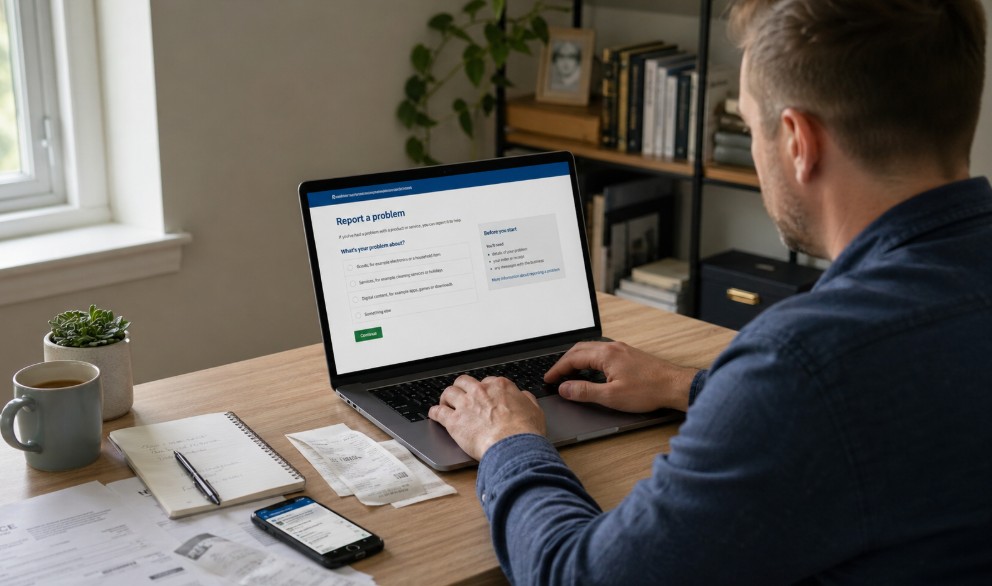
Reporting a company to Trading Standards in the UK involves following a clear and official process to ensure your complaint is properly assessed and acted upon.
Instead of contacting Trading Standards directly, most reports are handled through Citizens Advice, which reviews your issue and forwards it where necessary.
This system helps prioritise serious cases such as fraud, unsafe products, or unfair trading practices while ensuring your evidence is properly recorded. Acting promptly and providing accurate details can significantly improve the effectiveness of your complaint.
Key highlights:
- Contact Citizens Advice via phone or online to begin your report
- Provide detailed evidence, including receipts and communication records
- Trading Standards focuses on enforcement, not individual dispute resolution
- Your complaint may support wider investigations into a business
Following the correct steps ensures your report contributes to protecting other consumers.
What Is Trading Standards and What Do They Do?

Trading Standards is a local government service responsible for enforcing consumer protection laws across the UK. Their role is to ensure businesses operate fairly, safely, and within legal boundaries.
Rather than resolving individual complaints, they focus on identifying patterns of misconduct and taking enforcement action where necessary.
They operate across multiple areas, including product safety, unfair trading practices, and fraud prevention. By monitoring businesses and responding to reports, Trading Standards helps maintain trust in the marketplace.
A Trading Standards officer once explained their role clearly:
“Our priority is protecting the wider public by identifying harmful trading practices and stopping them at the source.”
This highlights an important distinction, your report contributes to a broader investigation, even if your personal issue isn’t directly resolved.
When Should You Report a Company to Trading Standards?
You should consider reporting a business when it appears to have broken the law or acted unfairly in a way that could affect other consumers. The key factor is not just dissatisfaction, but potential illegality or unethical behaviour.
Common situations include being misled, sold unsafe products, or pressured into purchases. If the issue suggests a wider pattern of misconduct, reporting becomes especially important.
In many cases, people hesitate because they assume their complaint is too small. However, multiple small reports can collectively trigger an investigation, making your input valuable.
What Types of Business Problems Can You Report?
Understanding what qualifies for a report helps ensure you’re using the system correctly. Trading Standards deals with serious consumer protection issues rather than everyday customer service complaints.
Situations you can report include:
- Unsafe or dangerous goods
- Counterfeit or fake products
- Misleading advertising or hidden charges
- Pressure selling or aggressive sales tactics
- Goods or services not delivered as promised
- Businesses refusing to honour legal consumer rights
A consumer protection adviser noted:
“Even if a single complaint seems minor, repeated reports about the same trader can lead to enforcement action.”
This reinforces the importance of reporting issues that may affect others, not just yourself. Taking action contributes to holding businesses accountable.
How Do You Report a Company to Trading Standards in the UK?

Reporting a company to Trading Standards in the UK follows a clear process, but it’s important to use the correct route depending on where you live.
In most cases, you will go through a consumer advice service rather than contacting Trading Standards directly.
Reporting Through Citizens Advice in England and Wales
If you are in England or Wales, the easiest and most effective way to report a company is through Citizens Advice. They act as the first point of contact and help ensure your complaint is properly recorded.
You can contact them by calling 0808 223 1133 (Monday to Friday, 9am–5pm) or by submitting an online form on their website. When you get in touch, you will need to explain your issue clearly and provide any supporting evidence.
The adviser will:
- Review your situation
- Explain your consumer rights
- Decide whether your case should be passed to Trading Standards
This step is important because it ensures only relevant and well-documented complaints are forwarded for investigation, making the process more efficient.
Reporting in Scotland and Northern Ireland
If you live in Scotland or Northern Ireland, you will need to contact a different service, but the process is very similar.
- In Scotland, contact Consumer Advice Scotland
- In Northern Ireland, contact Consumerline
These organisations will listen to your complaint, give advice, and pass your report to the appropriate authority if needed.
No matter where you are in the UK, the key is to provide accurate details and clear evidence. This helps ensure your complaint is taken seriously and increases the chances of further action being considered.
Can You Report a Company to Trading Standards Online?
Yes, reporting online is one of the most convenient methods available. Citizens Advice provides an online form that allows you to submit your complaint outside standard phone hours, particularly useful between Friday evenings and Monday mornings.
Once submitted, you can expect a response within a few working days. While this method may feel less immediate than a phone call, it allows you to provide detailed written information and attach supporting evidence.
Online reporting is especially useful for non-urgent cases where you want to document everything clearly. It also ensures your complaint is logged and tracked systematically.
What Evidence Do You Need Before Reporting a Business?

Providing the right evidence is essential when learning how to report a company to Trading Standards effectively.
Without clear and verifiable information, it becomes difficult for authorities to assess whether a business has broken the law or engaged in unfair practices.
Strong evidence not only supports your individual complaint but also helps build a broader case if multiple reports are made against the same company.
Essential Documents to Prepare
Before submitting your complaint, you should gather all relevant documents that clearly outline what happened.
The more organised and detailed your evidence is, the easier it becomes for Citizens Advice and Trading Standards to evaluate your case.
Key documents to include:
- Business name, address, and contact details
- Receipts, invoices, or proof of purchase
- Contracts, agreements, or written terms
- Emails, messages, or recorded communication
- Photos or videos showing faulty products or poor workmanship
- A clear timeline of events, including dates and interactions
Having these materials ready ensures your report is complete and reduces the chances of delays during the review process. It also demonstrates that your complaint is credible and well-documented.
How Evidence Strengthens Your Case?
Strong evidence plays a crucial role in determining whether further action will be taken. Authorities rely on consistent and detailed information to identify patterns of misconduct, especially when multiple complaints are made against the same business.
A Trading Standards representative highlighted this clearly:
“Clear, organised evidence helps us identify patterns quickly and decide whether enforcement action is necessary.”
The more precise your submission, the more useful it becomes. Even small details, such as timestamps, screenshots, or repeated claims, can help build a stronger case.
This level of preparation ensures your report is not only valid but also contributes meaningfully to wider consumer protection efforts.
What Happens After You Report a Company to Trading Standards?
Once your report is submitted, it is assessed and stored within a broader intelligence system. Trading Standards uses this information to identify trends and decide whether further investigation is required.
In many cases, you won’t receive direct feedback unless additional details are needed. This can feel frustrating, but it reflects the organisation’s focus on large-scale enforcement rather than individual case updates.
Outcome overview:
| Stage | What Happens |
| Submission | Your complaint is logged by Citizens Advice |
| Assessment | Information is reviewed and categorised |
| Investigation Decision | Authorities decide whether to act |
| Action | Possible warnings, inspections, or legal proceedings |
To better understand how this works in practice, I once spoke with a small business owner named Daniel, who reported a rogue contractor after renovation work was left incomplete and unsafe. He shared:
“I contacted Citizens Advice first, and they guided me through everything. I submitted photos, invoices, and messages. Even though I didn’t get a refund through Trading Standards, I felt reassured knowing action could be taken.”
Daniel’s experience reflects a common outcome. While Trading Standards didn’t resolve his personal dispute, his detailed report contributed to a broader investigation into the contractor’s conduct.
This demonstrates how individual complaints, when combined, can lead to enforcement action that protects other consumers.
Even if you’re not contacted after submitting your report, your information may still play a crucial role in future action.
Can Trading Standards Help You Get a Refund?

It’s important to be clear, Trading Standards does not resolve individual disputes or secure refunds. Their role is enforcement, not mediation.
If you’re seeking compensation, you’ll need to explore other options such as:
- Contacting the business directly
- Using alternative dispute resolution (ADR)
- Taking legal action through small claims court
This distinction often surprises people, but it ensures Trading Standards can focus on protecting the wider public rather than handling individual cases.
Can You Report a Company to Trading Standards Anonymously?
Yes, you can report a company to Trading Standards anonymously in certain situations, especially if you are worried about potential repercussions.
However, while anonymous complaints are accepted, providing your contact details can strengthen your case, as investigators may need to follow up for additional information or clarification.
Anonymous reports can still be useful, particularly when they involve serious concerns such as fraud, unsafe products, or illegal practices. That said, they may carry less weight if authorities are unable to verify key details or gather further evidence.
Ultimately, it’s important to balance your privacy with the effectiveness of your complaint, ensuring you provide enough accurate information to support any investigation
How Do You Find Your Local Trading Standards Office?
Finding your local Trading Standards office in the UK is straightforward and ensures your complaint reaches the correct authority.
The most reliable method is using the official GOV.UK tool, where you simply enter your postcode to be directed to the appropriate regional service.
This helps avoid confusion, as Trading Standards operates at a local council level rather than through a single national office.
To make the process easier, you can follow these steps:
- Visit the GOV.UK Trading Standards locator
- Enter your postcode accurately
- Access contact details for your local office
- Follow guidance specific to your area
In urgent cases, such as fraud or safety risks, contacting your local council directly may be appropriate.
However, for most situations, Citizens Advice remains the recommended first step for reporting and guidance.
When Should You Contact Other Organisations Instead?
Not every issue falls under Trading Standards, and understanding alternatives can save time and effort. Depending on your situation, other organisations may be better suited to help.
Comparison of reporting options:
| Issue Type | Best Organisation |
| Fraud or scams | Action Fraud |
| Company misconduct | Companies House |
| Consumer disputes | Citizens Advice / ADR |
| Overseas purchases | UK International Consumer Centre |
Choosing the right channel ensures your complaint is handled efficiently and by the appropriate authority. This avoids delays and improves your chances of resolution.
Final Thoughts on Reporting a Company to Trading Standards
Understanding how to report a company to Trading Standards in the UK empowers you to take action against unfair or illegal practices.
While the process may not deliver immediate personal outcomes, it plays a crucial role in maintaining fair business standards.
By following the correct steps, providing strong evidence, and using the appropriate channels, you contribute to a system designed to protect all consumers. Even a single report can make a difference when combined with others.
Frequently Asked Questions
Is it worth reporting a company to Trading Standards?
Yes, especially if the issue involves illegal or harmful practices. Your report may help trigger investigations and protect other consumers.
How do I complain to Trading Standards about a company?
You must contact Citizens Advice, which will assess your complaint and pass it to Trading Standards if appropriate.
Can I report a company trading illegally?
Yes, illegal trading practices should always be reported, as they fall directly under Trading Standards enforcement.
How do I report a scam business in the UK?
You can report scams through Citizens Advice or Action Fraud, depending on the nature of the issue.
Can Trading Standards shut down a company?
They can take legal action, which may result in fines, restrictions, or closure of a business.
How long does Trading Standards take to investigate?
There is no fixed timeline. Investigations depend on the complexity and severity of the case.
What is the difference between Citizens Advice and Trading Standards?
Citizens Advice provides guidance and collects complaints, while Trading Standards enforces the law and investigates businesses.

Blogger | Business Writer | Sharing startup advice on UK business blogs