
Amazon Delivery Franchise | How Much Is It?

UK Startup Blog Archive
Table of Contents
If you are searching for an Amazon delivery franchise in the UK, the opportunity you are most likely looking for is the Delivery Service Partner (DSP) programme.
You set up and operate your own delivery business, recruit and lead drivers, manage daily operations and deliver parcels from an assigned delivery station.
The headline financial figures need careful interpretation.
The programme advertises start-up costs from £10,000, requires £25,000 in liquid assets, and publishes annual profit potential of £50,000 to £150,000. Its financial projections are based on businesses operating 20–40 vans, and they are not guaranteed earnings.
Updated On 11.08.2026
What Does An Amazon Delivery Franchise Actually Mean In The UK?
The phrase Amazon delivery franchise is widely used by people researching the opportunity, but the official UK programme is called the Delivery Service Partner programme.
It is designed for entrepreneurs who establish and manage their own parcel-delivery businesses while working within the wider delivery network.
The model sits at the final stage of the parcel journey. Orders move through fulfilment operations to delivery stations, where parcels are prepared for delivery. Your company then manages the drivers and vehicles that take those parcels to homes and businesses.
The programme has operated internationally since 2018.
Current programme material says DSP businesses collectively deliver more than 20 million parcels each day, while the supplied programme information reports more than 4,400 DSP owners across 20 countries and more than 390,000 driving jobs created.
That scale does not make your own business passive. You remain responsible for building a capable workforce and managing the operation behind its deliveries.
How Much Money Do You Need For An Amazon Delivery Franchise?
The two numbers you are most likely to encounter are £10,000 and £25,000, but they describe different things. The lower figure is the advertised starting-cost threshold, whereas £25,000 is the liquid-assets requirement.
Having £25,000 available therefore does not mean you simply pay a £25,000 franchise fee. You need sufficient financial capacity to establish and support the business while meeting operating costs.
Costs To Plan For
- You may need working capital to cover expenditure while the operation becomes established.
- You need to budget for recruitment, driver wages and employment-related costs.
- You should model vehicle, insurance and equipment expenditure using the arrangements available to your business.
- You need to consider training, staff retention and recruitment costs as the driver team develops.
- You should prepare your own profit-and-loss forecast rather than treating the lowest advertised start-up figure as your complete budget.
The practical lesson is to separate entry cost, available liquidity and ongoing operating expenses when deciding whether you have enough capital.
DSP financial planning
Amazon DSP Profit & Financial Readiness Calculator
Estimate annual operating profit, profit margin, monthly business costs and cash runway while checking your figures against the published UK Delivery Service Partner financial requirements.
Published programme figures
UK DSP Financial Benchmarks
Use these figures as reference points only. Your actual costs, revenue and profit will depend on your own operation.
Review the UK DSP financial projections before building your own financial model.
Enter Your Business Scenario
Change the example figures below to reflect the business model you want to test. All calculator results are based only on the figures you enter.
Estimated scenario
Your DSP Financial Position
Financial Readiness Check
Calculation Breakdown
- Estimated annual revenue £0
- Driver and staff payroll £0
- Vehicle and fleet costs £0
- Insurance costs £0
- Recruitment and training £0
- Other operating costs £0
- Total annual operating costs £0
- Estimated annual operating profit £0
How Much Can You Make From An Amazon Delivery Franchise?
Published UK programme projections show potential annual revenue of around £900,000 to £1.8 million and potential annual profit of £50,000 to £150,000 for owners operating at the projected scale of 20–40 vans. These are projections rather than promised financial results.
The official DSP financial overview should therefore be read as an illustration of possible business economics, not a guaranteed return.
Revenue Versus Profit Explained
Revenue is the money generated by the business before its operating costs are deducted. Profit is what remains after relevant expenses have been paid.
Published Financial Picture
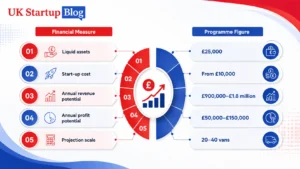
| Financial Measure | Programme Figure | What It Means |
| Liquid assets | £25,000 | Financial resources required to qualify |
| Start-up cost | From £10,000 | Advertised potential starting point |
| Annual revenue potential | £900,000–£1.8 million | Business turnover before costs |
| Annual profit potential | £50,000–£150,000 | Projected profit, not guaranteed owner income |
| Projection scale | 20–40 vans | Operating range underlying the projections |
The distinction matters because a £1 million turnover business does not give its owner £1 million of personal income.
What Can Reduce Your Final Profit?
Driver wages, recruitment, retention, vehicles, insurance, administration and operational performance can all affect what remains after revenue becomes profit.
The programme itself tells prospective owners to develop their own profit-and-loss model and research costs for their location rather than depending solely on headline projections.
That makes the £50,000–£150,000 range a potential outcome, not an automatic salary.
Who Is Amazon Looking For To Run A Delivery Business?

The programme focuses heavily on leadership. Logistics experience can be useful, but current programme material says it is not essential and places greater emphasis on business judgement, resilience, customer focus and the ability to recruit and lead people.
Capabilities That Matter
- You should be comfortable leading and retaining a team of delivery drivers.
- You need to make decisions in a fast-moving operating environment.
- You should be able to coach people and address performance problems.
- You need enough commercial understanding to monitor costs, staffing and business performance.
- You should be prepared for physically and operationally demanding delivery activity across your workforce.
A real UK owner profile reinforces that logistics experience is not an absolute prerequisite. Kemi Lasisi said:
“You need not have it all — just the potential, qualities and drive.”
The stronger question is therefore not whether you have previously delivered parcels, but whether you can build and manage the organisation that delivers them.
What Does Running An Amazon Delivery Franchise Look Like Day To Day?
Running a DSP means managing people, vehicles, routes and business performance throughout the operating day.
Official programme material describes a routine that can begin with checking staffing and fleet readiness and continue through delivery monitoring, problem solving and end-of-day debriefs.
A Typical Operating Day
| Stage | Typical Owner Responsibilities |
| Morning | Review staffing, routes, fleet readiness and safety requirements |
| Before departure | Check in drivers, distribute equipment and oversee loading |
| During deliveries | Monitor route progress and respond to operational problems |
| Business management | Review metrics, recruitment needs and team performance |
| End of day | Debrief drivers, address undelivered parcels and check vehicles |
| Next-day planning | Prepare staffing, equipment and fleet requirements |
Programme materials describe businesses operating seven days a week, 365 days a year.
They have also described a mature operating model of roughly 20–40 vans and 30–70 drivers, although staffing should be treated as an indication of scale rather than a guaranteed fixed requirement for every business.
Some secondary franchise material also states that owners may need an on-site presence for at least five days a week, particularly during start-up.
Because operational expectations can change, you should confirm this during the current selection process rather than treating an older third-party statement as a universal rule.
What Support Does Amazon Give You After You Become A DSP?
The programme is structured so that you own and manage the delivery company while receiving access to established logistics processes, technology, training and negotiated supplier arrangements.
Current programme material refers to more than 25 years of logistics experience, superseding older secondary descriptions that referred to more than 20 years.
Training And Operational Guidance
New owners can receive multi-week preparation that combines introductory learning with practical exposure to existing operations.
The programme also offers Road to Ownership training for eligible participants, with subjects including areas such as leadership and finance.
The official DSP daily operations material shows that owner development extends beyond initial classroom-style training into practical fleet, staffing and delivery management.
What Technology And Business Resources Are Available?
DSPs receive access to tools and processes designed around daily delivery operations.
Support described in programme and secondary materials includes route and operational technology, delivery-station assistance and support when drivers encounter problems on the road.
This helps you operate within an established delivery system, but you remain responsible for managing your company and employees.
Vans, Insurance And Negotiated Deals
The programme describes access to negotiated or discounted arrangements covering items such as branded vans, handheld devices and other services.
It also refers to third-party support for arranging appropriate business insurance.
That wording matters. Access to negotiated deals is not the same as being handed a free fleet with no associated cost or responsibility.
What Commitments And Risks Should You Understand Before Investing?
An Amazon delivery franchise opportunity may benefit from built-in parcel demand and established logistics infrastructure, but your own company still has workforce, fleet, cash-flow and performance responsibilities.
That makes operational execution central to the business model.
Commitments To Consider
- You are responsible for recruiting, retaining and developing a reliable driver team.
- You need sufficient working capital rather than relying only on the minimum start-up figure.
- You must manage fleet readiness, safety and day-to-day delivery disruptions.
- You need to monitor business metrics and coach employees when performance falls short.
- You should expect a hands-on management role rather than passive ownership.
- You must distinguish projected turnover from the cash ultimately available as profit.
The India-focused competitor article describes steady profits and effectively safe long-term returns, but those assertions are not supported by the UK programme evidence and should not be applied to a UK investment decision.
Its cost model and operating assumptions are also specific to India.
The more defensible assessment is that the opportunity gives you infrastructure and support while leaving meaningful commercial execution in your hands.
How Do You Apply For An Amazon Delivery Franchise In The UK?

Before applying, you should confirm that the programme is recruiting for an area that works for you and that you meet the financial requirements.
Opportunities can depend on current delivery-station needs, so static lists of supposedly available UK territories can become outdated.
Check Current UK Opportunities First
Use the live availability information rather than assuming that every town or delivery station is recruiting new partners.
The programme operates across UK locations, but an existing delivery operation in an area does not automatically mean a new DSP opportunity is available there.
What Should You Prepare Before Applying?
Applicants should be ready to provide information about their professional background and finances.
The official DSP application guidance refers to preparing a CV and financial information, including evidence relating to the £25,000 liquid-assets requirement and liabilities.
Preparing these details early also gives you an opportunity to test whether your own financial model is realistic before committing further.
Application, Selection And Launch
The broad journey is research, location check, application, assessment, selection, training and launch.
Successful applicants then need to build their business structure, recruit a team and prepare for operations from the relevant delivery station.
You should avoid relying on a guaranteed approval or launch timeframe unless one is provided during your current application, because timing can depend on location, selection and operational readiness.
Is An Amazon Delivery Franchise Worth Considering In The UK In 2026?
It can be worth investigating if you want to run a substantial, hands-on delivery business rather than simply become self-employed as a courier.
The published numbers show meaningful revenue potential, but the model also involves managing a sizeable workforce, vehicles and daily delivery performance.
It may suit you particularly well if you enjoy leading people, can manage operational pressure, have sufficient liquidity and are comfortable building a business around established delivery processes.
It may be less suitable if you want passive income, dislike workforce management, cannot comfortably meet the financial requirement or are attracted primarily by the £900,000–£1.8 million revenue figure without accounting for operating costs.
The opportunity is best evaluated as your own delivery company operating within a large logistics network, rather than as a simple purchase of guaranteed earnings.
Conclusion
If you are considering an Amazon delivery franchise in the UK, the DSP programme gives you the opportunity to build a genuine parcel-delivery company with access to established technology, logistics processes, training and delivery demand.
The financial headline is attractive but needs context.
You require £25,000 in liquid assets, advertised start-up costs can begin at £10,000, and programme projections indicate £900,000–£1.8 million in annual revenue with potential annual profit of £50,000–£150,000 for the specified operating scale.
Those numbers are projections, not promised earnings.
Your final decision should therefore depend as much on your ability to recruit, lead and retain drivers, control costs and manage a demanding delivery operation as it does on the headline revenue figure.
Frequently Asked Questions
Is Amazon DSP The Same As Amazon Flex?
No. DSP ownership involves building and managing a delivery company, while Flex is centred on individuals using their own availability to make deliveries.
Does Amazon Give DSP Owners Free Delivery Vans?
The programme describes access to negotiated or discounted vehicle arrangements rather than promising free vans. Vehicle costs and responsibilities should therefore be included in your business modelling.
Can You Choose Your Amazon DSP Delivery Territory?
Location depends on current programme opportunities and delivery-station requirements. You should check current availability rather than assuming you can select any UK territory.
Do You Need To Set Up A Limited Company For Amazon DSP?
The sources reviewed here do not provide enough current detail to state a universal UK company-structure requirement confidently. Confirm the required legal entity structure during the formal application and onboarding process.
Can You Own More Than One Amazon DSP Operation?
The reviewed current UK material does not establish an unrestricted right to open multiple operations. Expansion opportunities should therefore be confirmed directly through the programme once you are operating successfully.
How Long Does It Take To Launch An Amazon DSP Business?
There is no reliable universal launch period supported by the material reviewed here. Selection, training, delivery-station availability and your own operational readiness can affect the timetable.
Are Amazon DSP Earnings Guaranteed?
No. The £50,000–£150,000 annual profit figure is presented as potential and is based on projected operating assumptions rather than guaranteed individual results.
Note: Financial figures cited above are programme projections for businesses operating at the stated scale, including 20–40 vans, and should not be interpreted as guaranteed results.
UK programme information has been prioritised over India-specific competitor claims, while older secondary statements have been qualified where current official evidence does not confirm them.

Blogger & Content creator | An insightful writer sharing practical advice for UK entrepreneurs
Related Articles in Business
View All →
Is Raising Cane’s Opening in the UK? | London Locations Revealed
Yes, Raising Cane’s is officially coming to the UK. The American chicken restaurant brand plans to open its first UK restaurant at 22 Coventry Street in London’s West…
Best Parking App UK: 10 Startup-Led Parking Apps Compared for 2026
For most drivers, JustPark is the best parking app UK users can consider in 2026 because it combines parking search, advance booking and app-based payments in one platform.…
Cardzone UK Store Closures: Full List and Latest 2026 Update
Cardzone UK store closures are continuing in 2026, with several branches already gone from high streets and further shops now preparing to shut. The latest confirmed closures include…