
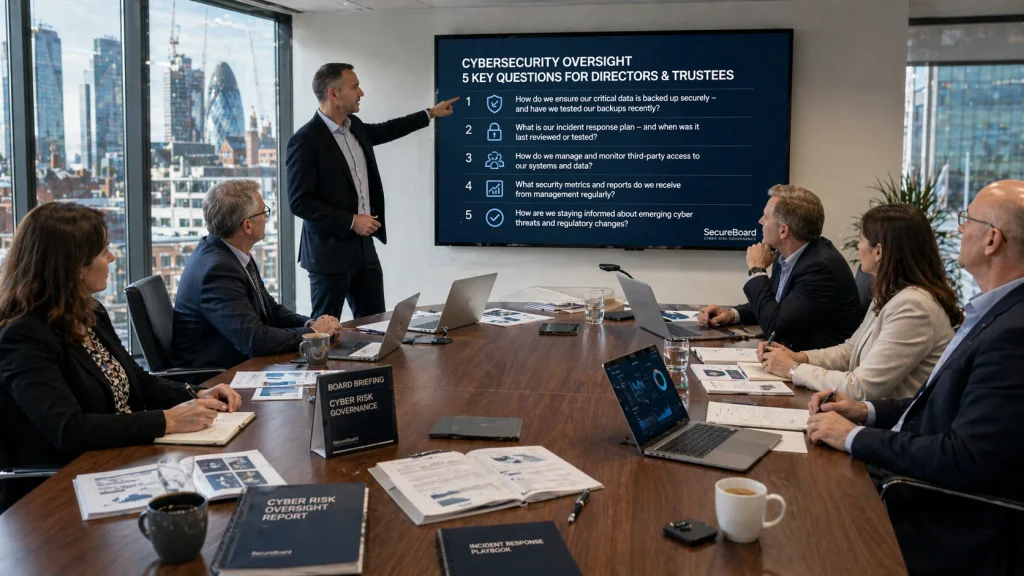
Board members and trustees at UK SMEs and charities often find themselves in a difficult position when it comes to technology. You know that a data breach or a ransomware attack is a significant risk to your operations, but you might not have the technical background to grill your IT team.
It’s easy to fall into the trap of accepting vague assurances that everything is under control. The challenge for many local organisations is that they rely on small internal teams or external providers who may not be used to reporting to a board. You don’t need to become an expert in firewalls to provide effective oversight.
Instead, you can focus on five specific areas that will tell you exactly how prepared your organisation is for a digital crisis. Read on to discover the specific questions that will help you protect your organisation.
Why Should Boards Ask Tougher Cybersecurity Questions in 2026?
1. When Was the Last Full Restoration Test for Our Backups?
Almost every IT team will tell you that they have a backup system in place. The problem is that having a backup isn’t the same as being able to recover your data. It’s common for businesses to discover that their backups are corrupted or incomplete only when they actually need them.
You should ask for the specific date when the last full restoration test was completed. It’s worth pointing out that a test should involve restoring an entire server or a large dataset to a clean environment to prove it works.
If your team can’t give you a date or a report from the last test, your business continuity plan is essentially a guess. You will also want to know how long a full recovery would take.
If it takes your team three days to get the systems back online, you need to decide if your organisation can survive that much downtime. Knowing the recovery time objective helps the board make better decisions about investment in more robust systems.
2. How to Get Clear Security Reporting for the Board?
One of the biggest hurdles for directors is the lack of clear, actionable information. Technical reports often contain far too much jargon and not enough insight for strategic decisions.
You might see lists of blocked viruses or firewall hits, but these don’t tell you if your overall risk has gone up or down. Many organisations now use a virtual CISO advisory service to get independent reports that make sense at a board level. This gives you a clear view of your security posture without the technical fluff.
Having access to independent advice means you aren’t just marking your own homework. It allows the board to see where the gaps are in the current strategy and where budget should be prioritised.
This type of reporting focuses on business outcomes, such as how well your staff are responding to phishing tests or whether your most sensitive data is properly encrypted. It’s a much more effective way to manage risk than trying to decipher technical logs.
3. How to Choose a Trustworthy Security Partner?
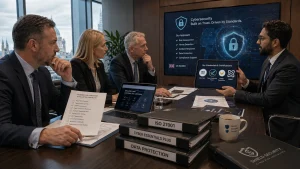
When you look for external support, you need to know you can trust the systems they use to protect you. It is worth checking if your provider has the right credentials to handle your data.
Looking for these specific certifications is a good way to identify a provider that takes their own security seriously. While many firms claim to be experts, these independent audits prove that they follow international standards for data protection and security management.
Instead of just taking a provider’s word for it, you can look for these badges as a mark of quality. This is particularly important for charities in Warwickshire that handle sensitive donor information and need to maintain high levels of trust.
4. How Will We Respond if Our Systems Go Offline?
Cybersecurity is important in preventing an attack, but it also needs to look at what happens when things go wrong. You need to ask if there is a documented incident response plan that the board has reviewed.
This plan should outline exactly who is responsible for making decisions during a crisis. For instance, you will need to know who has the authority to shut down the network or who is responsible for notifying the Information Commissioner’s Office (ICO) if data is stolen.
A good response plan should include the following elements:
- A clear list of emergency contacts for IT, legal and insurance partners.
- Defined roles for staff members so everyone knows their duties.
- A communication strategy for telling employees, customers and the media what is happening.
- Step-by-step instructions for isolating affected systems to stop a threat from spreading.
If the plan only exists in the head of your IT manager, your organisation is at risk if they are on holiday or unavailable when an attack happens. You should encourage your team to run a simulation exercise where the board walks through a hypothetical attack to see how the plan holds up.
5. Which Third Parties Have Access to Our Sensitive Data?

Your security is only as strong as the weakest link in your supply chain. Many SMEs and charities share data with marketing agencies, payroll providers or cloud software companies.
You should ask your IT team for a list of every third party that has access to your network or your data. It is important to know what security standards these partners meet before you trust them with your information.
If a partner has a security breach, it can quickly become your problem. You will want to ensure that your contracts include requirements for security and that you have the right to audit their processes if necessary. By keeping a close eye on your supply chain, you can reduce the risk of a breach coming from an unexpected direction.
Final Thoughts
Managing cybersecurity at a board level doesn’t require a degree in computer science. It requires a commitment to asking direct questions and demanding clear, non-technical answers.
By focusing on restoration tests, incident response and the quality of your security partners, you will move from a position of uncertainty to one of informed oversight. This will ensure that your organisation stays resilient in the face of evolving digital threats.

Blogger | Business Writer | Sharing startup advice on UK business blogs