
Contract Novation Agreement UK (2027): Meaning, Template, Legal Requirements and Business Examples


UK Startup Blog Archive
Table of Contents
A contract novation agreement allows businesses to replace one party to an existing contract with another, with the agreement of everyone involved. It is commonly used during company acquisitions, business restructuring, supplier changes, refinancing and construction projects.
For UK startups and established companies, novation can preserve valuable commercial relationships while allowing a new legal entity to take responsibility for future contractual performance.
However, a novation agreement does more than change a company name. It creates a replacement contractual relationship, making it essential to identify who remains responsible for outstanding payments, previous breaches, warranties and future obligations.
Our analysis of UK commercial contract guidance, publicly available legal commentary and business-transfer requirements highlights an important distinction: novation does not automatically eliminate every liability associated with the original contract.
This distinction matters particularly when businesses are preparing acquisitions, group reorganisations or supplier transitions in 2027.
| Contract novation overview | UK position |
| Main purpose | Replace an existing contractual party |
| Number of parties | Normally three |
| Consent required | Agreement of all affected contracting parties |
| Legal effect | Original contractual relationship discharged and replaced |
| Rights and obligations | Recreated under the replacement contract |
| Original party released | According to the terms of the novation |
| Written agreement | Strongly recommended |
| Deed required | Not universally, but commonly used |
| Typical applications | Business sales, construction, outsourcing and financing |
| Primary risk | Unclear allocation of historical and future liabilities |
What Is a Contract Novation Agreement?
A contract novation agreement is a legally binding arrangement through which an existing contract is discharged and a new contractual relationship is established, normally replacing one original party with an incoming party.
In commercial transactions, the replacement contract commonly reproduces the original agreement’s terms, subject to any changes expressly agreed by the parties.
Consider three businesses:
- Company A: The existing supplier that wants to leave the contract.
- Company B: The customer receiving the contracted services.
- Company C: The replacement supplier willing to assume the contractual responsibilities.
Company A originally agreed to provide services to Company B.
If all three companies agree to novation, Company C replaces Company A in the contractual relationship with Company B.
From the agreed effective date, Company C becomes responsible for performing the obligations allocated to it under the replacement agreement.
Company A is released from future performance obligations to the extent agreed, while responsibility for liabilities arising before the novation must be addressed separately.
Businesses should first understand what makes a contract legally binding in the UK, particularly the principles of consent, consideration and contractual intention.
How Does Contract Novation Work in Practice?
Suppose a Manchester-based technology company has a £120,000 software development agreement with a corporate customer.
The technology company decides to sell its development division to another business.
The purchaser wants to continue providing services to the customer under the existing commercial arrangements.
Rather than requiring the customer to negotiate a completely different contract, the three businesses agree to novation.
The replacement agreement can preserve the original service specifications, pricing arrangements, confidentiality obligations and completion milestones.
However, the businesses must also agree who will deal with any unpaid invoices, incomplete development work and software defects that arose before the transfer.
Our assessment is that this is where careful drafting creates the greatest commercial value. Transferring ongoing obligations is relatively straightforward compared with determining responsibility for historical performance.
What Is the Difference Between Novation, Assignment and Contract Variation?
One of the most important decisions when changing a commercial relationship is choosing the appropriate legal mechanism.
Novation, assignment and variation serve different purposes.
| Feature | Novation | Assignment | Variation |
| Primary purpose | Replace a contractual party | Transfer contractual rights or benefits | Change contractual terms |
| Transfers contractual burdens | Through new contractual obligations | Not ordinarily | Existing parties remain responsible |
| Original contract | Discharged and replaced | Generally remains in force | Continues as amended |
| New contractual party | Yes, normally | Not necessarily | Generally no |
| Consent | Agreement of all relevant parties | Depends on legal and contractual restrictions | Agreement of relevant parties |
| Typical example | New supplier replaces old supplier | Transfer of a payment receivable | Change to the service fee |
| Main financial concern | Liability allocation | Enforceability of assigned rights | Commercial effect of changed terms |
Novation is usually the appropriate mechanism where the intention is to replace the party responsible for performing contractual duties.
Assignment is more suitable where a business needs to transfer a right, such as the right to receive a contractual payment, without replacing the party responsible for performing the contract.
Assignment is not necessarily informal. Certain assignments require written documentation and notices to satisfy applicable legal requirements.
Variation is suitable when the existing parties intend to change the contract without changing who is legally responsible for it.
Neal Morris and Callum Miller, writing in a professional legal analysis published by RICS in April 2024, highlighted the importance of distinguishing assignment from novation, especially in construction contracts. Their discussion reinforces why businesses should examine the actual contractual effect rather than relying on the document’s title.
Can a Business Use Subcontracting Instead of Novation?
Sometimes.
A supplier may appoint a subcontractor to perform some or all of its work without replacing the original contractual relationship.
However, the original supplier will generally remain responsible to the customer for its contractual obligations, subject to the original agreement.
Subcontracting therefore does not provide the same legal release as a properly structured novation.
When Is a Contract Novation Agreement Required?
Novation becomes commercially important when a business wants another legal entity to assume its position under an existing contract, and the other party agrees.
We identified several common circumstances in which novation deserves consideration.
1. Selling a Business Through an Asset Purchase
A business sale does not always transfer contractual relationships automatically.
When the purchaser acquires selected assets rather than the shares in the existing company, it may be necessary to transfer supplier agreements, customer contracts and other commercial arrangements individually.
The buyer should investigate which agreements can be assigned, which require novation and which cannot be transferred without further approval.
This is a major consideration when buying an existing limited company, because the legal structure of the acquisition affects the treatment of contracts and liabilities.
Important: A share purchase is different. Where the same limited company remains the contractual party after its shares are sold, its contracts generally continue without novation. Nevertheless, change-of-control provisions may require notification or consent.
2. Moving From Sole Trader to Limited Company
A sole trader may establish a limited company as the business grows.
The newly incorporated company is a separate legal person.
Contracts originally entered into by the individual do not automatically become contracts of the company merely because the founder begins trading through it.
The customer or supplier may need to consent to a novation so that the limited company replaces the individual.
Entrepreneurs planning to register a new company with Companies House should therefore review their existing commercial agreements before moving significant work, payment arrangements or contractual responsibilities into the company.
3. Business Mergers and Group Restructuring
A corporate group may decide to centralise services or move contracts between subsidiaries.
For example, a parent company might want its procurement subsidiary to take responsibility for contracts previously held by an operating subsidiary.
Although both subsidiaries belong to the same group, they are separate legal entities.
Consequently, a contract may require novation unless the relevant terms and circumstances provide another lawful mechanism.
The commercial objective is often to simplify management while maintaining continuity for customers and suppliers.
4. Construction and Property Development
Construction projects frequently involve consultants, architects, engineers, contractors and developers.
A common arrangement involves a consultant initially contracting with the developer and subsequently being novated to the principal contractor.
The novation agreement must address the consultant’s responsibilities for design work already completed, future professional services and potential claims.
Professional indemnity insurance, collateral warranties and design obligations can make these transactions significantly more complicated than an ordinary supplier replacement.
5. Outsourcing and Technology Supplier Changes
Businesses regularly replace technology providers, logistics partners, administrators and specialist service providers.
Where an outgoing contractor is being replaced by another legal entity, novation can help maintain the original commercial framework.
Nevertheless, the incoming supplier should not automatically assume that it can use the outgoing supplier’s software licences, intellectual property or subcontractor arrangements.
Those rights require separate verification.
A confidentiality agreement or non-disclosure agreement may also require review where sensitive customer information or proprietary business records will be shared during the transition.
6. Refinancing and Financial Restructuring
Novation can also arise when responsibility for a contractual debt or financing obligation changes.
For example, a lender might agree to replace one borrower with another, discharging the original debt and creating a new debt obligation.
The transaction requires careful consideration of security, guarantees, interest arrangements, repayment terms and any applicable tax implications.
A loan novation should not be treated as merely changing the name shown on a repayment schedule.
What Are the Legal Requirements for a Valid Novation Agreement in the UK?
For businesses operating under the law of England and Wales, several elements are particularly important.
Agreement of the Parties
The outgoing party, incoming party and remaining contracting party must agree to the proposed replacement.
Consent may sometimes be established through conduct or a properly drafted advance-consent mechanism, but written agreement is substantially safer for commercial transactions.
A company cannot ordinarily escape its contractual obligations simply by notifying the customer that another business will perform them.
Clear Intention to Replace the Contract
The agreement should establish that the parties intend to discharge the existing contractual relationship and create a new one.
Ambiguous language about transferring work or delegating duties may not achieve that result.
Consideration or Execution as a Deed
An ordinary contractual novation under English law normally requires consideration.
The mutual release of obligations and creation of replacement commitments may provide the necessary consideration, depending on the circumstances.
Where consideration is uncertain, parties commonly execute the novation as a deed.
A deed is not compulsory for every novation agreement, although it is frequently used in significant commercial transactions.
Proper Identification of the Contract
The document should identify the original agreement, its date, parties and relevant amendments.
If several contracts are being replaced, they should be individually listed.
Appropriate Authority and Execution
The signatories must have authority to bind the relevant parties.
Where the agreement is executed as a deed, the applicable statutory and common-law execution requirements must be followed.
For example, an English company may generally execute a deed through two authorised signatories or a director signing in the presence of an attesting witness.
Different rules may apply to individuals, partnerships, LLPs, overseas entities and documents governed by other jurisdictions.
Scottish contract law also differs from English law, particularly in its approach to consideration. Businesses should obtain jurisdiction-specific advice rather than assuming one standard form works throughout the UK.
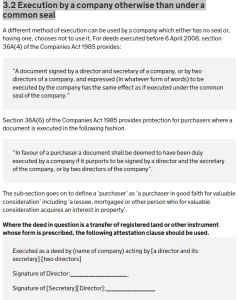
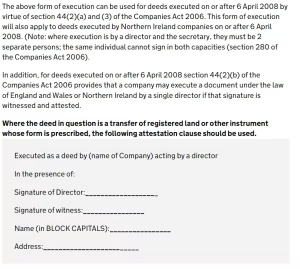
Official UK guidance on executing deeds, including the signature requirements for companies under section 44 of the Companies Act 2006.
How Do You Novate a Contract? A Step-by-Step UK Procedure
Businesses should follow a structured process rather than immediately asking the three parties to sign a standard template.
Step 1: Review the Existing Contract
Begin by examining the agreement that is to be novated.
Identify its parties, commercial obligations, termination provisions, assignment restrictions, consent requirements and any existing disputes.
Pay particular attention to:
- Outstanding payment obligations
- Performance milestones
- Existing warranties and guarantees
- Indemnities and liability limits
- Confidentiality and intellectual property clauses
- Applicable insurance requirements
- Dispute resolution provisions
- Restrictions on replacement suppliers
This initial review helps determine whether novation is necessary or whether assignment, variation or a completely new contract would be more appropriate.
Step 2: Obtain Agreement From the Parties
Discuss the proposed substitution with the remaining contracting party.
The customer or supplier may reasonably want reassurance that the incoming business has sufficient financial strength, operational capability and experience.
For instance, a customer may request financial statements, insurance certificates or evidence of relevant regulatory authorisations.
Consent should be properly documented and should not be presumed merely because the incoming company is associated with the outgoing company.
Step 3: Evaluate the Incoming Company’s Financial Position
Our commercial assessment places particular importance on evaluating the financial stability of the replacement entity.
A new contractor with insufficient liquidity could expose the remaining party to delays, service interruptions and recovery difficulties.
Review the incoming company’s ability to meet the contract’s costs, working-capital requirements and potential liabilities.
For higher-value arrangements, additional security or a guarantee may be appropriate.
Step 4: Agree the Liability Allocation
The parties should determine who will be responsible for past breaches, existing debts and future performance.
This is often the most commercially sensitive stage.
An outgoing contractor may want to be released from all relevant claims, whereas a customer may insist that the contractor remains responsible for defective work completed before the effective date.
The agreement should resolve these competing interests expressly.
Step 5: Prepare the Novation Agreement
The document should identify the parties, original contract, effective date, replacement obligations and agreed liability arrangements.
For straightforward arrangements, founders may be familiar with preparing a legal contract without a lawyer.
However, commercial novation requires additional care because three parties and potentially significant historical liabilities are involved.
Specialist legal review is particularly valuable when the agreement concerns financial borrowing, regulated operations, construction warranties or substantial recurring revenue.
Step 6: Execute the Agreement Correctly
Arrange signatures from all relevant parties.
Determine whether the agreement is being executed as a simple contract or deed, and use the appropriate execution formalities.
Confirm the effective date and whether completion depends on any outstanding conditions.
Step 7: Complete the Operational Handover
Signing the document is not the final administrative task.
Businesses should update:
- Customer and supplier records
- Purchase orders and invoices
- Bank payment instructions
- Contract management systems
- Insurance documents
- Data processing arrangements
- Service access permissions
- Relevant internal financial records
The incoming party should also receive the information and documentation necessary to perform its obligations.
What Clauses Should Be Included in a Contract Novation Agreement?
The content of the agreement is more important than its title.
Our review suggests that businesses should pay particular attention to the following provisions.
| Contract clause | Purpose | Importance |
| Identification of parties | Establish the correct legal entities | Essential |
| Original contract details | Identify the agreement being replaced | Essential |
| Effective date | Establish when substitution occurs | Essential |
| Discharge and replacement | Create the new contractual relationship | Essential |
| Assumption of obligations | Define incoming party responsibilities | Essential |
| Release provisions | Clarify outgoing party liabilities | Essential |
| Accrued rights and claims | Allocate pre-existing obligations | Essential |
| Payments and deposits | Reconcile outstanding balances | High |
| Warranties and indemnities | Allocate financial and legal risks | High |
| Insurance and guarantees | Preserve necessary protection | High |
| Confidentiality and data | Protect sensitive information | High |
| Governing law and disputes | Establish applicable legal procedures | Essential |
| Execution provisions | Ensure valid completion | Essential |
A carefully drafted agreement may also require schedules identifying individual contracts, service levels and relevant assets.
Businesses should avoid assuming that copying the original contract’s terms is sufficient. The novation must properly address what happens at the transition point.
Does Novation Transfer Existing Liabilities to the New Company?
Not automatically in every respect.
A novation ordinarily replaces the contractual relationship, but responsibility for accrued claims and liabilities depends on the transaction structure and drafting.
For example, suppose a supplier caused a breach before the novation date.
The customer may already have a right to claim damages.
Whether the original supplier remains responsible, whether the incoming supplier assumes responsibility or whether claims are released must be examined carefully.
A properly drafted agreement should distinguish between:
- Past liabilities: Obligations, claims or breaches arising before the effective date.
- Future liabilities: Duties and responsibilities arising from performance after the effective date.
- Continuing obligations: Contractual responsibilities, such as certain warranties or confidentiality duties, that may survive the change.
- Contingent liabilities: Potential future claims arising from events that occurred before novation.
An incoming company should not accept undefined historical liabilities without understanding their potential financial consequences.
Likewise, the remaining party should avoid releasing a financially strong outgoing contractor without assessing whether the replacement business provides adequate security.
Financial Example: A £200,000 Commercial Contract
Assume a service agreement has a total value of £200,000.
At the proposed novation date:
| Financial item | Illustrative amount |
| Original contract value | £200,000 |
| Services completed and accepted | £80,000 |
| Services remaining | £120,000 |
| Outstanding valid invoice | £15,000 |
| Customer deposit already paid | £10,000 |
| Disputed remedial work | £8,000 |
The figures are illustrative rather than a published transaction.
The parties need to determine how the £15,000 invoice, £10,000 deposit and £8,000 disputed work will be treated.
The novation must also establish who becomes entitled to future payments and who assumes responsibility for delivering the remaining £120,000 of services.
If these issues are ignored, the incoming party might inherit obligations it has not priced into the transaction, while the customer could face uncertainty over existing claims.
Contract Novation Agreement Template UK: What Should the Document Look Like?
A UK novation agreement commonly follows a structure similar to the following.
NOVATION AGREEMENT – ILLUSTRATIVE DRAFTING FRAMEWORK
Date: [Insert date]
Parties
- [Full legal name of outgoing party], company number [number], registered office [address].
- [Full legal name of remaining party], company number [number], registered office [address].
- [Full legal name of incoming party], company number [number], registered office [address].
Background
The outgoing party and remaining party entered into an agreement dated [date], relating to [description of services, products or obligations].
The parties wish to replace the outgoing party with the incoming party on the terms agreed in this novation document.
1. Effective Date
The novation shall take effect on [date], subject to satisfaction of any applicable completion conditions.
2. Discharge and Replacement
The parties agree that, with effect from the effective date, the original contractual relationship shall be discharged and replaced by a contractual relationship between the remaining party and incoming party, substantially on the terms identified in Schedule 1, subject to the amendments expressly set out in this agreement.
3. Incoming Party Obligations
The incoming party agrees to perform the obligations allocated to it under the replacement contract.
4. Release of Outgoing Party
The outgoing party shall be released from the obligations expressly identified in this agreement, subject to any retained liabilities, warranties, guarantees or indemnities specified in Schedule 2.
5. Accrued Rights and Liabilities
The parties shall identify and agree the treatment of all outstanding payments, pre-existing claims, accrued rights and liabilities arising before the effective date.
6. Financial Reconciliation
The parties shall reconcile invoices, deposits, credits, outstanding balances and other financial adjustments in accordance with Schedule 3.
7. Indemnities and Warranties
Any agreed indemnities and warranties shall be specifically stated, together with applicable limitations and procedures.
8. Governing Law
This agreement shall be governed by the laws of [England and Wales / Scotland / Northern Ireland, as applicable], with the agreed jurisdiction provisions.
9. Execution
The parties shall execute the agreement using the signature and, where applicable, deed-execution formalities appropriate to their legal status and the governing law.
Schedules
- Schedule 1: Original contract and amendments
- Schedule 2: Retained and assumed liabilities
- Schedule 3: Payments and financial reconciliation
- Schedule 4: Additional warranties, guarantees and transition requirements
This is an illustrative drafting framework, not a complete or sign-ready legal precedent. The required provisions and execution blocks will depend on the transaction, parties and applicable law. A solicitor should review the completed agreement before execution.
How Much Does a Contract Novation Agreement Cost in the UK?
There is no single statutory price for drafting an ordinary commercial novation agreement.
The legal cost depends on the number of parties, value of the original contract, complexity of liabilities and amount of negotiation required.
For example, transferring a routine service agreement between financially stable companies may require less legal work than novating a construction design appointment involving insurance, historical obligations and collateral warranties.
| Cost factor | Potential financial effect |
| Standard commercial agreement | Usually less complex drafting |
| Multiple original contracts | More documentation and review |
| Existing contractual disputes | Additional negotiation and legal advice |
| Construction warranties | Specialist insurance and liability review |
| Cross-border agreement | Additional jurisdictional complexity |
| Financial restructuring | Potential security and tax considerations |
| Regulated industry | Possible licensing and compliance requirements |
We recommend requesting a clearly scoped legal fee quotation that identifies drafting, negotiation, completion and any separate specialist advice.
For businesses considering starting a consulting business, a well-maintained contract register can make future client or service-provider transitions more efficient.
How Does Novation Affect Construction Contracts?
Construction novation requires particular attention because responsibility for professional design and project delivery may extend beyond the effective date.
A developer might initially appoint an architect to design a commercial building.
When a principal contractor becomes responsible for delivering the project, the architect’s appointment may be novated so the architect provides services to that contractor.
However, several questions arise.
Who is responsible for design errors made before novation?
Can the principal contractor pursue the architect for those errors?
Does the architect’s professional indemnity insurance cover the agreed obligations?
Have appropriate collateral warranties been preserved?
The answer depends on the contractual wording, the underlying appointment and the insurance arrangements.
Construction businesses should avoid relying on a generic novation form where the consultant’s liability for past design work is commercially significant.
How Does Contract Novation Affect Employees and Employment Rights?
Commercial novation and employment transfers should not be treated as the same legal process.
Where a business is transferred to a new employer, the Transfer of Undertakings (Protection of Employment) Regulations, commonly called TUPE, may apply.
When TUPE applies, employment relationships and associated rights generally transfer under the statutory framework, subject to the relevant rules and exceptions.
Employers therefore should not assume that they can simply ask employees to sign an ordinary commercial novation agreement to achieve the transfer.
The legal consequences include continuity of employment, existing contractual rights and applicable information and consultation obligations.
This distinction matters when selling a business with employees or moving a service operation to another contractor.
Employers should review their existing employment contract agreements and obtain specialist employment-law advice before completing the transaction.
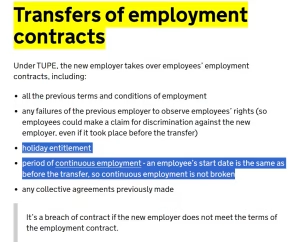
GOV.UK guidance explaining how employment contracts and employment rights are treated when TUPE applies to a business transfer.
Can a SaaS or Technology Contract Be Novated?
Yes, subject to the contract’s terms and the agreement of the relevant parties.
SaaS companies may need novation when a product division is sold, customers are moved to a new corporate entity or a service provider is replaced.
However, technology agreements introduce additional issues.
The incoming business must establish whether it can lawfully use the intellectual property, infrastructure, software licences and third-party services required to perform the contract.
Businesses should review:
- Ownership and licensing of software
- Data processing obligations
- Security and confidentiality requirements
- Customer access permissions
- Third-party platform restrictions
- Service-level commitments
- Data migration and retention arrangements
- Business continuity requirements
The Information Commissioner’s Office expects organisations using data processors to maintain appropriate written contractual arrangements and keep those records updated when processors change.
A contract novation therefore does not remove the need to comply with applicable UK GDPR obligations.
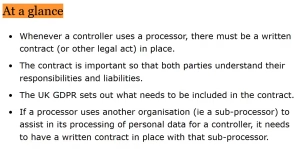
Information Commissioner’s Office guidance on written processor contracts and updating arrangements when a service provider changes.
What Are the Financial and Tax Implications of Contract Novation in 2026–2027?
The financial implications of novation deserve separate consideration from its contractual effect.
Novation can change which business records revenue, receives payments, performs work or assumes certain obligations.
However, it does not automatically establish a particular tax result.
Outstanding Payments and Revenue Recognition
Businesses should confirm which entity is entitled to payments before and after the effective date.
Finance teams should reconcile invoices, deposits, credit notes, work in progress and outstanding balances.
Accounting treatment depends on the specific contractual rights, obligations and applicable reporting standards.
VAT and Business Transfers
A commercial contract novation is not automatically a transfer of a business as a going concern, or TOGC.
Where a wider business or part-business transfer takes place, the parties should consider the applicable VAT conditions.
HMRC guidance updated on 4 November 2026 explains that where TOGC requirements are satisfied, the qualifying business transfer is not treated as a supply for VAT purposes.
This does not mean that every novation is outside the scope of VAT.
The actual transaction must be assessed separately.
Debt and Loan Novation
HMRC’s Corporate Finance Manual, updated on 27 August 2026, distinguishes between assignments of contractual rights and novations involving debt obligations.
The guidance explains that replacing a debtor through novation can extinguish the original debt and create a new debt.
For financial restructurings, this distinction can influence the legal and tax analysis.
Our 2027 assessment: Businesses should review the latest guidance when implementing transactions in 2027. The 2026 publication updates should not themselves be interpreted as introducing a new general novation law, and no universal 2027 change to novation requirements is established by these updates.
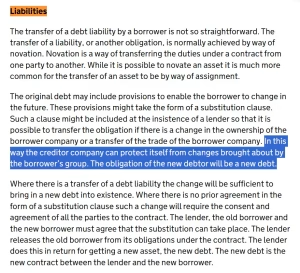
HMRC Corporate Finance Manual CFM11170, updated 27 August 2026, explaining assignment and novation in the transfer of debt obligations.
What Are the Advantages and Disadvantages of a Novation Agreement?
A properly structured novation can deliver significant commercial benefits, but it also introduces negotiation and compliance responsibilities.
| Advantages | Disadvantages |
| Maintains commercial continuity | Requires agreement of relevant parties |
| Enables replacement of a contractor | May involve substantial legal review |
| Can preserve established contractual terms | Historical liabilities may be disputed |
| Supports business acquisitions | Customer or supplier consent can delay completion |
| Provides a clear transition date | Accounting and systems updates are necessary |
| Can release the outgoing party from agreed obligations | Incoming party may need additional guarantees |
The commercial value depends on whether the replacement arrangement achieves the desired change without creating unacceptable risks.
Our Commercial Suitability Ratings
We assessed common transaction scenarios using four criteria: contractual continuity, legal complexity, commercial practicality and risk allocation.
The percentage ratings below are our editorial suitability assessments, not industry statistics, legal success probabilities or results of a professional survey.
| Transaction scenario | Novation suitability rating | Our assessment |
| Replacing a commercial supplier with customer consent | 95% | Strong use case when obligations must move |
| Transferring customer contracts during an asset purchase | 92% | Often appropriate where consent is obtainable |
| Moving sole trader contracts to a new limited company | 90% | Common practical solution |
| Construction consultant replacement | 88% | Appropriate but requires specialist drafting |
| Replacing a contractual borrower | 85% | Can work subject to lender consent and security |
| Transferring only a right to receive payment | 35% | Assignment may be more appropriate |
| Changing the price between existing contractual parties | 15% | Variation is generally more suitable |
| Share purchase with the contracting company unchanged | 10% | Novation is often unnecessary |
These ratings illustrate where novation is commercially useful, not whether a particular agreement will be legally valid.
What Are the Biggest Risks of a Contract Novation Agreement?
Our analysis identifies five recurring areas of commercial risk.
- Unclear historical liabilities: The agreement does not adequately distinguish existing claims from future obligations.
- Incorrect legal entities: The document uses a trading name instead of the correct contracting company or omits relevant parties.
- Inadequate financial due diligence: The incoming contractor lacks sufficient resources or insurance to fulfil the agreement.
- Missing contractual consents: The parties proceed without satisfying the original contract’s restrictions or approval requirements.
- Poor operational implementation: Payments, information systems, insurance or regulatory arrangements remain connected to the outgoing company after novation.
For businesses operating in 2027, these risks should be assessed together rather than treated as separate administrative issues.
When starting a business in the UK, founders should also establish a reliable process for storing contracts, recording amendments and documenting important commercial decisions.
How Can Businesses Prepare for Contract Novation in 2027?
A contract novation should be treated as a controlled commercial transition.
Before proceeding, businesses should complete a practical readiness assessment.
| Readiness question | Required action |
| Is the original contract identifiable? | Confirm agreement, amendments and parties |
| Does the incoming company have sufficient resources? | Review finances, insurance and capacity |
| Have all necessary consents been obtained? | Document approval |
| Are outstanding payments reconciled? | Agree the financial position |
| Are historical liabilities allocated? | Include express provisions |
| Are intellectual property rights available? | Verify ownership and licences |
| Have employment implications been reviewed? | Assess TUPE where relevant |
| Is the agreement being executed correctly? | Confirm signing formalities |
| Are systems ready for the transition? | Update invoices, access and records |
| Have tax implications been considered? | Obtain appropriate accounting advice |
Businesses considering a transition from sole trader to corporate trading should also assess their legal identity and contractual arrangements alongside the practical implications of being self-employed and employed where the founder’s working arrangements overlap.
For major transactions, the completion checklist should form part of the wider acquisition, restructuring or project implementation plan.
Conclusion
A contract novation agreement provides a practical legal mechanism for replacing a contractual party while maintaining continuity in an established business relationship.
For UK startups, SMEs, investors and contractors, it can be particularly valuable during acquisitions, corporate restructuring, outsourcing arrangements and construction projects.
However, the agreement must do more than identify the incoming company. It should clarify the effective date, document the parties’ consent and allocate outstanding payments, historical claims, future obligations and financial risks.
Our assessment for businesses preparing transactions in 2027 is that carefully reviewing these responsibilities before execution is essential to achieving a legally effective and commercially manageable transition.
Where significant liabilities, regulated services or complex contractual terms are involved, independent legal and financial advice remains an important safeguard.
Frequently Asked Questions
Is a novation agreement legally binding in the UK?
Yes. A properly formed novation agreement can be legally binding when the relevant requirements are satisfied, including agreement of the parties and appropriate consideration or deed formalities where applicable.
Does a novation agreement need to be signed by all three parties?
A novation normally requires the agreement of the outgoing, incoming and remaining parties. A signed three-party document is the clearest practical way to record that agreement.
Can you novate a contract without consent?
Generally, the relevant parties must agree to the substitution. A contract may contain an appropriate advance-consent mechanism, but businesses should not assume that a unilateral notice is sufficient.
Does novation cancel the original contract?
Novation ordinarily discharges the original contractual relationship and establishes a replacement relationship. The treatment of accrued rights, claims and continuing obligations must be determined from the agreement and circumstances.
Is a deed of novation always necessary?
No. A novation can be structured as an ordinary agreement where the legal requirements are met. A deed is often preferred where consideration is uncertain or the transaction is commercially significant.
Can a limited company novate a contract?
Yes. A limited company can be an outgoing, incoming or remaining party, provided the agreement is authorised and executed correctly.
Does novation automatically transfer employees?
No. Employment transfers may be governed by TUPE and other employment-law requirements. A commercial novation agreement should not be treated as a substitute for those rules.
Can an outgoing contractor still be liable after novation?
Yes, depending on the agreement and applicable law. Pre-existing claims, warranties, indemnities or other expressly retained obligations may remain enforceable.
Can novation be used for business loans?
Yes. Novation can replace a contractual debtor where the lender and other relevant parties agree. The transaction may require separate consideration of guarantees, security and tax treatment.
Is a novation agreement the same as a new contract?
Novation creates a new contractual relationship, commonly on substantially the same terms as the previous arrangement. It differs from negotiating an entirely unrelated contract because the replacement is connected to the discharge of the original agreement.

Expert Blogger | Strategic thinker anticipating future directions for UK business
Related Articles in Startup
View All →
Newscivil Com: Can This Digital News Platform Help UK Startups Spot Emerging Trends?
For startup founders, staying informed is no longer simply about reading the business pages each morning. Artificial intelligence, changing consumer habits, technology developments, government decisions and wider social…

Meet the Startup Turning Screen Time Into a New Way to Make Money
Britain does not exactly have a shortage of side hustles. You can deliver takeaways, sell clothes online, start freelancing, walk dogs, tutor in the evenings or attempt to…

8 Best Coworking Spaces for Bootstrapped London Startups to Launch and Scale in 2026
Bootstrapped founders don’t have the luxury of a fitted-out HQ from day one. What you need is a London coworking space that flexes with you: a hot desk…