
Government Funded Cyber Security Courses UK 2027: Free Training, Qualifications, Eligibility and How to Apply?


UK Startup Blog Archive
Table of Contents
Government funded cyber security courses in the UK allow eligible learners to develop digital security skills without paying the full cost of professional training.
Depending on their age, income, employment status and location, applicants may qualify for 100% funded courses through Skills Bootcamps, Free Courses for Jobs, the Adult Skills Fund or apprenticeships.
For 2027, several opportunities are available for beginners, career changers, IT professionals and employees of growing businesses. However, not every course advertised as government-funded is free for every applicant.
Our analysis of the 2026–2027 funding arrangements identified three particularly useful routes: Level 2 cyber security certificates for beginners, approved Level 3 qualifications for career development and employer-connected Skills Bootcamps for practical technical training.
The financial value of these programmes extends beyond free tuition. For UK businesses, cyber security training can strengthen internal risk management, reduce dependence on external specialists for routine security tasks and support a more resilient digital workforce.
The latest government research also provides a strong reason to consider cyber security training.
The UK cyber security workforce was estimated at approximately 145,900 people, while 57% of businesses reported a basic technical cyber security skills gap in research published in September 2026.
For individuals planning to study during 2027, the priority is to identify a recognised qualification, confirm that funding applies to their circumstances and select training that develops skills employers actually require.
Which Government Funded Cyber Security Courses Are Available in the UK for 2027?
Government-funded training does not operate through one nationwide cyber security programme. Instead, several funding routes support different qualifications, experience levels and employment objectives.
The following comparison identifies the principal opportunities available under arrangements confirmed for 2026–2027.
| Training route | Suitable applicants | Typical training | Funding position |
| Level 2 Cyber Security Certificate | Beginners and non-technical employees | Online safety, threats and basic protection | Free for eligible learners |
| Level 3 Certificate in Cyber Security Practices | Career changers and aspiring IT specialists | Threat intelligence, incident response, security testing | Approved for Free Courses for Jobs funding |
| Level 3 Technical Occupational Entry in Cyber Security | Learners seeking occupational preparation | Practical technical security knowledge | Approved funding route; provider availability varies |
| Cyber Security Skills Bootcamps | Adults aged 19+ seeking technical employment or progression | Employer-focused practical training | Free for eligible individual learners |
| Cyber Security Apprenticeships | Employees and new recruits | Paid work combined with technical qualifications | Government-supported employer training |
| Adult Skills Fund Courses | Eligible adult learners | Level 2, Level 3 and related digital qualifications | Full or partial funding depending on rules |
| TechFirst Opportunities | Eligible young people and university students | Digital and cyber skills, scholarships and placements | Government-backed opportunities with separate eligibility |
Importantly, the existence of an approved qualification does not mean every college has a funded place available.
Applicants should confirm the exact qualification, provider allocation, course dates and individual eligibility before enrolling.
People comparing different career development opportunities can also examine the wider options for government funding, including vocational qualifications, apprenticeships and employer-supported training.
What Changed in Cyber Security Training Funding During 2026?
Several funding developments during 2026 are particularly relevant to anyone planning cyber security education in 2027.
Adult Skills Funding Rules for 2026–2027
The Adult Skills Fund continues to support eligible adult learners in England.
Under the Department for Work and Pensions-funded Adult Skills Fund rules for 2026–2027, the relevant low-earnings threshold is £26,800 in gross annual earnings.
This is important because older funding information may still quote £25,750, the threshold used in the previous funding year.
The £26,800 threshold should not be treated as a universal rule throughout the UK. Devolved authorities in England and the governments of Scotland, Wales and Northern Ireland can operate different funding arrangements.
Furthermore, some learners aged 19–23 without a previous full Level 3 qualification can qualify through their first Level 3 entitlement even when their earnings exceed the threshold.
Changes to Apprenticeship Funding
From 1 August 2026, government funding for new apprenticeship starts in England became more favourable for employers recruiting younger apprentices.
Eligible apprentices aged 16–24 can have their training and assessment costs funded in full, up to the applicable funding band.
For apprentices aged 25 or over, employer contributions depend on whether the business pays the apprenticeship levy and has sufficient levy funds.
This creates an opportunity for startups recruiting junior cyber security employees, particularly those prepared to combine professional development with supervised technical work.
TechFirst Replacing Earlier CyberFirst Arrangements
From September 2026, CyberFirst became part of the wider TechFirst programme.
The newer arrangements support digital and technology pathways, including cyber security, for young people and eligible university students.
This development matters because applicants searching for older CyberFirst bursaries or competitions may encounter outdated application information.
The 2026–2027 funding arrangements provide a useful basis for planning in early 2027, but they do not guarantee that every programme will retain identical rules for the subsequent academic year.
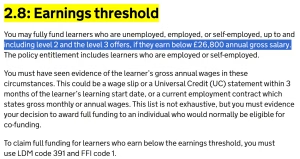
The official Adult Skills Fund 2026–2027 rules showing the £26,800 earnings threshold and full-funding provisions.
Can Beginners Study Cyber Security for Free Without IT Experience?
Yes. Beginners can access introductory cyber security qualifications without necessarily having previous employment in IT.
One established entry route is the Level 2 Certificate in the Principles of Cyber Security.
This qualification introduces the risks, terminology and security practices that employees and individuals encounter when using digital systems.
Typical learning topics include:
- Identifying phishing emails, scams and malicious websites.
- Understanding malware, ransomware and unauthorised access.
- Recognising the risks associated with passwords and user accounts.
- Understanding data protection and information security responsibilities.
- Applying basic network and device security practices.
- Recognising security incidents and appropriate reporting procedures.
These skills are directly relevant to administrative staff, finance teams, customer service employees and people considering their first technology-related position.
For example, an employee working with supplier payments should understand how criminals impersonate colleagues or vendors.
The increasing sophistication of AI-powered phishing demonstrates why basic cyber awareness now matters outside specialist IT departments.
A Verified Online Level 2 Course Example
Activate Learning advertises an NCFE Level 2 Cyber Security course delivered through online independent study.
Its published 2026–2027 offering includes a course running into July 2027, with flexible starts and assessor support.
The advertised course is free for applicants meeting its particular eligibility requirements.
However, students must check postcode eligibility, residency requirements and other restrictions before assuming they can enrol without charge.
A Level 2 qualification is a sensible starting point for people without technical experience, but it should not be confused with professional certification as a penetration tester or security engineer.
Which Level 3 Cyber Security Qualifications Have Government Funding Approval?
For learners who want to progress beyond basic security awareness, Level 3 training can provide a more substantial vocational foundation.
Our research identified specific cyber security qualifications appearing on the government’s official list of qualifications approved for funding.
| Qualification | Awarding organisation | Relevant funding approval | Current approved end date |
| Level 3 Certificate in Cyber Security Practices | NCFE | Free Courses for Jobs | 31 July 2028 |
| Level 3 Technical Occupational Entry in Cyber Security (Diploma) | NCFE | Free Courses for Jobs | 31 July 2028 |
| Level 3 Technical Occupational Entry for Cyber Security Technician (Diploma) | Pearson | Free Courses for Jobs | 31 July 2028 |
These approval dates establish that the qualifications remain within the relevant funding framework into 2027.
They do not confirm that a particular provider will offer funded places throughout that period.
Applicants should search using the complete qualification title because similarly named courses can have different awarding bodies, funding status and assessment requirements.
What Skills Does Level 3 Training Develop?
Depending on the qualification, Level 3 study may introduce:
- Security principles and organisational risk management.
- Cyber threat intelligence.
- Vulnerability identification.
- Security testing concepts.
- Incident detection and response.
- Legal and ethical responsibilities.
- Technical communication and professional practice.
For business owners, employees who understand these subjects can contribute to stronger internal processes.
For career changers, the same knowledge can provide a foundation for more advanced technical training or applications for junior IT security roles.
However, practical experience remains important. Completing a knowledge-based qualification does not automatically demonstrate the ability to manage a production security system.
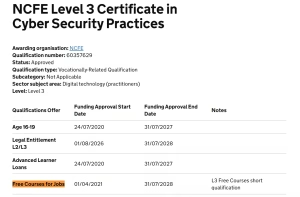
Official qualification funding approval for the NCFE Level 3 Certificate in Cyber Security Practices, showing Free Courses for Jobs approval through 31 July 2028.
Are Cyber Security Skills Bootcamps Worth Considering for a Career Change?
Skills Bootcamps are one of the more employment-focused forms of government-funded adult training in England.
They are flexible programmes lasting up to 16 weeks and are designed around workforce needs.
Eligible learners can complete funded training while developing skills that may help them move into employment, change occupation or progress in their existing role.
A key feature of Skills Bootcamps is the job interview offer for eligible participants completing the programme.
A job interview is not a guaranteed job offer.
This distinction is particularly important when assessing commercial training advertisements.
Cyber Security Bootcamp Example in Buckinghamshire
Buckinghamshire Council lists a Level 4 Cyber Security Skills Bootcamp aimed at people working in the digital sector who want to strengthen their defensive security capabilities.
Its curriculum includes workplace-focused subjects such as:
- Threat identification and analysis.
- Vulnerability assessment.
- Security operations.
- Incident response.
- Organisational security controls.
- Legal and regulatory responsibilities.
The programme is aligned with relevant Level 4 occupational knowledge and skills.
It demonstrates how cyber security bootcamps may provide a more applied learning experience than introductory online awareness courses.
Nevertheless, applicants should verify local availability and whether a programme is suitable for beginners or requires previous technical experience.
A learner with no networking or IT background may benefit from introductory study before undertaking an intensive technical bootcamp.
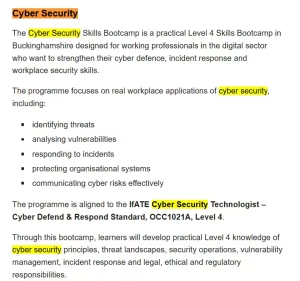
Buckinghamshire Council’s Cyber Security Skills Bootcamp listing.
Who Qualifies for Free Cyber Security Training in 2027?
Eligibility varies according to the funding programme.
The most important factors normally include age, location, residency status, previous qualifications, earnings and employment circumstances.
| Applicant circumstances | Potential funding route | Important eligibility consideration |
| Unemployed adult aged 19+ | Adult Skills Fund, Free Courses for Jobs, Skills Bootcamps | Approved qualification and residency requirements |
| Employee earning below £26,800 | Adult Skills Fund or Free Courses for Jobs | Threshold applies to relevant DWP-funded provision |
| Employee earning above £26,800 | Skills Bootcamp, apprenticeship or another eligible entitlement | Programme-specific rules |
| Self-employed professional | Skills Bootcamp or qualifying adult learning | Funding rules and regional availability |
| Learner aged 19–23 without a full Level 3 | Level 3 legal entitlement | Previous qualifications and residency |
| Existing IT employee | Apprenticeship or advanced technical bootcamp | Occupational relevance and eligibility |
| Student aged under 19 | School, college or youth skills routes | Adult Skills Fund criteria generally do not apply |
The previous version of this article presented a three-year residency requirement as if it applied to every applicant.
That is too broad.
Residency eligibility can depend on immigration status, the programme, the funding authority and applicable exemptions.
Applicants should therefore allow the chosen college or training provider to assess eligibility using the current rules.
Can Someone Claiming Universal Credit Study Cyber Security?
Potentially, yes.
Eligible Universal Credit claimants may access approved training, and some can undertake full-time study through qualifying employment-focused programmes while continuing to receive benefits.
However, course participation must remain consistent with their benefit conditions and work-related requirements.
Before enrolling, applicants should discuss training arrangements with their work coach where relevant.
Free course funding and Universal Credit entitlement are separate decisions.
Can Employed People Receive Free Training?
Yes.
Employment does not automatically disqualify an applicant from funded study.
A person working in retail, customer services, financial administration or another occupation may still qualify for a supported course.
However, funding eligibility should be confirmed before changing working hours or making financial commitments.
Where Can You Find Funded Cyber Security Courses in England, Scotland, Wales and Northern Ireland?
Government-funded education differs significantly across the four UK nations.
An applicant should not assume an English training provider’s eligibility rules apply throughout the UK.
| UK nation | Principal routes to investigate | Where to begin |
| England | Adult Skills Fund, Free Courses for Jobs, Skills Bootcamps and apprenticeships | National Careers Service and local skills authorities |
| Scotland | College funding, apprenticeships and supported cyber learning | My World of Work and Skills Development Scotland |
| Wales | Personal Learning Accounts and further education programmes | Careers Wales and participating colleges |
| Northern Ireland | Skill Up and other funded training or apprenticeship opportunities | Department for the Economy and local colleges |
England: Local Funding and Devolved Authorities
Applicants in England should begin with the National Careers Service course search.
Funding and available providers can vary between London, Greater Manchester, the West Midlands and other regions.
The responsibility for some adult skills funding has moved towards devolved regional authorities.
A training provider advertising a course nationally may therefore be unable to provide a funded place to applicants from every postcode.
Scotland: Colleges and Supported Digital Learning
Scotland operates its own education and skills funding arrangements.
Skills Development Scotland provides information about apprenticeships, training and course opportunities.
Some supported programmes provide free introductory cyber security education.
For example, Lead Scotland has advertised Scottish Government-funded cyber security and internet safety learning at SCQF Level 4.
Applicants should check whether places are currently available and whether the course is appropriate for professional career development or basic online safety.
Wales: Personal Learning Accounts
Wales offers Personal Learning Accounts for eligible adults undertaking approved qualifications.
The programme supports priority sectors, including digital skills.
Careers Wales currently identifies a general annual basic salary limit of £35,796 for the programme, while stating that approved digital and green skills courses are not subject to an earnings cap.
This exemption may be especially relevant to employed IT workers seeking advanced cyber security qualifications.
However, the course must be approved for Personal Learning Account funding, and other eligibility conditions still apply.

Careers Wales Personal Learning Accounts eligibility guidance.
Northern Ireland: Skill Up and Further Education
Northern Ireland operates separate employment and training programmes.
Its Skill Up initiative has offered free accredited courses to eligible adults aged 18 and above.
Cyber security applicants should check the current course catalogue and availability through the Department for the Economy and participating further or higher education providers.
Because funding arrangements can change between intakes, applicants should not assume that every previously advertised programme will remain open throughout 2027.
How Much Money Can Government Funding Save on Cyber Security Training?
The principal financial benefit is reducing or eliminating the learner’s tuition fees.
However, calculating the complete value of a course requires more than comparing advertised prices.
A funded course may still involve additional expenses:
| Cost category | Potential financial implication |
| Tuition fees | May be fully covered for eligible learners |
| Professional certification exams | Check whether vouchers are included |
| Laptop or equipment | May require separate expenditure |
| Travel | Relevant to classroom and blended courses |
| Childcare | May be eligible for additional support |
| Time away from paid work | Could affect earnings |
| Resit fees | Depends on provider conditions |
| Withdrawal charges | Must be checked before enrolment |
For example, a worker considering a funded online course may avoid tuition charges but still need to dedicate several hours each week to studying.
An intensive bootcamp may require a larger time commitment, even when tuition is free.
The correct financial calculation is therefore:
Total learner cost = tuition contribution + unavoidable additional expenses + income sacrificed during training.
A business evaluating employee training should also consider productivity, supervision and the ability to apply new knowledge.
For a small company, paying staff to attend relevant training may be commercially justified if the learning reduces operational errors or strengthens internal controls.
However, no course should be described as producing guaranteed financial savings without evidence of the business’s actual results.
Can UK Startups Receive Government Funding to Train Cyber Security Employees?
Yes. Employer-supported training is an important option for startups and small businesses that want to improve technical capabilities without relying entirely on external recruitment.
Apprenticeships and some other approved training programmes can reduce the cost of developing employees.
How the 2026 Apprenticeship Funding Changes Affect Businesses?
For new apprenticeship starts from 1 August 2026 in England, the government funding position depends partly on apprentice age and employer levy status.
| Apprentice age and employer position | Government contribution | Employer contribution |
| Age 16–24, eligible new start | 100% | 0% of eligible training and assessment costs |
| Age 25+, employer does not pay levy | 95% | 5% |
| Age 25+, levy-paying employer with exhausted funds | 75% | 25% |
The percentages apply within the relevant apprenticeship funding band. Costs exceeding the funding band remain the employer’s responsibility.
Consider an illustrative cyber security apprenticeship with an agreed training and assessment price of £10,000, entirely within its permitted funding band.
For an eligible apprentice aged 25 or over:
- A non-levy employer would ordinarily contribute £500.
- Government funding would cover the remaining £9,500.
- A levy employer with exhausted funds would contribute £2,500.
- Government funding would cover £7,500.
These examples explain the funding percentages rather than guaranteeing a particular apprenticeship price.
The employer must still pay the apprentice’s wages and meet its legal employment responsibilities.
New apprentices aged 16–24 may also attract additional hiring payments under the arrangements introduced from October 2026, subject to eligibility.

GOV.UK Apprenticeship Funding guidance showing the government contribution percentages from 1 August 2026.
Why Training Matters Beyond Recruitment?
For growing businesses, cyber security capability should be treated as part of workforce planning rather than an isolated technical expense.
A founder reviewing the company’s digital transformation should consider whether employees can protect the systems they increasingly depend on.
Likewise, effective cloud backup arrangements require employees who understand access controls, recovery procedures and information security responsibilities.
Training alone does not prevent every cyber incident. Its contribution comes from improving the quality and consistency of daily security decisions.
Which Cyber Security Skills Are Most Valuable for UK Employers in 2027?
The most commercially useful training should reflect demonstrable employer requirements.
Research by Ipsos and Perspective Economics for the UK government, published in September 2026, identified skills gaps, recruitment challenges and changes in the cyber security workforce.
The findings suggest that candidates should not focus exclusively on introductory certificates.
Technical knowledge must increasingly be combined with practical experience, risk awareness and the ability to explain security issues to business stakeholders.
The research identified the following skills in cyber security job advertisements covering 2025.
| Skill requested | Percentage of core cyber job postings |
| Cyber security skills | 66% |
| Auditing | 22% |
| Governance | 20% |
| ISO/IEC 27001 | 20% |
| Risk management | 19% |
| Incident response | 18% |
| Microsoft Azure | 16% |
| Automation | 15% |
| Artificial intelligence | 9% |
These percentages refer to advertised vacancies analysed for the research, not to the likelihood of obtaining employment.
AI-related requirements are particularly important.
The same study found that 70% of cyber security businesses reported staff using AI in their day-to-day activities, compared with 53% in the previous year’s research.
Our interpretation is that the most useful courses in 2027 will combine core security principles with practical exposure to cloud security, automation, incident handling and responsible AI use.
For startup teams, continuous learning becomes particularly important because security threats and workplace technologies evolve faster than many formal qualification programmes.
Why Practical Experience Matters?
Government research also highlights an important obstacle for people entering the sector.
Only 16% of core cyber security job advertisements in the analysed period were aimed at applicants with less than one year’s experience.
This demonstrates that a free course can support career development without necessarily overcoming employers’ experience requirements.
A learner should therefore seek opportunities to demonstrate practical competence.
Relevant portfolio activities could include documenting a security assessment in an authorised practice environment, configuring identity controls in a training lab or preparing an incident response exercise.
Practical exercises must be conducted on systems the learner owns or has explicit permission to test.
Can You Get a Cyber Security Job After Completing a Government Funded Course?
A funded qualification may support employment, but the outcome depends on the qualification level, the learner’s existing experience and the requirements of individual employers.
There is a substantial difference between understanding cyber threats and operating professional security systems.
| Career direction | Useful starting training | Further development |
| IT Support Technician | Level 2 cyber security and basic networking | Technical experience and additional IT qualifications |
| Junior Security Operations Analyst | Level 3 cyber security or practical bootcamp | Security monitoring and incident analysis |
| Cyber Security Technician | Occupational Level 3 or apprenticeship | Supervised workplace experience |
| Security Compliance Assistant | Cyber awareness, risk and governance training | Auditing, compliance frameworks and documentation |
| Digital Forensics Technician | Relevant technical apprenticeship | Specialist forensic procedures |
| Cyber Security Consultant | Technical training and experience | Client delivery, security assessment and professional development |
Career changers should examine the recruitment requirements of their target occupation before choosing a course.
For instance, someone planning to develop an IT consulting business will need more than theoretical knowledge.
Clients are likely to expect demonstrable expertise, appropriate professional standards, clear documentation and the ability to manage commercial responsibilities.
Similarly, a person starting a business offering security services should consider insurance, legal responsibilities, service contracts and the limitations of their qualifications.
Is a University Degree Necessary?
Not every cyber security role requires a university degree.
Some careers can begin through apprenticeships, technical education and relevant workplace experience.
However, employers may impose degree or experience requirements for particular specialist positions.
The 2026 labour-market research found that 77% of core cyber job postings sought at least a bachelor’s degree or equivalent.
Prospective learners should therefore avoid assuming that completing one short course will provide access to every specialist role.
How Can You Check Whether a Free Cyber Security Course Is Legitimate?
Not every advertisement describing a course as government-funded gives enough information to establish its funding status.
Before enrolling, we recommend checking the identity of the training provider and the precise nature of the qualification.
A reliable course description should identify:
- The full qualification title and level.
- The awarding organisation.
- The government funding programme.
- The eligibility criteria.
- The funding authority or delivery area.
- Whether certification and assessment fees are included.
- The scheduled learning hours and course duration.
- The arrangements for practical training and assessments.
- Any additional fees, cancellation conditions or withdrawal charges.
- Whether the course provides a regulated qualification, professional certification or certificate of attendance.
These distinctions matter financially.
A short course that provides a participation certificate may be useful for professional awareness, but it should not be advertised as equivalent to a regulated occupational qualification.
Likewise, a provider offering CompTIA Security+ preparation should explain whether the professional examination voucher is included.
Government funding approval, professional certification and general course accreditation are different concepts.
A qualification should be checked against the appropriate government register, while claims of independent course assurance should be confirmed with the relevant assurance body.
How Do You Apply for a Government Funded Cyber Security Course in 2027?
The application process depends on the funding programme, but learners can follow a practical sequence.
Step 1: Identify the Right Qualification
Choose a course that matches your current ability and intended employment outcome.
Beginners may prefer Level 2 training, while applicants with IT experience could investigate Level 3 programmes or practical bootcamps.
Step 2: Find an Approved Provider
Use the National Careers Service, your local authority’s Skills Bootcamp pages or a recognised college.
A useful starting point is the official Free Courses for Jobs guidance, which explains funding eligibility and how to find participating providers.
Step 3: Confirm Personal Eligibility
Ask the provider to establish eligibility according to the applicable funding rules.
Typical evidence may include:
- Proof of identity.
- Proof of address.
- Immigration or residency documentation where applicable.
- National Insurance number where required.
- Evidence of income or benefit circumstances.
- Details of previous qualifications.
Step 4: Obtain Written Confirmation of Funding
Before committing to the course, confirm:
- Whether tuition is fully funded.
- Whether any deposit is required.
- Whether examination fees are included.
- Whether additional learning expenses apply.
- Whether withdrawal or non-completion charges exist.
Step 5: Complete Assessments and Enrolment
Depending on the course, applicants may need to complete a digital skills assessment, eligibility interview or technical suitability exercise.
Bootcamps can involve more demanding entry requirements than introductory certificates.
Step 6: Plan the Employment Outcome
Identify the practical skills, portfolio evidence and career progression opportunities the course should provide.
For employed participants, it may be useful to agree with a manager how learning will be applied in the workplace.
For jobseekers, course completion should be connected to suitable vacancies, interviews and realistic next steps.
What Should Learners Prioritise When Planning Cyber Security Training for 2027?
Our analysis suggests that course selection should begin with an intended outcome rather than an advertised funding percentage.
A beginner whose objective is to improve digital safety in a small company may benefit from free introductory training.
Someone seeking a full-time cyber security career may need a recognised qualification supported by practical exercises and substantial technical learning.
An established IT worker may find that a specialist bootcamp or employer-funded apprenticeship provides better career value.
The following considerations can help distinguish those goals.
| Learner’s objective | Recommended initial approach |
| Improve everyday cyber awareness | Free introductory learning or Level 2 |
| Change career from a non-IT background | Level 2 followed by relevant technical training |
| Move from IT support into security | Level 3, Level 4 bootcamp or apprenticeship |
| Improve startup employee security | Workplace-focused awareness and incident-response training |
| Recruit a junior cyber employee | Consider funded apprenticeship pathways |
| Develop specialist consultancy skills | Advanced training combined with verified practical experience |
| Study while employed | Search for approved flexible online qualifications |
For 2027, learners should also distinguish confirmed course availability from forward-looking announcements.
A qualification approved for funding until 2028 may be available through a provider, but its next intake, allocated budget and individual eligibility must still be checked.
Likewise, a programme announced in 2026 does not automatically imply unrestricted enrolment throughout 2027.
Conclusion
Government funded cyber security courses in the UK offer valuable opportunities for people seeking practical digital skills, recognised qualifications or career progression during 2027.
The most useful options include approved Level 2 and Level 3 qualifications, Skills Bootcamps, apprenticeships and regional training schemes.
The 2026 funding changes make eligibility, employer contributions and provider selection particularly important.
For learners, the strongest financial benefit comes from combining funded education with relevant practical experience. For startups, investing in cyber security skills can support workforce development and operational resilience.
Before enrolling, confirm the qualification, funding status, costs and realistic employment outcomes.
Frequently Asked Questions
Are government funded cyber security courses completely free in 2027?
Some courses are fully funded for eligible learners, including approved adult qualifications and Skills Bootcamps. However, fees for equipment, exams or other expenses may still apply depending on the provider.
Can I complete a free cyber security course entirely online?
Yes. Some Level 2 and Level 3 qualifications offer online study. More advanced courses and apprenticeships may involve supervised practical assessments or workplace learning.
What is the income limit for government funded cyber security training?
The relevant earnings threshold under the DWP-funded Adult Skills Fund rules for 2026–2027 is £26,800 gross annually. Different arrangements may apply in devolved areas and under other funding programmes.
Can I study cyber security for free after the age of 40 or 50?
Yes. Many adult training programmes have no general upper age limit. Applicants must still meet the qualification, residency, income and other applicable funding requirements.
Are cyber security Skills Bootcamps guaranteed to provide employment?
No. Eligible participants can receive a job interview offer following successful completion, but this does not guarantee employment. Recruitment depends on employer decisions and candidate suitability.
Does the government pay for CompTIA Security+ certification?
Some funded programmes may include industry certification training and examination vouchers. Applicants should confirm that the specific examination is included rather than assuming government funding covers it.
Can a UK business receive funding to train an existing employee?
Yes. Apprenticeships and some eligible training programmes can support existing employees as well as new recruits. Funding depends on the programme, occupational requirements and employer circumstances.

Blogger | Business Writer | Sharing startup advice on UK business blogs
Related Articles in Startup
View All →
Newscivil Com: Can This Digital News Platform Help UK Startups Spot Emerging Trends?
For startup founders, staying informed is no longer simply about reading the business pages each morning. Artificial intelligence, changing consumer habits, technology developments, government decisions and wider social…

Meet the Startup Turning Screen Time Into a New Way to Make Money
Britain does not exactly have a shortage of side hustles. You can deliver takeaways, sell clothes online, start freelancing, walk dogs, tutor in the evenings or attempt to…

8 Best Coworking Spaces for Bootstrapped London Startups to Launch and Scale in 2026
Bootstrapped founders don’t have the luxury of a fitted-out HQ from day one. What you need is a London coworking space that flexes with you: a hot desk…