
How to Check if a Tradesman Is Insured in 2027? UK Insurance Verification Guide

UK Startup Blog Archive
Table of Contents
Hiring a tradesman without checking their insurance can expose homeowners, landlords and businesses to unexpected financial risks.
Whether you need a plumber, electrician, roofer or building contractor, confirming the right insurance is an important step before work begins.
To check if a tradesman is insured in the UK, ask for their current insurance certificate or policy schedule, check the business name, insurer, policy dates and cover limits, and verify any uncertainties directly with the insurer or broker. Make sure the policy covers the actual work being carried out.
Public liability insurance is particularly important because accidents involving third-party injury or property damage can result in expensive claims. However, having insurance does not automatically mean every type of damage is covered.
For 2027, our analysis focuses on a practical distinction: the difference between a tradesman having insurance and having insurance that is appropriate for your particular job.
How Can You Check if a Tradesman Is Insured in the UK?
The most reliable approach is to verify the documentation, business identity and insurance conditions before agreeing to the job.
1. Ask for a Current Insurance Certificate
Request a copy of the tradesman’s public liability insurance certificate, evidence of cover or policy schedule.
Check the following information:
| Insurance detail | What you should verify |
| Policyholder | Matches the tradesman or contracting business |
| Insurance company | A genuine, identifiable insurer |
| Policy number | A reference that can be checked |
| Policy dates | Cover is active throughout the planned work |
| Cover limit | Appropriate for the project’s financial risks |
| Business activities | Includes the actual trade and work proposed |
| Exclusions | No restrictions that make the cover unsuitable |
Some documents summarise the insurance without showing every exclusion. Request the relevant policy wording or written clarification where necessary.
For a clearer explanation of how these policies operate, understanding public liability is a useful starting point.
2. Check the Tradesman’s Legal Business Name
Compare the insured business name with the quotation, invoice and company information.
A limited company can be checked through Companies House, while a sole trader may operate under a trading name different from their personal name.
A company registration does not prove insurance exists. However, it helps establish whether the business providing the quotation is the same entity named on the policy.
If the names differ, ask for clarification before proceeding.
3. Verify the Insurer Using the FCA Register
The Financial Conduct Authority maintains a public register of regulated financial services firms.
You can use it to check whether the named insurer or intermediary is appropriately authorised or registered.
Visit the official FCA Financial Services Register and search using the insurer’s name or firm reference number.
Important: The FCA register verifies financial firms and their regulatory status. It does not confirm that an individual tradesman has an active public liability insurance policy.
For policy-level confirmation, contact the insurer or broker using independently verified contact details. They may require the tradesman’s permission before disclosing information.
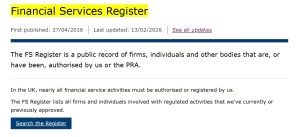
Checking an insurance provider using the FCA Financial Services Register.
4. Confirm That the Insurance Covers the Specific Work
This is one of the most important checks.
A general handyman policy might cover painting and minor repairs but exclude roofing, structural alterations or certain electrical work.
Similarly, a plumber’s insurance may not automatically cover gas appliance installations.
Ask whether the precise work described in your quotation is included.
For high-risk work, request confirmation of any relevant restrictions involving:
- Working at height, roofing or structural work
- Heat-producing equipment and hot works
- Excavation, demolition or work below ground
- Subcontractors and specialist activities
- Damage to property being worked on
If an exclusion could affect your project, ask the insurer or broker to clarify the position in writing.
5. Check the Insurance Expiry Date and Cover Limit
An insurance certificate issued in 2026 might expire before work starts or finishes in 2027.
Check both the commencement and expiry dates, particularly for projects lasting several months.
Also check whether the policy has an adequate financial limit. A larger limit is not automatically better if the policy excludes the work being performed.
6. Keep Written Evidence Before Work Starts
Save the certificate, any confirmation from the insurer, the quotation and the final contract.
For longer projects, request updated proof when a policy renews.
This gives both parties a clear record of the insurance arrangements agreed before work began.
What Types of Insurance Should a Tradesman Have?
Different insurance products protect against different risks. A tradesman’s business insurance package may contain several policies, depending on their occupation and workforce.
| Insurance type | Main purpose | When to check |
| Public liability | Certain third-party injury and property damage claims | Most work at customer premises |
| Employers’ liability | Employee injury and occupational illness claims | When the business employs staff |
| Professional indemnity | Certain claims involving professional advice, errors or design | Architects, designers and technical contractors |
| Contractors’ all-risk | Damage or loss involving construction works and materials | Extensions and substantial building projects |
| Tools and equipment | Damage, loss or theft of the tradesman’s equipment | Relevant to contractors, but not a substitute for liability cover |
Is Public Liability Insurance Legally Required?
Public liability insurance is generally not compulsory for tradespeople in the UK.
However, commercial clients, local authorities and trade membership schemes may require contractors to hold it.
For example, an electrician working in an occupied office could accidentally damage equipment or cause an injury. Suitable public liability cover may respond to an insured legal liability claim arising from that incident.
The precise protection depends on the policy.
Our analysis of public liability insurance for small businesses also highlights why cover limits, exclusions and business activities should be considered together.
When Is Employers’ Liability Insurance Compulsory?
Employers’ liability insurance is normally a legal requirement when a business has employees, although certain exemptions apply.
Under the rules in force in November 2026, the minimum compulsory cover is £5 million.
A business that fails to obtain compulsory cover can face fines of up to £2,500 for each uninsured day.
This requirement is different from public liability insurance.
A sole trader working alone will not normally need employers’ liability insurance, but the position can change when employees or certain labour-only subcontractors are involved.
Businesses can assess the financial implications through the guidance on employers’ liability insurance costs.
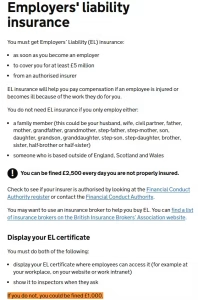
GOV.UK explains the £5 million minimum employers’ liability insurance requirement and the penalties for non-compliance.
Does a Builder Need Professional Indemnity Insurance?
Professional indemnity insurance becomes particularly relevant when a contractor provides professional design, specifications or technical advice.
For example, an architectural designer could make a professional error that leads to additional construction expenses.
Ordinary public liability insurance may not respond to that type of purely financial loss.
The appropriate level of cover depends on the design responsibility, contractual obligations and potential financial exposure.
This is why professional indemnity needs to be considered separately from general liability insurance.
How Much Public Liability Insurance Should a Tradesman Have in 2027?
There is no universal statutory public liability insurance minimum for all UK tradespeople.
Typical insurance limits available in the market include £1 million, £2 million and £5 million, with larger amounts available for more demanding projects.
The right limit depends on the nature of the job, the property, contractual conditions and potential losses.
| Project | Insurance consideration |
| Interior decorating | Property damage and accidental injury |
| Plumbing repairs | Escape-of-water damage and relevant exclusions |
| Roofing | Working-at-height risks and damage to neighbouring property |
| Electrical installation | Insured electrical activities and resulting property damage |
| Commercial refurbishment | Client-required limits and multiple contractors |
| Structural renovations | Existing structures, contract works and specialist exclusions |
A commercial client may require £5 million in public liability cover even though this is not a general legal minimum.
From a financial risk perspective, the value of the contract alone should not determine the insurance limit.
A relatively inexpensive repair could still cause extensive damage to an expensive property.
Can You Check a Tradesman’s Insurance Online Without Asking Them?
There is currently no universal public UK database that allows someone to enter a tradesman’s name and independently confirm every active public liability policy.
The most practical checks are to obtain the relevant documents and confirm their validity with the insurer or broker.
Trade directories sometimes indicate whether they have checked insurance evidence. However, verification may reflect the documents reviewed on a particular date rather than live insurance status.
It is also important to distinguish between insurance and professional registration.
For example, an engineer’s Gas Safe registration confirms their registration and relevant qualifications for gas work. It does not independently establish that their public liability policy is active.
Similarly, an electrician’s trade registration does not replace checking their insurance.
For regulated work, both checks matter.
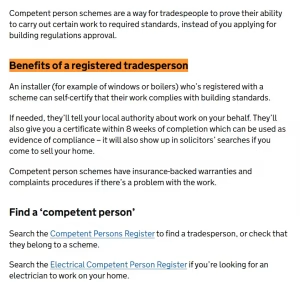
Checking whether a tradesperson belongs to a relevant Competent Person Scheme.
What Should You Check for Different Types of Tradespeople?
The insurance questions should reflect the contractor’s actual work rather than relying on a generic certificate.
| Tradesperson | Important insurance or credential check |
| Plumber | Public liability and escape-of-water-related conditions |
| Electrician | Electrical work included in cover; appropriate technical registration |
| Roofer | Working-at-height activities and roof-related exclusions |
| Builder | Public liability, contract works and subcontractor arrangements |
| Gas engineer | Gas Safe registration, relevant work categories and suitable insurance |
| Cleaner | Property damage, accidental injury and employee cover where applicable |
| Handyman | Whether the intended activities are included or excluded |
A self-employed handyman doing basic maintenance presents different risks from a contractor managing a structural renovation.
When comparing a handyman’s quoted rate, consider the work included, insurance position and the contractor’s experience instead of focusing only on the hourly price.
Commercial cleaning firms should also consider their employment arrangements and the insurance obligations that can arise when they expand. Those requirements form part of the broader process of starting a cleaning business.
For major projects, ask whether the main contractor’s insurance extends to the work of subcontractors or whether each specialist must maintain separate cover.
Does a Tradesman’s Insurance Cover Bad Workmanship or Accidental Damage?
This is an important distinction that homeowners and businesses should understand before hiring.
Public liability insurance may cover accidental damage caused by insured business activities where the tradesman is legally liable and the policy responds.
However, it does not automatically pay to correct poor workmanship.
Consider two different situations.
Example 1: Accidental Property Damage
A plumber accidentally damages an adjoining room while completing an insured installation.
Depending on the policy wording and circumstances, the resulting property damage could fall within public liability cover.
Example 2: Defective Installation
A contractor installs a kitchen cabinet incorrectly, and it needs to be removed and fitted again.
The cost of correcting that workmanship may not be insured under an ordinary public liability policy.
The customer may instead need to rely on contractual rights, consumer protection or a relevant guarantee.
A written agreement is therefore just as important as appropriate insurance. Understanding what makes a contract legally binding can help homeowners and businesses establish responsibility for defective work.
What Should Homeowners Check About Their Own Insurance?
Checking the tradesman’s insurance is only one part of protecting a renovation project.
Homeowners should contact their buildings insurer before substantial alterations, extensions or structural work.
Some policies restrict or alter cover during major building projects, while others may require additional protection.
This can be particularly important for older properties or homes built using unusual materials, where specialised home insurance may already be necessary.
Ask your insurer whether the planned work affects your existing policy, and whether joint or additional contract works insurance is advisable.
A contractor’s insurance should not be assumed to replace the homeowner’s buildings insurance.
What Are the Warning Signs of an Uninsured Tradesman?
Insurance verification should happen before paying a substantial deposit or allowing work to begin.
Warning signs include an expired certificate, an unexplained difference between the insured name and the contracting business, or a refusal to provide basic policy details.
Be cautious if the contractor claims to be fully insured but cannot identify the insurer or clarify the work covered.
Similarly, a screenshot of a certificate without sufficient details should not be treated as conclusive evidence.
A genuine insurance certificate is evidence worth checking, not a guarantee that every possible claim will be accepted.
For substantial projects, the written quotation should also identify who is responsible for materials, subcontractors, damage, rectification work and site safety.
What Should You Do if a Tradesman Refuses to Show Insurance?
A tradesman is not generally required by law to show a customer a public liability insurance certificate.
However, customers are entitled to ask for evidence and decide whether to proceed.
If a contractor is reluctant to share the policy documentation, ask whether their insurer or broker can provide a suitable confirmation of cover.
You can make evidence of appropriate insurance a condition of the contract before work starts.
Where uncertainty remains unresolved, obtaining alternative quotations from contractors willing to verify their cover is a reasonable commercial decision.
For a larger project, request a written statement such as:
Before confirming the work, please provide evidence of your current public liability insurance, including the insured business name, policy period, cover limit and confirmation that the proposed activities are covered. Please also confirm the insurance arrangements for any subcontractors.
This creates a practical record without requesting unnecessary personal information.
Final Checklist Before Hiring a Tradesman in 2027
Before confirming a tradesman, make sure the business identity, insurance documentation, policy dates and covered activities have been checked.
For larger or higher-risk projects, obtain clarification of important exclusions, subcontractor arrangements and responsibility for damage to existing property.
The most effective approach is not simply to find a contractor who says they are insured. It is to establish that the correct legal business holds appropriate, current insurance for the work you are paying it to complete.
Insurance verification, proper trade credentials and a clear written contract together provide stronger protection for homeowners, landlords and businesses than any one document alone.
Frequently Asked Questions
How do I know if a builder has public liability insurance?
Ask the builder for their insurance certificate or policy schedule, check the insured name, dates and cover limit, and seek confirmation from the insurer or broker where necessary.
Can I check a tradesman’s insurance with their name?
There is no universal public insurance search covering all UK tradespeople. The tradesman’s name can help you verify their business identity, but policy verification normally requires documentation.
Is a self-employed tradesman required to have insurance?
Public liability insurance is generally optional unless required by a contract or relevant scheme. A self-employed person who hires employees may become legally required to hold employers’ liability insurance.
Does Checkatrade guarantee that a tradesman is insured?
A directory may undertake insurance checks as part of its vetting process, but you should confirm what was checked and when. Request up-to-date evidence for your particular project.
Can a tradesman work without public liability insurance?
Generally, yes. However, they may be unable to meet contractual insurance requirements, and an uninsured claim could create significant financial difficulties.
What happens if an uninsured tradesman damages my property?
You may be able to pursue the tradesman for the damage or obtain a remedy under your contract and applicable consumer law. Whether compensation is recoverable depends on the circumstances and the contractor’s ability to pay.

Blogger | Business Writer | Sharing startup advice on UK business blogs
Related Articles in Startup
View All →
Newscivil Com: Can This Digital News Platform Help UK Startups Spot Emerging Trends?
For startup founders, staying informed is no longer simply about reading the business pages each morning. Artificial intelligence, changing consumer habits, technology developments, government decisions and wider social…

Meet the Startup Turning Screen Time Into a New Way to Make Money
Britain does not exactly have a shortage of side hustles. You can deliver takeaways, sell clothes online, start freelancing, walk dogs, tutor in the evenings or attempt to…

8 Best Coworking Spaces for Bootstrapped London Startups to Launch and Scale in 2026
Bootstrapped founders don’t have the luxury of a fitted-out HQ from day one. What you need is a London coworking space that flexes with you: a hot desk…