
The Low-Cost Physical Touches That Makes New Business Look Established


UK Startup Blog Archive
Most founders spend their first branding pound on a logo, a website and a fistful of social ads, then wonder why the brand still feels thin. The reason is simple: customers don’t only meet you on a screen.
They hold your invoice, open your parcel, walk past your stand, shake your hand at an event. Startup branding on a budget isn’t about spending more on the digital layer, it’s about claiming the physical moments you already own.
A handful of cheap, tangible touches can make a three-month-old business look like it has been trading for years. Here’s where to put that small budget to work.
How Can Startup Branding Look Established on a Small Budget?
Branding is More Than a Logo and a Website

A brand is the sum of every impression a person forms about you, and a surprising share of those impressions happen offline. The founder who pours everything into a slick homepage but hands over a blank, hand-scrawled receipt is leaking credibility at exactly the point the customer is paying attention.
Brand consistency is what reads as “established”, the same name, the same mark, the same tone showing up wherever the customer touches the business. The good news for anyone watching cash flow is that physical consistency is cheap.
You don’t need bespoke print runs or a brand agency. You need your existing logo applied, sensibly and repeatedly, to the things customers already see.
Low-cost marketing, done well, is mostly about coverage and repetition rather than production value. Decide what your brand looks like once, then make sure first impressions line up everywhere, from the packing slip to the shop door.
It helps to think in terms of touchpoints rather than channels. List every moment a real person physically interacts with your business in a typical week, the parcels you post, the cards you hand over, the desk you sit behind at a market.
Most early-stage founders find a dozen or more, and most of those moments are currently blank. Each blank one is a small, free opportunity you’re not yet taking.
The Custom Stamp: Your Cheapest Brand Workhorse
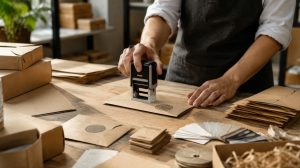
If you only invest in one physical branding tool, make it a custom stamp. For roughly £15 to £40, a self-inking rubber stamp turns plain, unbranded materials into branded ones in a single press, and it keeps doing so for thousands of impressions before it needs re-inking.
That cost-per-use is hard to beat, a one-off outlay against a near-unlimited number of touchpoints. The versatility is the point. One stamp can brand outer packaging and mailers, thank-you cards, loyalty cards, invoices, compliment slips and plain envelopes.
It works on kraft paper, tissue, card and cardboard, where small-batch printing would be expensive and slow. For founders who want their packaging branding to look intentional without committing to printed boxes, suppliers such as Otypo produce custom stamps from your own logo or text, which is often the fastest route from “plain” to “branded”. The result reads as deliberate even though the spend is tiny.
There’s a practical reason it beats printing early on, too. Printed packaging means minimum order quantities, upfront cost and a design you’re locked into until the pallet runs out.
A stamp scales with you instead of ahead of you. Order it today, use it tonight, and replace it cheaply when your logo evolves. For a business still finding its feet, that flexibility is worth as much as the savings.
Where a Stamp Earns Its Keep?
Use it on the moments that already carry emotional weight. A thank-you card stamped with your mark turns a transaction into a relationship.
A loyalty card that looks part of a system, rather than a printed afterthought, encourages a second visit. Even an invoice gains a little authority when it carries a consistent brand. None of this requires design skill, just the discipline to stamp the things you’d otherwise leave blank.
Signage the Day You Go Physical
The moment you take a stall at a market, run a pop-up or sign for a first desk, you need to be findable and recognisable. Signage is where many founders assume the cost jumps, but it doesn’t have to.
A simple printed banner, a foam-board sign or a vinyl logo for a window costs far less than a permanent fascia and does the job for an early-stage presence.
Keep it readable from a distance and keep it consistent with everything else, same logo, same colours, same name treatment.
A market stall with a clean branded banner looks like a real business, the same stall with an A4 sheet taped to the front looks like a hobby. The difference in cost is small. The difference in first impressions is not.
One caveat worth knowing, if you put a pavement sign or A-board outside a unit, some local councils require a licence and most set rules on size and placement. It’s a quick check with your local authority, and getting it right avoids a fine that would dwarf the cost of the sign itself.
Name Badges and Branded Touches at Events

Networking events, trade shows and first demos are where founders meet the people who can change the trajectory of the business, and where a tiny amount of branding goes a long way.
Simple name badges with your logo make a two-person startup look like a team, signal that you take the occasion seriously, and quietly make you easier to remember after a room full of introductions.
The same logic extends to the small things you hand over, a branded folder, a stamped business card, a compliment slip in a sample bag. Each is a low-cost cue that you operate to a standard. People extrapolate from details, give them good ones to extrapolate from.
Get the Digital and Physical to Match
The touches above only compound if they look like they belong together. The logo on your stamp should be the logo on your website, the colours on your banner should be the colours on your invoices.
Mismatched versions, an old logo here, a slightly different shade there, read as carelessness, and carelessness is the opposite of “established”.
Before you order anything physical, lock down one master version of your logo and a short note of your exact colours and fonts, then apply it everywhere without deviation.
This is also the cheapest way to look bigger than you are. A customer who sees the same tidy identity on your site, your parcel and your thank-you card assumes there’s a system behind it, and a system implies a real, functioning business. You’re not faking scale, you’re simply refusing to leak the credibility you’ve already earned.
Startup Branding on a Budget: Consistency on a Shoestring
The thread running through all of this is that looking established is less about budget than about coherence.
A stamp, a banner and a set of badges might cost less than a single month of ads, yet together they make a young brand feel settled and serious across every physical encounter.
Pick the touchpoints your customers actually meet, apply your brand consistently, and let the small, tangible details do the convincing that a logo alone never can.
FAQs – Startup Branding on a Budget
How much should an early-stage startup spend on physical branding?
Far less than most founders expect. A custom stamp (£15–£40), a simple banner or window vinyl, and a set of branded name badges can together cost less than a single month of online ads. The priority is consistency across the touchpoints customers actually see, not high production budgets, so start with the items you already hand over blank.
Why is a custom stamp good value for a new business?
A self-inking stamp is a one-off cost that brands thousands of items before re-inking, giving an extremely low cost-per-use. One stamp can mark packaging, thank-you cards, loyalty cards, invoices and envelopes, turning plain materials into branded ones without committing to expensive small-batch printing. That flexibility makes it the cheapest reliable workhorse in a bootstrapped branding kit.
What physical touchpoints matter most for first impressions?
Focus on the moments customers already experience: packaging and thank-you notes, invoices and compliment slips, any signage when you go physical, and name badges at events. These carry emotional or social weight, so consistent branding there does the most work. A coherent logo, colour and name treatment across them is what makes a young business read as established.
Do name badges really make a difference for a small team?
Yes, far more than their price tag implies. At networking events, trade shows and first demos, branded badges make a two-person startup look like an organised team, signal that you take the occasion seriously, and make you easier to recall afterwards. People judge professionalism from small cues, and a tidy badge is an inexpensive one that consistently reads well.

Blogger & Content creator | An insightful writer sharing practical advice for UK entrepreneurs
Related Articles in Business
View All →
Shell Petrol Station Franchise Cost in the UK: Real Investment, Income and Process
If you are searching for the Shell petrol pump franchise cost in the UK, the first thing to understand is that Shell does not currently advertise its UK…

Is Raising Cane’s Opening in the UK? | London Locations Revealed
Yes, Raising Cane’s is officially coming to the UK. The American chicken restaurant brand plans to open its first UK restaurant at 22 Coventry Street in London’s West…
Best Parking App UK: 10 Startup-Led Parking Apps Compared for 2026
For most drivers, JustPark is the best parking app UK users can consider in 2026 because it combines parking search, advance booking and app-based payments in one platform.…