
Chick-fil-A Franchise Cost in 2026: UK Investment, Fees, Profits and Requirements

UK Startup Blog Archive
Table of Contents
The Chick-fil-A franchise cost in the UK is approximately £10,000, making it an unusually accessible entry point into the international fast-food franchise market. In the United States, the company separately advertises an initial franchise fee of $10,000.
However, this low investment comes with an important distinction. Chick-fil-A operates a unique Owner-Operator model in which selected entrepreneurs manage restaurants rather than purchasing the premises and building an independently saleable restaurant asset.
As Chick-fil-A expands across Britain, interest in its franchise opportunities is growing among hospitality professionals, experienced managers and aspiring entrepreneurs.
The financial opportunity looks attractive at first glance, but understanding the operating agreement, ongoing fees, earning potential, selection process and restrictions is essential before applying.
This guide examines the Chick-fil-A franchise cost in 2026, with particular attention to UK opportunities and the differences between operating a restaurant and owning a conventional franchise business.
How Much Does a Chick-fil-A Franchise Cost in the UK in 2026?
Chick-fil-A has publicly identified approximately £10,000 as the initial investment for a UK Owner-Operator. It is substantially below the initial investment normally associated with establishing a large quick-service restaurant.
The crucial point is that the £10,000 is not the full development cost of a restaurant.
Chick-fil-A supports restaurant establishment through its corporate investment model, while the franchisee concentrates on operating the business, recruiting employees, developing the team and serving the local community.
| Cost component | UK position in 2026 |
| Initial Owner-Operator investment | Approximately £10,000 |
| Restaurant property acquisition | Not a conventional property purchase by the Operator |
| Construction and restaurant fit-out | Supported through Chick-fil-A’s corporate model |
| Kitchen equipment | Provided through the brand’s operating arrangements |
| Initial stock and working capital | Exact UK contractual allocation not publicly detailed |
| Ongoing franchise charges | Individual UK terms require confirmation |
| Guaranteed annual income | None publicly established |
| Property ownership | Not automatically transferred to the franchisee |
| Business involvement | Full-time, hands-on operation |
The approximately £10,000 figure is supported by Chick-fil-A’s official UK announcements. However, prospective franchisees should obtain the latest investment schedule and contractual details directly from the company before making financial commitments.
An entrepreneur researching the broader UK franchise market might compare this arrangement with the Pepe’s franchise cost, where the investment structure includes restaurant fit-out and other substantial startup expenses.
The two models serve different financial objectives. Chick-fil-A primarily offers an opportunity to operate a recognised restaurant business, while many conventional franchises allow entrepreneurs to build equity in a separately owned business.
Why Is the Chick-fil-A Franchise So Cheap?
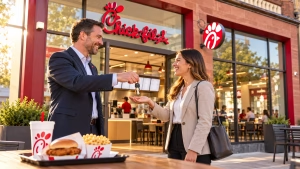
The Chick-fil-A business model differs substantially from traditional restaurant franchising.
In a conventional franchise, entrepreneurs commonly finance the premises, equipment, refurbishment, initial stock and opening expenses. They then pay an ongoing royalty for the right to use the brand.
Chick-fil-A reduces much of the initial capital burden through its corporate-funded restaurant model.
The company can exercise considerable control over its locations, brand standards, operating systems and selection of franchisees.
For approved Operators, the attraction is access to an established restaurant concept without personally financing the full physical development cost.
However, the trade-off is significant.
Operators accept strict contractual arrangements, substantial management responsibilities and limitations on their ability to treat the restaurant as a transferable investment.
From a business perspective, the lower initial capital requirement does not necessarily mean the franchise generates a higher investment return than alternatives.
An established Operator could earn substantial income from a successful location, but may not accumulate the same saleable business equity as an entrepreneur who owns their restaurant premises, equipment or independently transferable franchise business.
What Does the Chick-fil-A Franchise Fee Actually Cover?
The initial investment provides entry into a structured business relationship rather than outright ownership of a fully developed restaurant.
Successful franchisees can benefit from an established brand, an operational framework, menu development, training, marketing support and corporate infrastructure.
Chick-fil-A is especially recognised for its focused chicken menu, customer-service approach and consistent operational standards.
The company also benefits from selecting Operators who commit directly to managing their locations rather than delegating everything to salaried managers.
A franchisee’s responsibilities generally include overseeing daily restaurant operations, maintaining customer-service standards, recruiting and developing staff, managing restaurant performance and representing the brand locally.
This means entrepreneurs must consider their personal commitment alongside their financial investment.
A restaurant business requiring long working hours, large teams and continuous operational oversight cannot be evaluated in the same way as a passive property investment.
The wider commercial considerations are similar to those facing entrepreneurs evaluating a Pizza Hut franchise, although the contractual models and capital requirements are different.
What Are the Ongoing Chick-fil-A Franchise Fees?
One of the most important questions is how much income an Operator retains after paying the brand’s ongoing charges.
The US model offers a useful insight, although its contractual percentages should not automatically be treated as the terms offered to UK franchisees.
Under the 2026 US Franchise Disclosure Document, the fee arrangements include an operating service fee calculated with reference to 15% of gross receipts, with specified equipment-rental and business-service adjustments, together with an additional fee based on 50% of defined net profit.
| Fee | US franchise disclosure | UK position |
| Initial franchise fee | $10,000 | Approximately £10,000 |
| Base operating service fee | Calculated with reference to 15% of gross receipts, subject to contractual adjustments | Current UK percentage not publicly confirmed |
| Additional operating service fee | 50% of defined net profit | Current UK percentage not publicly confirmed |
| Advertising contributions | Varies under the US agreement | UK arrangement requires confirmation |
| Premises and equipment charges | Governed by contractual arrangements | UK arrangement requires confirmation |
These US fees must not be interpreted as simply deducting 65% from restaurant turnover.
Gross receipts and net profit are different measures. The base service fee also interacts with other specified charges under the agreement.
The definition and timing of net profit are therefore particularly important.
A prospective UK Operator should request a written explanation of revenue sharing, allowable operating expenses, fees, profit distribution, tax treatment and any other deductions before signing an agreement.
How Much Revenue Does a Chick-fil-A Restaurant Generate?
Chick-fil-A has demonstrated strong sales performance in its established US market.
Figures reported from its 2026 US Franchise Disclosure Document provide a useful benchmark for understanding the commercial scale of the brand.
The 2025 figures covered eligible US restaurants operating throughout the year.
| Restaurant type | Average annual US sales | Median annual US sales |
| Non-mall restaurants | $9.16 million | $9.09 million |
| Shopping-mall restaurants | $4.58 million | $3.36 million |
| Delivery kitchens | $2.55 million | $2.75 million |
The non-mall figures covered 2,302 restaurants, while the mall results covered 201 and the delivery-kitchen category only three. Approximately 49% of the non-mall restaurants achieved sales at or above their category average.
These figures demonstrate the revenue potential of established US locations, but they are not forecasts for British restaurants.
The UK market has different property costs, labour requirements, consumer spending patterns, delivery economics and levels of brand recognition.
Furthermore, restaurant sales are not the same as franchisee earnings.
A restaurant generating millions in revenue must still pay for food, employees, premises-related costs, utilities, insurance, operational services and contractual fees before determining its distributable profit.
How Much Profit Can a Chick-fil-A Franchise Owner Make?
There is no verified public UK-wide average annual income figure for Chick-fil-A Owner-Operators that prospective franchisees can responsibly use as a guaranteed earning expectation.
US restaurant sales figures should not be converted into a UK franchisee income forecast.
However, a financial sensitivity example demonstrates why operating margins matter.
Consider a hypothetical UK restaurant generating £2 million in annual sales.
If labour costs increase by two percentage points of revenue, annual operating costs rise by £40,000, assuming other factors remain unchanged.
The additional expenditure reduces the restaurant’s operating surplus before considering how contractual profit-sharing arrangements allocate the resulting change.
This is particularly relevant in hospitality, where restaurant operators must manage staffing, food waste, ingredient prices and service quality simultaneously.
For franchisees, an effective business plan should therefore calculate expected earnings under pessimistic, central and optimistic trading scenarios.
These scenarios should distinguish between total restaurant revenue, operating profit before brand fees, contractual distributions, the Operator’s income and personal tax.
Without a properly documented UK agreement and representative trading figures, any online claim that Chick-fil-A franchisees are guaranteed a particular six-figure salary should be treated cautiously.
Does a Chick-fil-A Franchisee Actually Own the Restaurant?
Chick-fil-A describes its franchisees as independent Owner-Operators. They take responsibility for their restaurant businesses, but the relationship differs from acquiring an unrestricted, independently transferable restaurant business and its underlying property.
Under the US structure, the brand retains control of the physical restaurant assets through its corporate arrangements.
The Operator obtains contractual operating rights rather than purchasing the restaurant freehold.
For UK applicants, the exact rights relating to business ownership, renewal, transfer, succession and termination must be checked against the UK franchise agreement.
The distinction matters because a conventional restaurant franchise may offer entrepreneurs opportunities to increase business value over time and eventually sell their interest, subject to the franchise contract.
Someone considering a Five Guys franchise should therefore evaluate the capital required, degree of control, contractual restrictions and potential resale rights, rather than comparing franchise fees alone.
An experienced restaurant manager seeking to operate a recognised international brand may value Chick-fil-A’s relatively modest entry requirement.
An investor primarily interested in creating a saleable multi-site business may prefer a different ownership structure.
Neither approach is automatically superior. The appropriate choice depends on the entrepreneur’s objectives.
What Are the Requirements to Open a Chick-fil-A Franchise?
Chick-fil-A places considerable importance on the personal capabilities and long-term commitment of applicants.
Its official UK materials emphasise leadership, entrepreneurial thinking, community involvement and a willingness to operate restaurants directly.
The company also makes clear that previous experience working at Chick-fil-A is not essential.
According to its UK information, more than 25% of newly selected franchise Operators covered by its published statement had not previously worked for Chick-fil-A.
This means hospitality experience can be advantageous without necessarily being the only acceptable professional background.
A candidate with experience managing a large retail outlet, logistics team or service operation may possess relevant leadership skills.
For context, the US franchise programme publishes requirements including at least five years of professional experience, previous team leadership, suitable financial history, the ability to commit full-time and the legal right to operate a franchise in the United States.
Those are US programme requirements and should not be presented as a confirmed, identical UK eligibility checklist.
The practical qualities a UK candidate should demonstrate include financial discipline, staff management, customer-service leadership, operational decision-making and sustained commitment.
Can Anyone With £10,000 Become a Chick-fil-A Franchisee?
No.
Meeting the financial requirement does not guarantee selection.
Chick-fil-A uses a highly selective process because franchisees are responsible for representing the brand and managing substantial restaurant operations.
Applicants need to demonstrate that they can lead people, maintain service standards and work effectively within the company’s operating model.
The relatively low franchise fee can attract substantial interest, but financial accessibility should not be confused with easy acceptance.
How to Apply for a Chick-fil-A Franchise in the UK?
Chick-fil-A maintains a UK franchise information and application route.
Entrepreneurs should begin through the company’s official UK franchising page, which directs prospective applicants towards the relevant selection process.
The following stages provide a practical preparation framework rather than a guaranteed sequence or timetable published by Chick-fil-A.
- Review the UK opportunity. Examine the Operator model and decide whether full-time restaurant management is compatible with personal and professional commitments.
- Assess relevant experience. Prepare examples of leadership, staff development, commercial performance and customer-service improvement.
- Confirm financial readiness. Establish the availability of the initial investment and obtain clarification of any additional financial obligations.
- Submit an expression of interest. Use the official franchise application route rather than an unverified third-party franchise advertisement.
- Prepare for selection assessments. Be ready to discuss operational problems, leadership decisions, financial management and community engagement if invited.
- Review the proposed agreement. Obtain professional advice on financial distributions, business structure, termination, renewal and other legal obligations.
- Complete the required training. Successful candidates should establish exactly what training, restaurant preparation and corporate support their particular agreement provides.
Candidates should not assume they can independently choose any preferred UK town and purchase an available territory.
Restaurant openings depend on Chick-fil-A’s expansion strategy and selection decisions.
Where Is Chick-fil-A Expanding in the UK?
Chick-fil-A began its permanent UK expansion in 2025 and has continued introducing restaurant locations during 2026.
Its current UK presence includes restaurants in Leeds, Kingston upon Thames and Liverpool, alongside licensed locations in Northern Ireland.
Its Liverpool restaurant opened on 27 August 2026, led by local Owner-Operator David Pritchard.
The company has also announced its first Scottish restaurant and UK drive-thru location at Hamilton Palace Grounds, scheduled to open on 29 October 2026.
Chick-fil-A originally announced plans to invest more than $100 million in Britain over ten years and establish an initial network of five restaurants within its first two years.
This expansion matters for franchise candidates because the brand is still developing its position in the UK restaurant market.
Unlike the United States, where Chick-fil-A benefits from decades of market recognition, its British business must continue building consumer awareness and loyalty.
There is also an important difference between franchised restaurants and licensed outlets.
Chick-fil-A has identified licensing opportunities in venues such as airports, universities, healthcare facilities and other managed food-service environments.
These arrangements are not necessarily equivalent to the independent Owner-Operator opportunity.
British consumers will also see growing competition among American chicken restaurant brands, including the planned expansion discussed in the article on Raising Cane’s in the UK.
What Support Does Chick-fil-A Provide Its Franchisees?
Chick-fil-A’s business model relies on combining corporate systems with local restaurant leadership.
Brand support can reduce some of the complexity that comes with launching an independent restaurant.
Operators benefit from working within an established concept rather than developing an entirely new menu, identity and operating system.
The broader support framework includes franchisee development, restaurant operational guidance, established product standards, marketing resources and brand infrastructure.
Nevertheless, the presence of corporate support does not remove the Operator’s responsibility for restaurant performance.
Recruiting dependable staff, developing managers, controlling labour productivity and delivering a consistent customer experience remain essential.
For example, rapid restaurant growth can create recruitment and training difficulties if management capacity does not expand alongside customer demand.
An Operator who neglects staffing and service quality may experience operational problems despite working with a recognised brand.
The financial strength of a franchise network therefore depends partly on its systems and partly on the capability of individual franchisees.
What Are the Main Risks of a Chick-fil-A Franchise?
Limited Independence
Operators must comply with established brand procedures and contractual requirements.
Entrepreneurs seeking complete independence over menus, suppliers, branding and expansion decisions may find the arrangement restrictive.
Dependence on the Franchise Agreement
The agreement determines the Operator’s business rights, responsibilities, distributions and relationship with the franchisor.
Understanding termination clauses, renewal provisions and what happens to the business if an Operator leaves is particularly important.
Labour-Intensive Management
Quick-service restaurants depend heavily on staff recruitment, training and retention.
A busy location may require a large workforce and considerable management attention.
No Guaranteed Profit
A recognised brand can attract customers, but restaurant earnings still depend on sales volumes, operating costs and contractual financial arrangements.
Restricted Passive Investment Potential
The model is not designed for investors who want to fund a restaurant and delegate all operating responsibilities.
Market Development Risk
The UK operation is newer than Chick-fil-A’s established North American business.
Customer adoption, site economics and local competition could affect trading performance.
Sunday Trading Restrictions
Chick-fil-A traditionally closes its restaurants on Sundays.
This is a distinctive part of the company’s operating philosophy, but it also means the business does not operate on a day when many other UK restaurants trade.
Applicants should consider how a six-day operating week affects potential sales, staffing patterns and customer expectations.
Is Chick-fil-A Better Than a Traditional Restaurant Franchise?
The answer depends primarily on how an entrepreneur defines business ownership and financial success.
| Business consideration | Chick-fil-A Owner-Operator model | Conventional restaurant franchise |
| Initial capital | Relatively low published entry investment | Often substantially higher |
| Property and fit-out investment | Corporate-supported model | Frequently funded by franchisee |
| Operational involvement | Full-time management expected | Depends on franchise agreement |
| Brand control | Highly structured | Also structured, but varies |
| Profit distribution | Governed by distinctive franchise terms | Usually royalties and other fees |
| Business resale | Contractual restrictions require careful review | May be possible subject to approval |
| Passive investment | Not the intended model | Sometimes possible |
| Expansion opportunities | Highly selective | Varies by brand and territory |
Chick-fil-A’s principal financial advantage is reducing the capital required to enter restaurant operations.
However, a lower investment does not automatically create superior profitability, greater control or more opportunities to accumulate business assets.
For someone evaluating restaurant ownership as part of a wider entrepreneurial career, the process of starting a business in the UK involves many of the same foundational decisions about business structure, financial planning, operational risk and long-term goals.
Is a Chick-fil-A Franchise Worth It in 2026?
Chick-fil-A offers an unusual combination of relatively low advertised initial investment, international brand recognition and a structured operating model.
For an experienced hospitality professional who wants to manage a large restaurant without providing the capital normally required for construction and equipment, it could be an attractive opportunity.
However, financial suitability depends on the agreement offered to the individual applicant.
The main question is not simply whether £10,000 is affordable.
It is whether the expected income, working commitments, contractual obligations and long-term business rights provide an acceptable commercial return.
A candidate should seek answers to several issues before proceeding: the precise UK startup payment, all recurring charges, a representative restaurant profit-and-loss statement, average UK Operator earnings, the treatment of losses, contractual termination rights and any additional funding responsibilities.
Independent franchise solicitors and accountants can help identify problems that may not be apparent from promotional material.
For entrepreneurs specifically seeking long-term ownership of transferable business assets, comparison with other restaurant opportunities remains essential.
The Chick-fil-A franchise is therefore best evaluated as an opportunity to operate and develop a restaurant business within an established corporate system, rather than as a low-cost method of purchasing a substantial property-backed asset.
Frequently Asked Questions
How much does a Chick-fil-A franchise cost in the UK?
Chick-fil-A has publicly stated an initial investment of approximately £10,000 for UK Owner-Operators. Applicants should confirm the latest terms and any additional obligations directly with the company.
How much does a Chick-fil-A franchise cost in the USA?
The advertised US initial franchise fee is $10,000. This should not be confused with the full cost of developing and operating a restaurant.
Can I open a Chick-fil-A franchise with £10,000?
Having £10,000 does not guarantee approval. Chick-fil-A assesses applicants’ leadership experience, professional background and commitment to running a restaurant full-time.
How much does a Chick-fil-A franchise owner make per year?
There is no verified public UK-wide average Operator income figure. Earnings depend on restaurant performance, costs and the applicable franchise agreement.
Does Chick-fil-A pay for the building?
Chick-fil-A’s corporate-supported model funds restaurant development rather than requiring Operators to purchase the entire property and equipment package. Exact UK contractual arrangements should be confirmed.
Can you own multiple Chick-fil-A franchises?
Additional restaurant opportunities may be available to selected successful Operators, but expansion is not automatic. Chick-fil-A generally emphasises hands-on, locally involved restaurant leadership.
Is Chick-fil-A accepting UK franchise applications?
Its UK franchising website provides an expression-of-interest and application route. The availability of individual restaurant opportunities remains subject to the company’s selection and expansion plans.
Is Chick-fil-A a profitable franchise?
Its established US restaurants report substantial average sales, but restaurant revenue is not the same as an Operator’s earnings. UK profitability cannot reliably be determined without UK-specific financial information.

Expert Blogger | Strategic thinker anticipating future directions for UK business
Related Articles in Business News
View All →
Shell Petrol Station Franchise Cost in the UK: Real Investment, Income and Process
If you are searching for the Shell petrol pump franchise cost in the UK, the first thing to understand is that Shell does not currently advertise its UK…
Cardzone UK Store Closures: Full List and Latest 2026 Update
Cardzone UK store closures are continuing in 2026, with several branches already gone from high streets and further shops now preparing to shut. The latest confirmed closures include…

The £1.3bn Industry Quietly Benefiting From Britain’s Startup Economy
When you picture the infrastructure behind Britain’s startup economy, self-storage probably isn’t the first thing that springs to mind. Coworking spaces, cloud software and laptops in coffee shops,…