
What Happens if You Break an NDA in the UK? Legal Consequences and 2027 Rules


UK Startup Blog Archive
Table of Contents
Breaking a Non-Disclosure Agreement (NDA) in the UK can result in legal action, financial compensation, an injunction preventing further disclosure, or disciplinary action if the breach involves an employee. However, not every NDA breach leads to a lawsuit, and breaking an NDA is not automatically a criminal offence.
For startup founders, entrepreneurs and employees, the financial consequences can extend beyond compensation. Revealing a confidential business strategy, customer database, product design or investment proposal could damage commercial relationships and reduce a company’s competitive advantage.
The most important distinction is whether the information was legally protected and whether the disclosure was prohibited. Certain disclosures, including qualifying whistleblowing and reporting crimes to the police, cannot lawfully be prevented by an NDA.
Our analysis of UK contract law and the changes introduced during 2025 and 2026 also highlights significant workplace confidentiality reforms scheduled for September 2027.
What Actually Happens if You Break an NDA?
When someone breaks an enforceable NDA, the affected party may pursue a civil claim for breach of contract.
An NDA is a legally binding agreement requiring information to remain confidential or restricting how it may be used.
It can protect customer databases, financial projections, product development plans, commercial negotiations and other sensitive information.
The consequences depend on several factors, including the wording of the agreement, the circumstances of disclosure, the information’s commercial value and whether any loss can be established.
| Potential consequence | What it means for the person who breached the NDA |
| Legal notice | A solicitor may demand that further disclosure stops |
| Financial compensation | A court may award damages for losses caused by the breach |
| Injunction | A court may order someone to stop using or sharing information |
| Employment consequences | An employee may face disciplinary action or dismissal |
| Legal expenses | The losing party may be ordered to pay some legal costs |
| Commercial damage | Business relationships and future opportunities may suffer |
| Settlement | Both parties may negotiate a resolution without a full trial |
Importantly, a company cannot automatically demand whatever amount it chooses simply because an NDA has been broken.
The legal enforceability of any agreement depends on its terms and circumstances. Understanding what makes a contract legally binding helps explain why some confidentiality claims succeed while others fail.
Can You Go to Jail for Breaking an NDA in the UK?
No. Breaking an NDA is ordinarily a civil matter, not a criminal offence.
A person cannot be imprisoned simply because they disclosed information contrary to a confidentiality agreement.
However, separate criminal liability may arise if the underlying conduct involves another offence, such as unlawful access to computer systems or certain offences involving personal data.
There is also an important distinction between breaching an NDA and disobeying a court order. Deliberately breaching an injunction can amount to contempt of court, which may carry serious sanctions, including imprisonment.
For most business disputes, the primary legal remedies remain compensation and court orders restricting further disclosure.
How Much Can You Be Sued for Breaking an NDA?
There is no universal financial penalty or fixed percentage for breaking an NDA in the UK.
Unlike a statutory fine, compensation for breach of contract generally depends on the loss suffered, the contractual terms and the applicable legal principles.
A business pursuing damages may need to demonstrate that a breach occurred, establish the resulting loss and show a sufficient connection between the two.
How are NDA damages calculated?
Consider a hypothetical UK technology startup negotiating a £60,000 software contract.
Before negotiations conclude, a contractor shares confidential pricing information with a competitor. The competitor uses this information to secure the customer.
Assume the startup can demonstrate that it lost the contract because of the disclosure and that the contract would have generated a 25% contribution margin after relevant costs.
| Financial calculation | Illustrative amount |
| Lost contract value | £60,000 |
| Expected contribution margin | 25% |
| Estimated lost contribution | £15,000 |
| Potential damages starting point | £15,000 |
This is an illustration, not a prediction of what a court would award. The startup would still need to prove causation, recoverable loss and any applicable adjustments.
The distinction matters because claiming the entire £60,000 contract value would not necessarily reflect the actual financial loss.
Some agreements contain liquidated damages clauses specifying an amount payable following particular breaches.
Such clauses may be enforceable, but a provision amounting to an unlawful contractual penalty can be challenged.
Our financial assessment is that founders should focus on evidence of commercial harm rather than threatening arbitrary compensation figures.
Legal costs also matter. A commercially minor dispute can become financially disproportionate if litigation expenses exceed the realistic recovery.
What Are the New NDA Laws for 2026 and 2027?
UK confidentiality law has undergone important changes, particularly where NDAs are used to restrict reporting of workplace misconduct.
The legislation distinguishes ordinary business confidentiality from disclosures that the law protects.
What changed in 2025 and 2026?
From 1 October 2025, provisions under the Victims and Prisoners Act 2024 introduced additional protections in England and Wales for victims of crime who enter into NDAs.
For agreements covered by these rules, confidentiality restrictions cannot prevent certain disclosures concerning relevant criminal conduct to specified people or organisations for permitted purposes.
These include the police, regulated legal professionals, certain healthcare professionals, victim support services and close family members.
The rules do not automatically invalidate an entire NDA. Restrictions protecting unrelated confidential commercial information may remain enforceable.
From 6 April 2026, sexual harassment became an expressly qualifying category of disclosure under UK whistleblowing law. Workers making legally protected disclosures can therefore benefit from protections against detriment and, where applicable, automatic unfair dismissal.
On 30 October 2026, further employment reforms also strengthened employer duties concerning prevention of sexual harassment. These obligations are distinct from NDA enforceability.
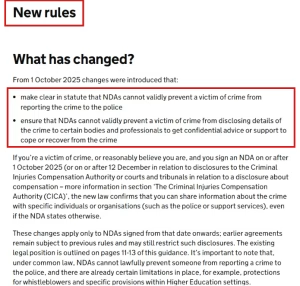
UK government guidance explaining the protections introduced for victims of crime, including permitted disclosures under NDAs signed from 1 October 2025.
What is changing in September 2027?
The Employment Rights Act 2025 introduces further restrictions designed to prevent employers from using confidentiality clauses to silence workers about relevant workplace harassment and discrimination.
According to the UK government’s timetable updated on 5 November 2026, regulations implementing these workplace NDA restrictions are scheduled to take effect in September 2027.
The reforms are intended to make provisions unenforceable insofar as they prevent workers from making covered allegations or disclosures about relevant harassment, discrimination or an employer’s response.
The final application will depend on commencement arrangements and secondary legislation, including any exceptions.
Importantly, these restrictions should not be confused with a complete ban on commercial NDAs. Businesses will still have legitimate reasons to protect product designs, customer information and trade secrets.
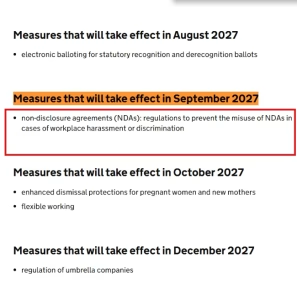
The government’s November 2026 employment reform timetable schedules new workplace NDA restrictions for September 2027.
When Can You Legally Break an NDA Without Being Sued Successfully?
Signing an NDA does not eliminate legal rights or prevent every possible disclosure.
Whether a confidentiality restriction is enforceable depends on the law and the specific information being disclosed.
- Qualifying whistleblowing: UK law protects certain disclosures made in the public interest concerning wrongdoing. An NDA cannot override statutory whistleblowing protections.
- Reporting criminal activity: Confidentiality clauses cannot lawfully stop someone reporting a crime to the police.
- Seeking permitted advice or support: Legislation and other applicable rules protect certain disclosures to legal advisers, professional advisers and support services, depending on the circumstances.
- Information already public: An NDA may not protect information that has legitimately entered the public domain, although the circumstances of its release still matter.
- Contractual exclusions: Agreements commonly exclude information already known to the recipient, independently developed or received lawfully from another source.
For example, someone reporting suspected tax fraud to HMRC may have whistleblowing protections where the statutory requirements are satisfied. The practical process of reporting someone to HMRC is different from publicly disclosing a company’s confidential tax records.
An NDA also cannot automatically prevent a worker from discussing pay where disclosure falls within statutory equal-pay protections.
Nevertheless, protected disclosures must satisfy the relevant legal conditions. Posting confidential documents on social media is not automatically protected merely because the person believes their employer acted wrongly.
What Happens if an Employee Breaks an NDA at Work?
Employment-related confidentiality breaches can create both contractual and disciplinary consequences.
For instance, an employee might accidentally email financial information to an external recipient or deliberately transfer a customer list to a competitor.
The employer should investigate what happened and assess whether the behaviour was intentional, negligent, authorised or legally protected.
The confidentiality obligations contained in an employment contract can remain relevant after an employee leaves, provided the restrictions are legally enforceable.
Where serious misconduct is suspected, the employer may consider suspending the employee pending investigation. Suspension should not be treated as an automatic punishment or proof of wrongdoing.
A deliberate and serious confidentiality breach may justify dismissal for gross misconduct. However, employers must consider the facts, relevant employment rights and the fairness of their procedure.
Employees should understand whether dismissal without a written warning is lawful before assuming an employer can terminate employment immediately.
The outcome can also differ for contractors and self-employed professionals, who may not have the same statutory employment protections.
What Should You Do Immediately After Accidentally Breaking an NDA?
An accidental disclosure does not necessarily eliminate contractual liability. However, prompt action can limit damage and potentially prevent a small incident from escalating.
We recommend the following practical response:
- Stop further disclosure. Do not forward, publish or otherwise circulate the protected information.
- Review the agreement. Identify the relevant clause, confidentiality period and notification obligations.
- Preserve evidence. Keep relevant emails, messages and access records rather than deleting them.
- Contain the incident. Where appropriate, arrange for the unintended recipient to stop using the information and securely delete or return it.
- Obtain legal advice. A solicitor can assess whether disclosure is prohibited, permitted or legally protected.
- Respond appropriately. Do not ignore a formal legal notice or threaten the other party without understanding your position.
Where the leaked material contains personal data, a separate regulatory assessment may be required.
Under UK GDPR, organisations must report certain personal data breaches to the Information Commissioner’s Office without undue delay and, where feasible, within 72 hours of becoming aware of a reportable breach.
Not every confidentiality breach is a reportable personal data breach. The nature of the information and risks to individuals determine the reporting obligations.
This is particularly important for startups handling payroll records, healthcare information, customer identification documents or financial data.
How Should Startup Founders Respond When Someone Breaks Their NDA?
For business owners, the primary objective should be to prevent further harm rather than immediately pursue expensive litigation.
A structured response normally involves confirming the facts, identifying protected information, preserving evidence and obtaining commercial legal advice.
Consider a software founder who discovers that a former contractor has copied the company’s product roadmap.
The founder should establish what the contractor received, whether the NDA covers the material, whether it has been shared and whether any restrictions remain enforceable.
Where disclosure is continuing or imminent, urgent advice on an injunction may be appropriate.
However, founders should also evaluate the financial viability of enforcement.
| Situation | Commercial priority |
| Accidental email to one recipient | Containment and confirmation of deletion |
| Confidential pitch deck shared externally | Assess contractual protection and actual exposure |
| Former employee using customer records | Investigate misuse and consider urgent legal action |
| Trade secrets disclosed to competitors | Protect information and evaluate injunctions |
| Legally protected whistleblowing | Avoid improper enforcement and investigate allegations |
A major issue we identified in business confidentiality disputes is the difference between a perceived violation and a provable financial loss.
Founders should document disclosures before signing commercial partnerships, introducing sensitive investment information or allowing contractors access to internal systems.
A robust approach to starting a business should therefore include contract management and protection of intellectual property from the outset.
How Can Businesses Prevent NDA Breaches Before They Happen?
An NDA is not a substitute for information security.
Our assessment of common startup operating risks suggests that founders should combine contractual protection with practical access controls.
The UK Intellectual Property Office recommends identifying confidential information clearly, specifying the permitted purpose and ensuring the recipient understands how information may be used.
Businesses should consider the following safeguards:
- Use appropriately drafted one-way or mutual NDAs.
- Restrict access to sensitive business documents.
- Record what information is disclosed and to whom.
- Require contractors to return or securely destroy confidential material when appropriate.
- Train employees in confidentiality and data handling.
- Review NDAs when the commercial relationship changes.
- Include appropriate exceptions for lawful reporting and protected disclosures.
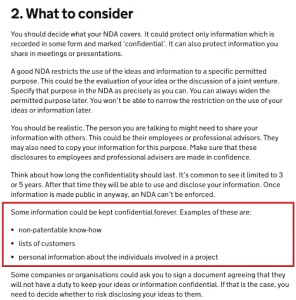
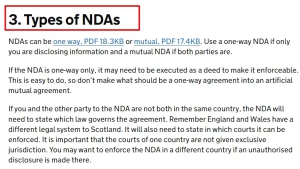
Intellectual Property Office guidance explaining how businesses should define confidential information, permitted uses and appropriate NDA durations.
Where someone operates another business alongside employment, additional attention should be paid to conflicts of interest and customer information.
The rules concerning being self-employed and employed can also become relevant when commercially sensitive information crosses between businesses.
Founders should distinguish an NDA from a non-compete clause. A confidentiality agreement protects specified information, whereas a restrictive covenant may limit certain competitive activities, subject to separate legal enforceability tests.
For a deeper understanding of how confidentiality obligations are structured, it is useful to distinguish a confidentiality agreement from an NDA.
Final Thoughts
Breaking an NDA in the UK can expose individuals and businesses to compensation claims, injunctions, legal expenses and commercial disruption. However, the consequences depend on the agreement, the information disclosed and whether the disclosure was legally protected.
For 2027, the important development is the scheduled introduction of stronger restrictions on using workplace NDAs to silence allegations of harassment or discrimination.
For entrepreneurs, the most effective strategy remains protecting genuinely confidential business information while ensuring agreements comply with the law.
An NDA should protect legitimate commercial interests, not prevent someone from exercising legal rights.
Frequently Asked Questions
Can you break an NDA if the company is doing something illegal?
An NDA cannot prevent legally protected whistleblowing or reporting criminal activity to the police. However, disclosures must comply with the relevant legal rules, and public disclosure is not automatically protected.
Can you be sued for breaking an NDA after leaving a job?
Yes. Confidentiality obligations may continue after employment ends, depending on the wording and enforceability of the agreement. Leaving a company does not automatically cancel an NDA.
Does breaking an NDA mean you automatically lose your job?
No. Employment consequences depend on the seriousness of the breach, the circumstances and the applicable employment law. Employers should investigate fairly before taking disciplinary action.
Can an NDA be enforced if there was no financial loss?
Potentially, yes. A valid contractual breach may exist even without substantial provable financial loss. However, compensation may be limited, while injunctive relief may be available in appropriate circumstances.
What if someone breaks a verbal confidentiality agreement?
A verbal agreement may sometimes be legally enforceable, although proving its terms can be difficult. Confidentiality obligations may also arise independently of an express written NDA.
Can an NDA last forever in the UK?
Some obligations protecting genuine trade secrets can continue indefinitely. Other information may be protected for a defined period, commonly several years. Enforceability depends on the agreement and circumstances.
Can you cancel an NDA after signing it?
You may be able to terminate an NDA by mutual agreement, through an applicable termination clause or on other lawful grounds. However, termination does not necessarily end confidentiality obligations that expressly survive termination.

Expert Blogger | Strategic thinker anticipating future directions for UK business
Related Articles in Business
View All →
Starting a Business in London: How to Identify Market Trends and Emerging Opportunities
London remains one of the UK’s most attractive destinations for entrepreneurs, offering access to international markets, skilled professionals, diverse communities and a thriving business ecosystem. However, starting a…

Is Wetherspoons a Franchise? Costs, Ownership, Requirements and How to Apply in 2026
Yes, Wetherspoons is a franchise. J D Wetherspoon, one of Britain’s largest pub operators, now offers franchise opportunities to eligible hospitality businesses, experienced operators, investors and organisations. However,…

Amazon Delivery Franchise Cost UK: Investment, Profit, Fees and Requirements
The Amazon delivery franchise cost in the UK starts from approximately £10,000, while prospective business owners are generally expected to demonstrate at least £25,000 in liquid assets. This…