
Self Employed Handyman Hourly Rate UK 2027: Prices, Day Rates and Earnings

UK Startup Blog Archive
Table of Contents
A self-employed handyman in the UK typically charges £25–£50 per hour, although experienced tradespeople and those working in London can charge £40–£65 or more.
For 2027, these remain useful planning ranges based on 2026 market pricing rather than confirmed national averages for the coming year.
However, the amount a handyman charges is not the amount they take home. Fuel, tools, insurance, travel, customer enquiries and unpaid administration all affect the actual profitability of a handyman business.
We analysed recent UK trade pricing information alongside the operating costs faced by independent tradespeople. Our findings suggest that chargeable working hours, minimum booking fees and the type of jobs accepted are just as important as the advertised hourly rate.
For homeowners, understanding these costs helps when comparing quotes. For tradespeople, the figures provide a starting point for building a financially sustainable business.
What Is the Average Self Employed Handyman Hourly Rate in the UK for 2027?
The typical market rate depends on the handyman’s experience, location and the complexity of the work.
| Service level | Indicative hourly rate | Day rate |
| Beginner handyman | £20–£30 | £150–£210 |
| General handyman | £30–£40 | £200–£280 |
| Experienced multi-skilled handyman | £40–£55 | £260–£350 |
| London-based handyman | £40–£65+ | £280–£400+ |
These are indicative pricing bands based on 2026 market information, not guaranteed or officially established 2027 rates. A day rate usually reflects a block booking rather than eight separately charged hours.
A handyman specialising in straightforward property maintenance may charge less than someone handling complex repairs or installations.
For example, a tradesperson offering painting alongside general maintenance can compare their prices with the self-employed painter and decorator hourly rate.
There is also a noticeable difference between independent handymen serving local households and property-maintenance contractors working for landlords or commercial clients.
How Much Do Handymen Charge Across Different UK Regions?
Location influences prices because operating expenses, parking charges, customer demand and competition differ substantially.
Our comparison of recent regional pricing information gives the following approximate ranges.
| UK region | Indicative hourly charge |
| London | £40–£65 |
| South East England | £30–£55 |
| South West England | £25–£50 |
| Midlands | £25–£50 |
| North of England | £25–£45 |
| Scotland | £25–£50 |
| Wales | £25–£45 |
| Northern Ireland | £20–£45 |
These are broad regional ranges, not statistically measured local averages.
A real example comes from the Hampshire-based handyman service Eddie Webb, which publicly states:
“In our corner of Hampshire we typically quote £30 per hour or £220 a day”
This demonstrates why the highest advertised hourly price is not always necessary for a sustainable business. A tradesperson with regular customers, manageable travel distances and consistent bookings may earn more than somebody charging substantially higher rates but struggling to fill their working week.
Local demand also influences the rates charged for related services such as gardening and outdoor property maintenance.
How Should a Self-Employed Handyman Calculate Their Hourly Rate?
Choosing an hourly rate by copying the cheapest competitor can leave a small business struggling financially.
A better approach is to calculate the income required, add business expenses and divide the result by the number of realistic billable hours.
Hourly rate = (Target annual profit before personal tax + annual business expenses) ÷ annual billable hours
Consider a handyman with the following financial targets:
| Financial requirement | Annual amount |
| Target profit before personal tax | £36,000 |
| Operating expenses | £8,000 |
| Required turnover | £44,000 |
| Billable hours | 1,100 |
| Required hourly rate | £40 |
This calculation assumes 25 chargeable hours per week over 44 working weeks.
Although the handyman may spend 40 hours each week on business activities, the remaining hours can be absorbed by travelling, purchasing materials, preparing quotes, answering enquiries and administration.
That produces a billable utilisation rate of just 62.5%.
We consider billable utilisation one of the most important measures for independent tradespeople because increasing chargeable hours can improve profitability without increasing advertised prices.
Anyone starting a handyman service should include these assumptions in a simple business plan.
How Much Can a Self-Employed Handyman Earn After Expenses and Tax?
Revenue and personal earnings are two different financial figures.
Consider a sole trader charging £40 per hour, working 25 billable hours weekly across 44 weeks.
| Earnings calculation | Annual amount |
| Gross service revenue | £44,000 |
| Business expenses | −£8,000 |
| Profit before personal tax | £36,000 |
| Estimated Income Tax | −£4,686 |
| Estimated Class 4 National Insurance | −£1,406 |
| Estimated annual take-home income | £29,908 |
Illustrative calculation using the announced 2027/28 tax thresholds for a sole trader in England, Wales or Northern Ireland with a full Personal Allowance, no other taxable income and no additional deductions.
Scottish Income Tax and individual circumstances can produce different results.
That works out to approximately £2,492 per month, before personal pension contributions or other individual commitments.
The example also shows why a £40 hourly charge should not be confused with £40 in disposable earnings.
For further financial planning, understanding self-employed tax and deductible operating costs can help tradespeople avoid unexpected liabilities.
What Business Expenses Reduce a Handyman’s Profit?
Independent handymen must finance equipment, transport and business administration themselves.
Common operating expenses include:
- Transport: fuel, van maintenance, insurance and business travel.
- Tools: drills, ladders, saws, testing equipment and replacements.
- Protection: public liability insurance and relevant safety equipment.
- Marketing: website maintenance, local advertising and trade-platform fees.
- Administration: invoicing, accountancy and bookkeeping software.
- Consumables: fixings, sealants and materials that cannot be recovered through customer charges.
For tradespeople operating a vehicle, the rules governing van expenses can materially affect taxable profit.
It is equally important to distinguish between what a business can charge for mileage and what it can claim as a tax deduction.
The two amounts are not necessarily identical.
A review of allowable expenses should form part of the annual pricing exercise. However, an expense being tax-deductible does not make it free: it still represents money spent by the business.
Should a Handyman Charge Hourly, Daily or Per Job?
There is no universally suitable pricing method. The best approach depends on how predictable the work is.
| Pricing model | Suitable work | Business advantage |
| Hourly | Small repairs and uncertain tasks | Covers actual working time |
| Half-day | Several household maintenance jobs | Reduces gaps between bookings |
| Full-day | Larger property maintenance projects | Provides more predictable revenue |
| Fixed-price | Furniture assembly and repeatable installations | Rewards efficient completion |
For example, a handyman charging £40 per hour might quote £280 for a seven-hour booking rather than £320 for eight separate hourly charges.
A full-day booking can still be profitable because it may eliminate journeys between multiple properties.
For smaller jobs, minimum charges are important. A £50–£70 minimum booking fee may be appropriate where travelling and preparation take longer than the actual repair.
Customers should be told whether this includes the first hour or is an additional call-out charge.
How Much Should a Handyman Charge for Common Jobs?
Many domestic maintenance jobs are easier to sell at a fixed price because the customer knows the likely cost beforehand.
| Handyman job | Indicative labour price |
| Install a curtain pole or blind | £30–£60 |
| Fit a shelf | £30–£60 |
| Mount a television | £60–£120 |
| Assemble a wardrobe | £60–£120 |
| Replace a toilet seat | £30–£50 |
| Replace a dripping tap | £40–£80 |
| Reseal a bath or shower | £50–£100 |
| Replace a fence panel | £60–£120 |
Indicative 2026 guide prices for budgeting into 2027. Materials, access difficulties, VAT where applicable and specialist requirements may increase the total.
A tradesperson quoting for several jobs should consider the complete booking rather than pricing every task independently.
For instance, fitting three shelves and a curtain pole during one visit may produce better value for the homeowner while protecting the handyman’s productive working time.
More complex work should not automatically fall within general handyman pricing. Gas work requires appropriate Gas Safe registration, and electrical work must comply with applicable safety and building regulations.
What Tax Changes Should Self-Employed Handymen Prepare for in 2027?
Several developments affect how tradespeople manage profits and records.
Income Tax and National Insurance
The announced 2027/28 figures include:
| Tax item | 2027/28 position |
| Standard Personal Allowance | £12,570 |
| Basic Income Tax rate in England, Wales and Northern Ireland | 20% |
| Class 4 NI on profits above £12,570 up to £50,270 | 6% |
| Class 4 NI on profits above £50,270 | 2% |
| VAT registration threshold | £90,000 taxable turnover |
The Income Tax figures shown are for the standard case; Scotland has different non-savings Income Tax rates. VAT registration is assessed using the applicable rolling 12-month and forward-looking tests, rather than annual profit.
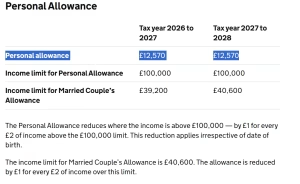
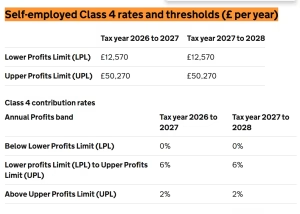
GOV.UK tax rates and allowances for 2027/28.
Trading Allowance Increase to £3,000
The government announced an increase in the trading allowance from £1,000 to £3,000 from 6 April 2027, alongside an increase in the relevant Self Assessment trading-income reporting threshold.
This is particularly relevant to people carrying out occasional handyman jobs alongside employment.
However, claiming the trading allowance instead of actual business expenses is not necessarily beneficial for an established handyman with significant equipment and transport costs.
The measure was announced for implementation through the Finance Bill 2026–27, so its final legislative position should be checked when it takes effect.
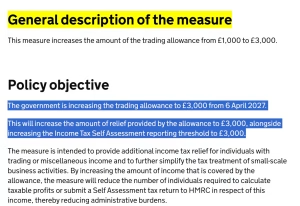
HMRC’s announced increase in the trading allowance from £1,000 to £3,000 from April 2027.
Making Tax Digital From April 2027
From 6 April 2027, Making Tax Digital for Income Tax will extend to qualifying sole traders and landlords whose combined gross self-employment and property income exceeded £30,000 in the 2025/26 tax year.
Affected handymen will need to maintain digital records and submit quarterly updates using compatible software.
This is based on qualifying gross income before expenses, not take-home profit.
Reliable bookkeeping and suitable accounting software can therefore become an important part of business operations.
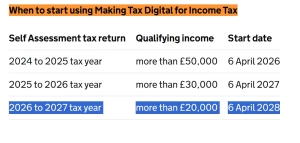
Making Tax Digital start dates and qualifying-income thresholds.
How Can Self-Employed Handymen Increase Their Profit Without Overcharging?
Increasing profitability does not necessarily require raising every customer’s hourly price.
Our business analysis identifies several practical opportunities.
- Reduce unnecessary travel: Accepting jobs within a defined service area can lower fuel costs and increase the number of chargeable hours available.
- Build recurring maintenance relationships. Landlords, letting agents and small commercial properties may require regular repairs. Repeat bookings can reduce customer acquisition costs, although payment terms should be agreed clearly.
- Introduce minimum booking charges: Small jobs should recover the costs of travel, scheduling and equipment preparation.
- Improve quotation accuracy: Photographs, measurements and a written work specification reduce the risk of underpricing.
- Measure profit by job: A £150 repair that requires five hours of total business time and substantial materials may be less profitable than two nearby £90 jobs completed efficiently.
- Review prices annually: A rise from £40 to £44 per hour represents a 10% increase in the advertised rate. Whether it improves total earnings depends on customer retention and booking volume.
Businesses should also maintain appropriate public liability insurance and understand waste-carrier requirements when removing waste from customer properties.
Anyone entering self-employment should register appropriately with HMRC, obtain a UTR number when required and keep adequate records for their tax returns.
Is Becoming a Self-Employed Handyman Worth It in 2027?
Self-employment can be financially attractive for tradespeople who can secure regular work and manage their operating expenses.
It offers control over prices, working hours, service specialisation and customer relationships. However, income is not guaranteed, and sole traders must fund their own holidays, sickness cover and retirement savings.
For somebody considering a transition from employment, it may be possible to develop a customer base while employed and self-employed, subject to contractual restrictions and tax obligations.
The strongest starting position is usually a manageable service area, sufficient tools, clear prices and enough working capital to cover quieter periods.
These should be considered alongside the wider requirements of starting a business.
Final Thoughts
For 2027, a self-employed handyman can use £30–£45 per hour as a practical starting point for general work, while experienced specialists and those operating in expensive locations may charge more.
The important distinction is between turnover and personal income. A successful handyman business needs enough chargeable hours to cover expenses, taxation, unpaid administration and time away from work.
By setting a realistic minimum booking charge, tracking profit by job and preparing for the 2027 tax changes, independent tradespeople can build a more sustainable business without relying solely on higher hourly prices.
Frequently Asked Questions
How much should a beginner handyman charge per hour?
A beginner may charge approximately £20–£30 per hour, depending on their skills, location and operating costs. Rates should still cover travel, tools and other business expenses.
What is a reasonable handyman day rate in the UK?
A general handyman may charge around £200–£280 per day, while experienced tradespeople and London-based contractors can charge considerably more.
Can a self-employed handyman earn £50,000 a year?
Yes, £50,000 in annual revenue is possible. For example, charging £50 per hour for 1,000 billable hours generates £50,000 before expenses and tax.
Should a handyman charge for travelling?
Travel can be included in the hourly rate, minimum booking charge or a separately agreed fee. Customers should know the pricing arrangement before work begins.
Do self-employed handymen need insurance?
Public liability insurance is strongly advisable, and customers or commercial contracts may require it. Other cover may be needed depending on the business, equipment and whether staff are employed.
Do handymen have to register for VAT?
VAT registration is generally required when taxable turnover exceeds £90,000 over the relevant rolling 12-month period, or is expected to exceed that amount in the next 30 days alone.
Is £40 an hour a good rate for a self-employed handyman?
£40 is a reasonable market rate for many experienced handymen, but profitability depends on billable hours, location, operating expenses and the type of work undertaken.

Blogger | Business Writer | Sharing startup advice on UK business blogs
Related Articles in Startup
View All →
Newscivil Com: Can This Digital News Platform Help UK Startups Spot Emerging Trends?
For startup founders, staying informed is no longer simply about reading the business pages each morning. Artificial intelligence, changing consumer habits, technology developments, government decisions and wider social…

Meet the Startup Turning Screen Time Into a New Way to Make Money
Britain does not exactly have a shortage of side hustles. You can deliver takeaways, sell clothes online, start freelancing, walk dogs, tutor in the evenings or attempt to…

8 Best Coworking Spaces for Bootstrapped London Startups to Launch and Scale in 2026
Bootstrapped founders don’t have the luxury of a fitted-out HQ from day one. What you need is a London coworking space that flexes with you: a hot desk…