
How to Change Address with Companies House in 2027? A Complete Startup Guide

UK Startup Blog Archive
Table of Contents
To change your address with Companies House in 2027, you need to sign in to the Companies House WebFiling service, enter your company registration number and authentication code, select the registered office address change option and submit your new address through the AD01 filing process.
Changing a registered office address directly with Companies House is free, and businesses must report the change within 14 days.
However, following the corporate transparency reforms and identity verification developments throughout 2026, startup founders need to consider more than simply updating their company postcode.
Whether you are moving from a home office in Manchester to commercial premises, relocating your London startup to reduce operating costs or switching to a professional registered office service, the process needs to be managed alongside your tax, banking and legal responsibilities.
We analysed the current filing requirements and their practical implications for entrepreneurs, small businesses and growing limited companies across England.
Companies House Address Change: Key Information
| Particulars | Details |
| Registered office address form | AD01 |
| Online filing fee | £0 |
| Reporting deadline | Within 14 days |
| Online filing processing target | Most filings within 24 hours |
| Director address change form | CH01 |
| Individual PSC address change form | PSC04 |
| LLP address change form | LL AD01 |
| Historical home address removal | £34 per eligible document |
| Authentication code delivery | Up to 10 working days |
| HMRC notification | Automatic for registered office changes, with separate updates where applicable |
What Has Changed for Companies House Address Updates Going Into 2027?
The Companies House filing environment has changed considerably since the introduction of the Economic Crime and Corporate Transparency Act 2023.
Businesses entering 2027 must operate within a more closely monitored registration system, where the accuracy of company information and the identity of individuals responsible for businesses are increasingly important.
The following developments are particularly relevant to startup founders.
| Regulatory development | Implementation | Impact on startups |
| Appropriate registered office requirement | March 2024 | Addresses must support reliable delivery of official correspondence |
| Restrictions on PO Box addresses | March 2024 | Standalone PO Boxes are no longer acceptable |
| Historical residential address protection | January 2025 | Eligible former home addresses can be suppressed |
| GOV.UK One Login for WebFiling | October 2025 | Updated account sign-in requirements |
| Mandatory director and PSC identity verification | November 2025 | Directors and relevant company controllers must verify their identities |
| Revised Companies House fees | February 2026 | Higher incorporation and confirmation statement costs |
| End of identity verification transition period | November 2026 | Greater emphasis on meeting individual verification obligations |
| Presenter identity verification | No earlier than November 2027 | Planned additional requirements for individuals submitting filings |
The 12-month identity verification transition period that began on 18 November 2025 reached its conclusion in November 2026.
Directors and people with significant control should check that they have completed the verification and personal code submission requirements applicable to their individual roles.
Companies House also plans to introduce mandatory identity verification for filing presenters and registration requirements for third-party filing agents no earlier than November 2027.
These planned changes are not yet universal filing requirements. Companies House intends to provide at least six months’ notice before their implementation.
For entrepreneurs starting a business in the UK, establishing a compliant company address and maintaining secure access to filing accounts should form part of the initial business administration process.
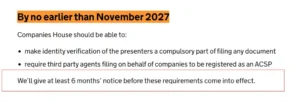
Companies House reform timeline showing identity verification developments in 2026 and proposed filing requirements for 2027.
Which Company Address Do You Actually Need to Change?
One of the most important distinctions for startup owners is that a business can have several addresses serving different legal and commercial purposes.
Moving premises does not necessarily mean every address associated with the company needs to change.
| Address type | Purpose | Publicly available? | Filing requirement |
| Registered office address | Official legal correspondence | Yes | AD01 |
| Trading address | Location of daily business activities | Depends on publication | HMRC and relevant organisations |
| Director service address | Official correspondence for a director | Yes | CH01 |
| Director residential address | Director’s usual home address | Generally protected | CH01 |
| PSC service address | Correspondence for an individual company controller | Yes | PSC04 |
| PSC residential address | Personal residence of the company controller | Generally protected | PSC04 |
| SAIL address | Inspection of specified statutory company records | Yes | AD02 and related filings |
| Registered email address | Official electronic communication | No | Separate online service |
A technology startup may have its registered office at an accountant’s premises in Birmingham while its employees work remotely from London, Leeds and Bristol.
Similarly, an online retailer may maintain a registered office in England while operating from a separate warehouse.
Neither arrangement automatically requires the registered office to match the physical location of day-to-day business activities.
The key is to identify which information has changed and notify the organisations responsible for maintaining those records.
Do Sole Traders Need to Change Their Address with Companies House?
A conventional sole trader does not register with Companies House in the same way as a limited company.
If you operate as a sole trader, your address changes should generally be reported to HMRC, your bank, insurers and other relevant organisations.
The AD01 process is primarily relevant to incorporated companies rather than self-employed individuals operating without a company.
What Are the Registered Office Address Requirements in England?
A company registered in England and Wales must maintain its registered office within that jurisdiction.
This means an English startup can relocate its registered office from London to Manchester, Birmingham, Newcastle or another eligible location in England or Wales.
However, it cannot ordinarily transfer its registered office to Scotland or Northern Ireland through a standard AD01 filing.
The company may operate elsewhere, but its registered office must remain within its registered jurisdiction.
What Makes a Registered Office Address Appropriate?
Under the strengthened company registration rules, the address must be suitable for receiving official communications and legal documents.
An appropriate address must:
- Be a genuine physical address within the relevant UK jurisdiction.
- Allow correspondence to reach someone acting on behalf of the company.
- Enable the sender to obtain acknowledgement of delivery.
- Be available for legitimate use by the company.
- Support the reliable handling of statutory correspondence.
A standalone Royal Mail PO Box or an equivalent mailbox-only arrangement is no longer sufficient.
Businesses using accountants, solicitors, formation agents or virtual office providers must ensure that the service meets these requirements.
An attractive London postcode alone does not make an address compliant.
For startups evaluating coworking spaces in London, it is important to establish whether registered office use is included in the membership agreement or requires an additional subscription.
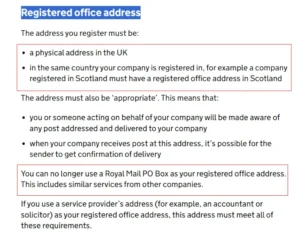
Official Companies House requirements for an appropriate registered office address, including restrictions on PO Boxes.
How to Change Address with Companies House Online in 2027?
Online filing is generally the quickest and most cost-effective method for updating a limited company’s registered office.
Before starting, make sure you have access to the company’s filing account, company registration number and six-character authentication code.
Step 1: Confirm Your New Registered Office Address
Arrange permission to use the new address before submitting the change.
If you are moving into rented commercial premises, check the lease conditions. If you are using an accountant or registered office provider, obtain confirmation that statutory correspondence can be accepted on your behalf.
You should also confirm the correct postcode, building number and address format.
Step 2: Access the Companies House WebFiling Service
Visit the official Companies House online filing service.
Select the Start now option and follow the sign-in process using GOV.UK One Login.
Existing users who have not yet connected their WebFiling account to GOV.UK One Login may need to complete the account-linking process.
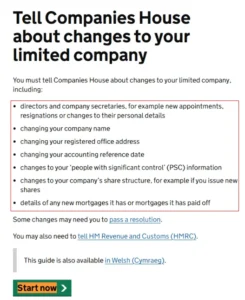
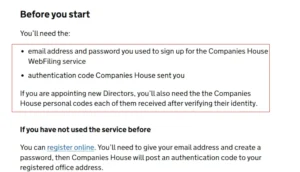
Official GOV.UK service for submitting changes to a limited company through Companies House WebFiling.
Step 3: Select Your Limited Company
Locate your company using its registration number and access the relevant company records.
Enter the company authentication code when requested.
The authentication code confirms your authority to submit company information electronically. It should not be confused with your individual Companies House personal code.
If you manage multiple companies, double-check that you have selected the correct entity before proceeding.
Step 4: Enter the New Registered Office Address
Select the option to change the registered office address.
Provide the requested address information, which will generally include:
- Building name or number.
- Street name.
- Town or city.
- County, where applicable.
- Postcode.
- Relevant jurisdiction.
Confirm that the new address meets the appropriate address requirements.
Step 5: Review and Submit the AD01 Filing
Check all the information carefully before submitting the change.
You should receive an electronic acknowledgement of the submission. Retain this alongside your company administration records.
An acknowledgement of receipt does not necessarily mean the address has been accepted and registered.
Step 6: Confirm the Updated Address on the Public Register
Once the application has been processed, search for your company on the Companies House public register.
Check that the new address appears on the company overview and that the registered office change has been recorded in the filing history.
The change becomes legally effective when Companies House registers it, rather than when you first submit the application.
Businesses can use the same public register when checking company name availability and reviewing the legal information associated with an existing company.
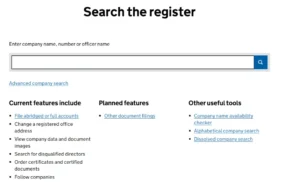
Companies House public register showing the registered office address and company filing history.
Can You Change Your Companies House Address Without an Authentication Code?
You cannot normally complete a standard online registered office address change without the company’s authentication code or access through an appropriately authorised filing arrangement.
This can become a significant problem when a startup has changed accountants, stopped using a formation agent or lost access to its previous business premises.
Companies House provides a recovery process that allows eligible companies to request an authentication code at an active company officer’s residential address instead of the existing registered office.
This is particularly useful when the existing registered office is controlled by a former service provider.
Delivery can take approximately 10 working days, so founders should arrange access before relocating wherever possible.
What Is the Difference Between an Authentication Code and a Personal Code?
Following the 2026 identity verification developments, business owners need to distinguish between two separate types of security credentials.
| Security credential | Company authentication code | Companies House personal code |
| Associated with | The company | An individual |
| Main purpose | Authorising electronic company filings | Linking verified identity to company roles |
| Issued through | Companies House authentication process | Identity verification process |
| Used for | Address changes and other company filings | Director and PSC verification requirements |
| Security | Must be kept confidential | Must be kept confidential |
A director who has verified their identity should not assume their personal code replaces the company authentication code.
We recommend maintaining secure access to company filing credentials independently of external accountants and formation agents, while allowing trusted professionals to access the information necessary for their work.
When Do You Need to Use the AD01 Paper Form?
Although the online route is preferred, certain companies may need to submit a paper AD01 form.
Companies House specifically identifies circumstances such as:
- The company has been moved to a Companies House default address.
- The company is in liquidation.
- The company is applying for restoration to the register.
- The company is an unregistered company.
Some companies enrolled in protected electronic filing arrangements cannot submit certain changes on paper.
Therefore, founders should check the current official AD01 instructions rather than assuming that paper filing is always an available alternative.
The form requires information including the company name, registration number, new address, confirmation of address suitability and appropriate authentication.
Paper applications generally take longer to process than electronic submissions.
Limited liability partnerships must use the corresponding LL AD01 process rather than the ordinary limited company AD01 form.
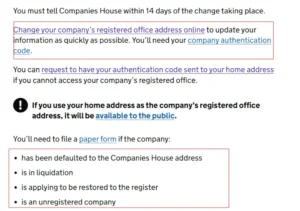
Companies House AD01 guidance explaining the registered office address change process and circumstances requiring paper filing.
How Much Does It Cost to Change Your Registered Office Address?
There is no standard Companies House filing fee for changing a company’s registered office address.
However, the overall financial impact depends on the type of address being adopted and whether the business requires additional administrative or professional support.
The increase in Companies House fees during 2026 should not be confused with the cost of an ordinary address change.
| Company administration service | Fee applicable going into 2027 |
| Online registered office address change | £0 |
| Online company incorporation | £100 |
| Online confirmation statement | £50 |
| Paper confirmation statement | £110 |
| Online company name change | £20 |
| Eligible personal information suppression | £34 per document |
These figures reflect the published fee structure available in November 2026 and may be subject to subsequent changes.
What Additional Expenses Should Startup Founders Budget For?
Although the filing itself is free, moving a business can create several additional expenses.
| Potential expense | Illustrative cost |
| Registered office subscription | £60–£200 annually |
| Professional mail forwarding | £30–£150 annually |
| Accountant or agent administration | £25–£100 |
| Updated stationery and printed materials | £20–£150 |
| Historical home address removal | £34 per eligible document |
| Website and document updates | £0–£100 |
These are illustrative planning estimates rather than fixed industry prices. Actual costs depend on the provider, location and services included.
For a bootstrapped startup, we recommend comparing the full annual cost of an address service rather than focusing exclusively on its advertised introductory price.
A low-cost registered office package may become more expensive once mail handling, scanning and renewal fees are included.
How Can Changing Your Company Address Reduce Startup Operating Costs?
Many founders initially register their companies at commercial premises because they want an established business presence.
However, maintaining a physical office purely for registration purposes can create unnecessary expenditure.
Consider a hypothetical digital consultancy operating in London that moves to a remote-first business model.
| Expense | Previous annual cost | Revised annual cost |
| Office rental or workspace membership | £6,000 | £1,200 |
| Utilities and office expenses | £1,200 | £0 |
| Registered office service | £0 | £120 |
| Mail handling | £0 | £80 |
| Total annual cost | £7,200 | £1,400 |
The company would reduce these particular overheads by £5,800 annually, representing approximately an 80.6% reduction.
This example assumes the business no longer needs the original office and that the replacement workspace and address services meet its operational requirements.
It is not a guaranteed saving, but it illustrates why location strategy can be important for businesses operating with limited working capital.
For startups with remote teams, software-based services or online retail operations, separating the registered office from the primary trading location may offer greater flexibility without requiring an expensive permanent office.
How Long Does a Companies House Address Change Take?
Companies House aims to process most online filings within 24 hours.
Straightforward registered office updates may therefore be completed relatively quickly, although manual checks, incorrect information and administrative delays can extend the processing time.
Founders should distinguish between the reporting deadline, processing time and the legal effective date.
| Stage | Timeframe |
| Reporting the address change | Within 14 days |
| Typical online filing target | Within 24 hours for most filings |
| Authentication code delivery | Up to 10 working days |
| Legal effective date | When Companies House registers the change |
| Service of documents at the previous address | Permitted for 14 days following registration |
| Paper filing | Variable and generally slower |
Under Section 87 of the Companies Act 2006, documents may still be validly served at the company’s previous registered office during the 14-day period beginning on the registration date of the new address.
This makes temporary access to the old address particularly valuable.
Where commercially possible, arrange mail forwarding or continued correspondence handling during the transition instead of cancelling your previous address service immediately.
How Do You Change a Company Director’s Address with Companies House?
A change to a limited company’s registered office does not necessarily update the personal information associated with its directors.
Directors have two main address records: their public service address and their usual residential address.
Changing a Director’s Service Address
The service address is the public correspondence address associated with the director.
If a founder uses the company’s registered office as their correspondence address, they should review whether the director’s address record needs a separate update after the company moves.
Where an address is explicitly linked to the registered office, check whether that link has been carried forward correctly.
The CH01 filing is used to update the details of an individual director.
Changing a Director’s Residential Address
If a director moves home, they must update their residential address information with Companies House within the applicable 14-day reporting period.
A director’s usual residential address is generally protected from public disclosure, provided it has not also been used in a public capacity, such as a registered office or service address.
Moving home does not require the company to change its registered office unless the home is also being used for that purpose.
Updating a Person with Significant Control
A founder who owns more than 25% of a company’s shares or voting rights will normally meet one of the conditions for being classified as a person with significant control (PSC).
Other forms of significant influence or control can also establish PSC status.
Where the same individual is both a director and a PSC, their information may need to be updated in both capacities.
PSC04 is the relevant filing for changes to the details of an individual PSC.
Founders should review both records rather than assuming one submission automatically updates every company role.
Can You Remove Your Home Address from Companies House in 2027?
Yes. Eligible individuals can apply to suppress residential addresses that previously appeared on the public Companies House register.
This is particularly relevant to home-based businesses that initially registered using their residential address before moving to professional premises.
Since January 2025, individuals have been able to apply to suppress home addresses previously used as a company’s registered office.
However, updating the current address does not automatically remove historical addresses from earlier filing documents.
How Does the SR01 Process Work?
If your company remains active, you should first replace your home address with an appropriate registered office address.
You can then identify eligible historical documents containing your residential information and apply using form SR01.
The process generally involves:
- Reviewing the company’s filing history.
- Identifying documents containing the residential address.
- Completing the appropriate suppression application.
- Paying £34 for each eligible document.
- Submitting the application and supporting evidence where required.
For dissolved companies, there is generally a six-month waiting period before applying to suppress a home address used as the registered office.
How Much Does Historical Address Removal Cost?
| Number of eligible documents | Suppression fee |
| 1 | £34 |
| 2 | £68 |
| 3 | £102 |
| 5 | £170 |
| 10 | £340 |
Depending on the circumstances, Companies House may retain the first part of a UK postcode rather than removing every geographic reference.
Furthermore, suppression from Companies House does not guarantee removal from third-party websites that previously copied the information.
For privacy-conscious founders, using a professional registered office from the beginning may prevent unnecessary public exposure and subsequent administrative costs.
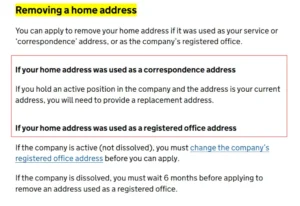
Official Companies House guidance on removing residential addresses and the £34 fee per document, updated in 2026.
Does Companies House Automatically Notify HMRC When You Change Address?
Companies House automatically notifies HMRC when a registered office address change is approved.
However, this does not mean every address connected to the company’s tax affairs has been updated.
A startup may have separate records for its registered office, trading premises, payroll operations and VAT registration.
| HMRC service | What the business should do |
| Registered office information | Companies House sends notification automatically |
| Corporation Tax | Check the updated information and report separate changes where necessary |
| VAT registration | Report applicable address changes within 30 days |
| PAYE | Update relevant employer details separately |
| Director’s personal tax records | Update independently where necessary |
| Self Assessment | Report relevant personal or business address changes |
| Trading address | Notify HMRC when applicable |
What Happens to Corporation Tax Records?
A company’s Unique Taxpayer Reference and existing Corporation Tax obligations do not normally change merely because its registered office moves.
Nevertheless, founders should review their business tax account and ensure that correspondence is reaching the correct address.
A registered office change does not cancel outstanding Corporation Tax payments, accounts deadlines or filing obligations.
Do VAT-Registered Startups Need to Update Their Address Separately?
Where a relevant VAT registration detail changes, the business must notify HMRC within 30 days.
Startups should review their VAT account, invoicing templates and accounting software after relocation.
This is especially important for businesses that submit VAT returns regularly and receive correspondence about their registration or compliance obligations.
Customers and suppliers may also use online services to check whether a company is registered for VAT, making accurate business information important for commercial credibility.
Can You Use a Virtual Office as Your Companies House Address?
Yes. A virtual office can be used as a registered office provided it meets the appropriate address requirements and the service provider permits its use for company registration.
This arrangement can be particularly useful for remote-first businesses, consultants, freelancers operating through limited companies and early-stage technology startups.
A compliant virtual office should support the receipt and handling of statutory correspondence rather than simply offering a prestigious postcode.
Which Registered Office Option Is Suitable for a Startup?
| Address option | Main advantage | Main limitation |
| Home address | Minimal additional expense | Public exposure of residential information |
| Accountant’s office | Professional correspondence management | Dependent on the service agreement |
| Commercial premises | Direct access to business correspondence | Higher operating costs |
| Virtual office | Flexibility and residential privacy | Ongoing subscription costs |
| Coworking space | Flexible workspace and networking | Registered office use may cost extra |
| Standalone PO Box | Basic mail collection | Not acceptable as a registered office |
Before purchasing a virtual office package, check its renewal costs, mail forwarding charges, cancellation conditions and document-handling arrangements.
It is equally important to establish how the provider deals with urgent legal correspondence.
A company that receives a court notice several days late may face consequences far more expensive than the annual saving achieved through a cheap address subscription.
What Happens If Your Companies House Address Is Incorrect or Rejected?
Companies House has strengthened its ability to challenge inaccurate information and unsuitable registered office addresses.
An address change may be rejected or challenged if the new address fails to meet the relevant legal requirements.
Common problems include incorrect postcodes, missing building details, unauthorised use of another organisation’s premises and addresses outside the company’s registered jurisdiction.
What Is a Companies House Default Address?
Where the registrar determines that a company’s registered office is unsuitable, the company may be moved to a default address maintained by Companies House.
This is an administrative enforcement mechanism rather than a registered office service that companies can voluntarily use.
The business may be required to provide a suitable replacement address, together with evidence of its right to use that address, within 28 days.
Failure to resolve the issue can result in enforcement action and potentially the company being struck off the register.
What Should You Do If an Address Change Is Rejected?
| Reason for rejection | Recommended action |
| Incorrect postcode | Verify the full postal address |
| Inappropriate registered office | Arrange a compliant physical address |
| Wrong registration jurisdiction | Select an address within the permitted jurisdiction |
| Unauthorised use of premises | Obtain permission or choose another provider |
| Authentication problem | Recover or reset the appropriate credentials |
| Incorrect filing route | Check the applicable form and company status |
Founders should correct rejected submissions promptly, retain correspondence and check that the replacement application has been accepted.
Does Changing a Company Address Affect Credit, Funding or Business Contracts?
Changing a registered office does not automatically alter the company’s legal identity, ownership, existing debts or company registration number.
Nevertheless, inconsistent address information can create additional checks when banks, lenders, suppliers or investors assess the business.
An address discrepancy between Companies House and a bank statement may require further verification during a funding application.
Similarly, an investor conducting due diligence may ask for an explanation if the startup has repeatedly changed its registered office or uses an address that appears unsuitable.
These issues do not mean a legitimate relocation will damage a company’s creditworthiness. The risk arises primarily from inconsistent or incomplete information.
Do Existing Business Contracts Remain Valid?
Existing contracts generally remain in force following a registered office address change because the company remains the same legal entity.
However, some agreements specify procedures for communicating changes to formal notice addresses.
Founders should review their commercial leases, financing agreements, supplier contracts and customer agreements to identify any notification requirements.
Understanding how to prepare a legal contract is particularly valuable for startups managing multiple supplier and customer relationships.
Where an agreement contains specific relocation restrictions or notice provisions, follow those requirements rather than assuming the Companies House filing is sufficient.
What Should England-Based Startups Update After Moving Their Registered Office?
An effective address change should extend beyond Companies House.
From a business administration perspective, synchronising relevant legal, financial and commercial records reduces the possibility of missed payments, delayed correspondence and unnecessary compliance investigations.
| Organisation or platform | Required action |
| Business bank | Update registered office and trading information |
| HMRC | Check Corporation Tax, VAT and PAYE details |
| Accountant | Provide the new address and effective date |
| Insurance provider | Update company and operational premises information |
| Business lenders | Follow notification requirements |
| Customers | Communicate changes affecting invoices or correspondence |
| Suppliers | Update billing and delivery records |
| Company website | Replace the registered office address |
| Payment processors | Update business verification information |
| Accounting software | Amend invoice and company templates |
| Local council | Update business rates information if trading premises change |
| ICO | Update applicable data protection registration details |
| Licensing authorities | Report premises changes where required |
| Postal services | Arrange temporary mail redirection if appropriate |
Limited companies should also ensure their legally required company information remains correctly displayed on relevant business letters, order forms and websites.
Moving the company’s registered office does not extend its statutory filing deadlines.
Maintaining an accurate compliance calendar can help businesses avoid late filing penalties from Companies House, particularly when relocation coincides with annual accounts or confirmation statement deadlines.
Does Changing Your Business Address Affect Business Rates in England?
A registered office address change does not automatically create or remove business rates liability.
Business rates generally relate to the occupation and use of non-domestic property rather than simply the address appearing on the Companies House register.
A startup relocating from commercial premises to a compliant virtual office may therefore have different property-related obligations from a retailer moving between two physical shops.
If the business is actually leaving or occupying commercial premises, it should contact the relevant local authority and review its business rates position.
Founders should also consider whether any applicable rate relief, premises licence, planning permission or commercial lease obligations need to be reviewed.
A Companies House address update cannot be used to avoid liabilities arising from the actual occupation of business premises.
What Is the Best Address Change Timeline for a Startup?
We recommend planning the address transition as a short compliance project rather than treating it as an isolated filing.
The following timetable is designed for startups relocating within England.
| Period | Recommended action |
| 14 days before relocation | Secure the replacement address and check permission |
| 10 days before relocation | Recover company authentication credentials if necessary |
| 7 days before relocation | Review contracts, banking and insurance requirements |
| Relocation day | Submit the Companies House address change where ready |
| Following registration | Confirm the address on the public register |
| First 7 days after registration | Update financial records, website and suppliers |
| Within 14 days of relevant changes | Complete applicable director, PSC and company filings |
| First 14 days after registration | Maintain access to correspondence at the previous address |
| Within 30 days | Complete applicable VAT address updates |
| Following month | Audit records and resolve outstanding discrepancies |
The timeline should be adjusted to the company’s individual circumstances, especially if the business cannot access its original registered office or has outstanding compliance issues.
What Should Startup Founders Prepare for Companies House Reforms in 2027?
The direction of Companies House reform is towards stronger verification, more accurate company information and greater accountability for the individuals responsible for corporate filings.
The planned introduction of presenter verification no earlier than November 2027 could affect the way accountants, formation agents, company secretaries and other representatives submit information on behalf of businesses.
Startup founders should prepare by ensuring that their directors and PSCs have completed applicable identity verification requirements, their filing credentials are secure and their registered office service is reliable.
Companies using external agents should also establish how those providers intend to comply with future Authorised Corporate Service Provider requirements.
In our analysis, businesses that maintain accurate company information throughout the year are better positioned to manage regulatory developments than those that only review their records when a filing deadline approaches.
For an early-stage business, good corporate administration is not simply a legal obligation. It supports investor confidence, financial transparency and sustainable growth.
Conclusion
Changing your address with Companies House in 2027 remains a relatively straightforward and free process for most limited companies in England.
However, the introduction of stronger identity verification requirements, appropriate address rules and additional privacy protections means startup founders should approach relocation with greater attention to corporate compliance.
The most effective approach is to arrange a suitable address, secure your company authentication credentials, submit the relevant AD01 filing and verify that the new information has been registered.
Businesses must then review any separate director, PSC, HMRC, banking and contractual records that require updating.
By managing the entire transition properly, entrepreneurs can reduce administrative disruption, protect personal privacy and maintain the credibility of their company as it grows.
Frequently Asked Questions
Can I change my Companies House address for free?
Yes. Companies House does not charge a standard filing fee for changing a limited company’s registered office address. However, accountants, formation agents and registered office providers may charge separately for their services.
Can I change my registered office before moving premises?
Yes. You can register a replacement address before physically relocating, provided you have permission to use it and can reliably receive official correspondence there. The registered office does not have to be the location where you conduct your daily business activities.
Does changing my address affect my company registration number?
No. Your company registration number remains the same because the address change does not create a new legal entity.
Can I change my registered office address through a confirmation statement?
You should submit the separate AD01 address change filing rather than relying on the annual confirmation statement. Address changes have their own reporting requirements and should not be delayed until the confirmation statement deadline.
Can a dormant company change its registered office?
Yes. Dormant companies must maintain an appropriate registered office address and can change it using the applicable Companies House filing process.
Can I have two registered office addresses for the same company?
No. A company can have only one registered office address at a time. However, it can maintain multiple trading locations and other correspondence addresses.
Can my accountant change my Companies House address for me?
Yes. An appropriately authorised accountant or company formation agent can submit the address change on your behalf using the relevant filing arrangements. Additional filing agent requirements are planned for no earlier than November 2027.
Can I change my registered office to an overseas address?
No. An English company registered in England and Wales must retain its registered office within that jurisdiction, even if its founders live overseas or its commercial activities take place internationally.
Can someone use my home address to register a company without permission?
If a company is using your address without authorisation, you can report the disputed address to Companies House and apply to have it changed through the relevant RP07 procedure. You may need to provide evidence supporting your connection to the property.
Does changing a registered office address require a shareholder vote?
A shareholder vote is not normally required for an ordinary registered office address change within the permitted jurisdiction.
However, directors should check the company’s articles of association, shareholder agreements and internal decision-making requirements before authorising the change.

Blogger | Business Writer | Sharing startup advice on UK business blogs
Related Articles in Startup
View All →
Newscivil Com: Can This Digital News Platform Help UK Startups Spot Emerging Trends?
For startup founders, staying informed is no longer simply about reading the business pages each morning. Artificial intelligence, changing consumer habits, technology developments, government decisions and wider social…

Meet the Startup Turning Screen Time Into a New Way to Make Money
Britain does not exactly have a shortage of side hustles. You can deliver takeaways, sell clothes online, start freelancing, walk dogs, tutor in the evenings or attempt to…

8 Best Coworking Spaces for Bootstrapped London Startups to Launch and Scale in 2026
Bootstrapped founders don’t have the luxury of a fitted-out HQ from day one. What you need is a London coworking space that flexes with you: a hot desk…