
How to Calculate Market Share of the Business?


UK Startup Blog Archive
Table of Contents
Market share shows how much of a defined market a business controls during a particular period. To calculate it, divide the business’s sales by the total sales generated across the relevant market, then multiply the result by 100.
Market Share = (Business Sales ÷ Total Market Sales) × 100
For example, if a company generates £500,000 in annual sales within a market worth £10 million, its market share is 5%.
What Is Market Share?
Market share is the percentage of total industry sales earned by a particular business. It helps business owners understand their position compared with competitors and assess whether the company is gaining or losing ground.
A business can calculate market share using revenue, units sold, customer numbers or another industry-specific measure.
Revenue is the most common method, but it is not always the most informative. A low-cost retailer, for example, may sell the most units without generating the highest revenue.
Market share can help a business evaluate:
- Its competitive position
- The effectiveness of marketing and sales activities
- Opportunities for expansion
- Changes in customer demand
- Performance against major competitors
It should be reviewed alongside profit margins, customer retention and cash flow. A company can increase its share of the market while becoming less profitable if it relies heavily on discounts or expensive advertising.
What Is the Market Share Formula?
The standard formula is:
Market Share (%) = (Business Revenue ÷ Total Market Revenue) × 100
Both figures must cover the same market, geographical area, product category and period. Comparing a company’s UK quarterly sales with annual worldwide industry revenue would produce a meaningless result.
Revenue-Based Example
Assume a small software company generates £1.2 million in UK sales during the year. The total UK market for the relevant type of software is estimated at £24 million.
Market Share = (£1.2 million ÷ £24 million) × 100
Market Share = 5%
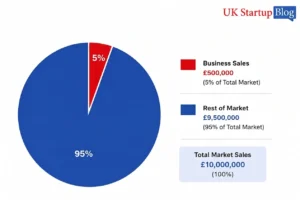
The company therefore controls approximately 5% of its defined UK market by revenue.
How Do You Calculate Market Share Step by Step?
Calculating the percentage itself is straightforward. Defining the correct market and collecting comparable information usually require more work.
Define the Relevant Market?
Start by deciding exactly what the business sells, who buys it and where those customers are located. A broad market definition can make the business appear insignificant, while an overly narrow definition may exaggerate its position.
A specialist vegan bakery in Manchester, for example, should not automatically compare itself with the entire UK food industry. A more useful market might be vegan bakery sales within Greater Manchester.
The definition should cover:
| Element | Question to Answer |
| Product or service | What specific category is being measured? |
| Customer | Is the market consumer, business or public sector? |
| Location | Is it local, regional, national or international? |
| Sales channel | Does it cover online, physical or combined sales? |
| Period | Is the calculation monthly, quarterly or annually? |
Thorough research is essential when defining the market. Appropriate market research tools can help a company assess customer demand, industry trends and the size of its potential audience.
Select a Measurement Method
Choose whether the calculation will use revenue, units, customers or transactions. The same measurement must be used for both the business and the wider market.
For example, do not divide the company’s revenue by the total number of units sold across the industry.
Find the Business’s Sales
Use reliable internal records to identify revenue or sales volume for the selected category and period. Accounting software, invoices, sales reports and management accounts may provide the necessary figures.
Only include sales that fall within the defined market. If a business sells several products, revenue from unrelated categories should be excluded.
The figures must also be calculated consistently. If the market value excludes VAT, returns and discounts, the company’s sales figure should be prepared on the same basis.
Estimate Total Market Sales
The total market figure may come from industry reports, trade associations, distributor data, published company accounts, customer surveys or research conducted by the business.
When a reliable total is unavailable, the company can estimate market size using customer numbers, average annual spending and purchasing frequency.
Apply the Formula
Divide the company’s relevant sales by total market sales and multiply by 100.
If a company sells 18,000 units in a market where 300,000 comparable units are sold:
(18,000 ÷ 300,000) × 100 = 6%
The company has a 6% market share by sales volume.
Which Types of Market Share Can a Business Calculate?
Different calculations reveal different aspects of competitive performance.
| Type | Calculation | What It Shows |
| Revenue market share | Business revenue ÷ market revenue × 100 | Share of total market value |
| Unit market share | Business units sold ÷ total units sold × 100 | Share of sales volume |
| Customer market share | Business customers ÷ total market customers × 100 | Share of the available customer base |
| Segment market share | Business segment sales ÷ total segment sales × 100 | Position within a particular niche |
| Relative market share | Business share ÷ leading competitor’s share | Strength compared with the market leader |
Revenue Market Share
Revenue-based market share is useful when prices vary significantly between businesses. Premium brands may have a higher revenue share despite selling fewer products.
If a company earns £900,000 from a market valued at £15 million:
(£900,000 ÷ £15 million) × 100 = 6%
Unit Market Share
Unit market share measures the number of products sold rather than their monetary value.
Suppose a bicycle company sells 8,000 bicycles, while 100,000 bicycles are sold across its defined market:
(8,000 ÷ 100,000) × 100 = 8%
Comparing unit and revenue market share can also reveal pricing differences. An 8% unit share combined with a 5% revenue share may indicate that the company sells lower-priced products than its competitors.
Customer Market Share
Some subscription and service businesses may find customer numbers more helpful than product units.
If a broadband provider has 12,000 customers in a local market containing 150,000 potential or active customers, its customer share is:
(12,000 ÷ 150,000) × 100 = 8%
Businesses using this method must define whether the denominator represents active buyers or everyone who could potentially buy. These are different measures and should not be presented as though they are interchangeable.
Relative Market Share
Relative market share compares a business directly with the largest competitor.
Relative Market Share = Business Market Share ÷ Leading Competitor’s Market Share
If a business has a 12% share and the market leader holds 20%:
12% ÷ 20% = 0.6
The business is 60% of the size of the market leader based on the selected measure. Relative market share is normally expressed as a ratio or multiple rather than as the company’s overall share of the industry.
How Can a Business Estimate Market Size?
Reliable market totals are not always publicly available, particularly for local businesses or new industries. In this situation, the business can use either a top-down or bottom-up estimate.
Top-Down Estimation
A top-down calculation begins with a broad industry value and reduces it to the relevant segment.
For example, a company might start with the estimated value of the UK market, then narrow it by region, customer type and product category. This approach is relatively quick, but every assumption can reduce accuracy.
Bottom-Up Estimation
A bottom-up calculation estimates how many suitable customers exist and how much they are likely to spend.
Assume a business targets 20,000 companies and estimates that each spends an average of £600 per year on the relevant service:
20,000 customers × £600 = £12 million estimated market size
If the business earns £720,000 from that market:
(£720,000 ÷ £12 million) × 100 = 6%
The calculation should record every assumption so it can be reviewed when better information becomes available.
How Often Should Market Share Be Calculated?
Most businesses should calculate market share at least annually. Businesses operating in seasonal, fast-moving or highly competitive industries may benefit from monthly or quarterly monitoring.
Using a rolling 12-month period can reduce distortions caused by seasonal peaks. Retailers, for example, may generate a substantial proportion of annual revenue during the final quarter. Comparing one busy month with a competitor’s full-year performance would be misleading.
Maintaining accurate sales and customer information through a customer relationship management system can make regular calculations easier.
How Should Changes in Market Share Be Interpreted?
A rising percentage is generally positive, but the reason for the change matters.
| Business Sales | Total Market | Market Share | Interpretation |
| Rising | Rising more slowly | Falling | Business is growing but losing ground |
| Rising faster than the market | Rising | Increasing | Business is outperforming the market |
| Falling | Falling faster | Increasing | Share is up despite lower sales |
| Stable | Growing | Falling | Business is not keeping pace |
| Falling faster than the market | Falling | Falling | Competitive position is weakening |
Consider a company whose revenue falls from £1 million to £900,000. If the market contracts from £10 million to £7.5 million, its market share increases from 10% to 12%.
Although the percentage has improved, the business has still lost £100,000 in revenue. Market share must therefore be interpreted alongside actual sales, profitability and wider market conditions.
What Are the Most Common Calculation Mistakes?
One common mistake is using an unclear market definition. A business may calculate its share of the national market when it only serves one region, producing a figure that is not useful for operational decisions.
Other mistakes include comparing different periods, mixing revenue with units, using outdated market data and including unrelated product sales. Businesses may also overlook refunds, VAT, currency differences or competitor sales made through alternative channels.
Estimated market figures should not be presented as exact. A sensible approach is to calculate a range using conservative, expected and optimistic market-size assumptions.
For instance, if annual business revenue is £500,000 and the market is estimated to be worth between £8 million and £10 million, the company’s likely share is between 5% and 6.25%.
How Can a Business Increase Its Market Share?
A company can grow its market share by winning customers from competitors, encouraging existing customers to spend more or reaching parts of the market that are currently underserved.
Possible approaches include improving product quality, strengthening customer service, adjusting prices, expanding distribution and communicating a clearer point of difference.
A stronger digital presence for business growth may also help a company reach more potential customers and generate additional sales.
However, expansion should remain profitable. Heavy discounting may increase unit share while reducing revenue quality and margins.
Entering a new category through a business diversification strategy can create additional opportunities, but the new category should be measured as a separate market where appropriate.
Why Is Market Share Important for Business Decisions?
Market share gives decision-makers a clearer view of competitive strength. It can show whether revenue growth comes from improved performance or simply reflects growth across the entire industry.
The figure can support decisions about marketing budgets, pricing, recruitment, investment and expansion. It may also help a company set realistic performance targets.
Nevertheless, market share is not a complete measure of business success. A smaller company with loyal customers and healthy margins may be stronger than a larger competitor that relies on low prices and unprofitable sales.
Conclusion
To calculate market share, divide the business’s relevant sales by total sales across the same market and multiply the result by 100. The accuracy of the result depends on using a precise market definition, comparable figures and a consistent time period.
Businesses should calculate both revenue and unit share where possible, track changes over time and compare the result with profitability. Used correctly, market share provides valuable evidence about competitive performance, growth and the company’s position within its industry.
Frequently Asked Questions
Can a Small Business Calculate Market Share?
Yes. A small business can calculate its share of a local, regional or niche market. Defining a realistic market is particularly important because comparing a local company with an entire national industry may not produce a useful result.
Can Market Share Be More Than 100%?
No. A properly calculated share of a market cannot exceed 100%. A result above 100% normally means the business and market figures cover different products, periods, locations or measurement methods.
Is Market Share Calculated Before or After VAT?
Either basis can be used if both figures are consistent. In most commercial analysis, revenue excluding VAT provides a clearer comparison because VAT collected is not business income. The total market value must also exclude VAT.
What Is a Good Market Share?
There is no universal good percentage. A 2% share may be highly valuable in a large market, while a 40% share of a small declining market may offer limited growth. Profitability, market size, competition and future demand must also be considered.
What Is the Difference Between Market Share and Market Size?
Market size is the total value or volume of sales available across the defined market. Market share is the percentage of that total captured by one business. If a market is worth £20 million and a company earns £2 million from it, the market size is £20 million and the company’s market share is 10%.

Expert Blogger | Strategic thinker anticipating future directions for UK business
Related Articles in Tax & Accounting
View All →
Why the Two Year Accounts Rule is Not Actually a Rule?
Ask most new business owners when they can first apply for a mortgage and the answer comes back the same way every time: two years of accounts, minimum,…

The Most Overlooked Tax Reliefs Available to UK Taxpayers
Most people know about the Personal Allowance and ISA limits, but there’s a whole range of tax reliefs that go unclaimed every year. Whether you’re employed, self-employed, or retired, you’ll likely be missing out on at least…

Rachel Reeves Back Door Death Tax | What It Means for UK Families?
For many families in the UK, home ownership is more than just a place to live. It’s a legacy, a source of pride, and often the largest financial…