
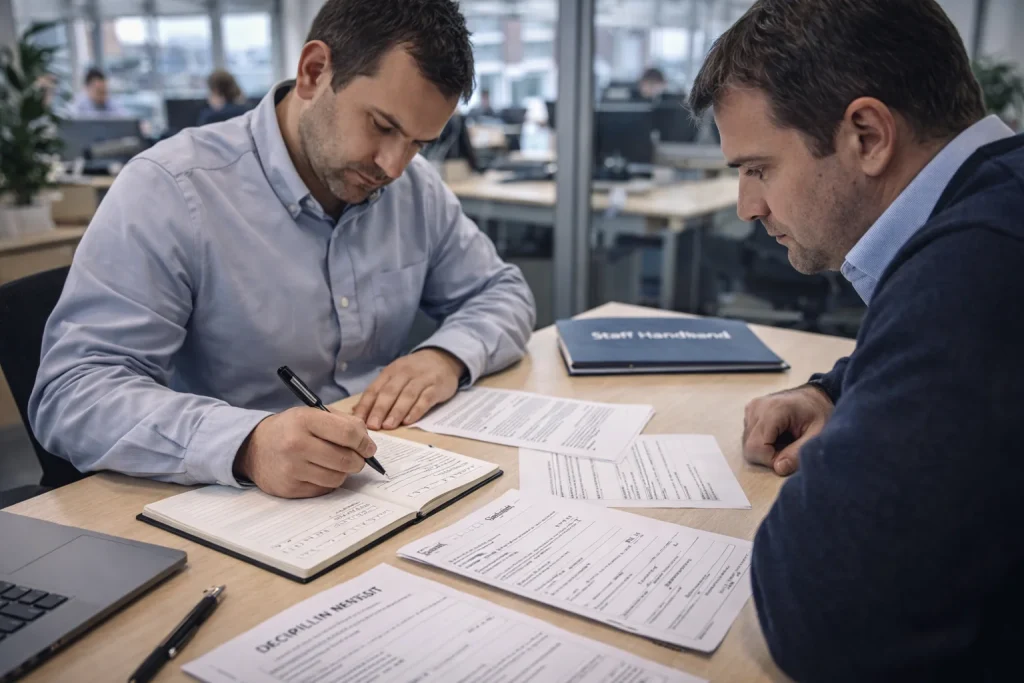
To avoid dismissal for gross misconduct, you should cooperate with the investigation, present evidence, explain any mitigating circumstances, and make sure your employer follows a fair disciplinary process.
Gross misconduct does not automatically mean you will lose your job. In many UK cases, employees avoid dismissal because the employer fails to investigate properly, ignores mitigation, or does not consider alternatives such as a final written warning.
Key points to remember:
- Stay calm and do not resign immediately
- Read your employer’s disciplinary policy carefully
- Gather evidence, witnesses and written records
- Attend every meeting and explain your side
- Highlight any mitigating circumstances
- Ask for a companion at your disciplinary hearing
- Appeal if you believe the decision is unfair
What Counts as Gross Misconduct in the Workplace?

Gross misconduct is behaviour serious enough to destroy the trust between you and your employer. Unlike ordinary misconduct, which may result in a warning, gross misconduct can lead to summary dismissal without notice.
There is no exact legal definition in UK law, so employers usually define gross misconduct in their handbook or disciplinary policy.
However, Acas and most tribunals commonly treat the following as gross misconduct:
| Ordinary Misconduct | Gross Misconduct |
| Repeated lateness | Theft or fraud |
| Minor breach of company policy | Violence or threats |
| Occasional misuse of company property | Serious harassment or discrimination |
| Poor timekeeping | Gross negligence |
| Minor insubordination | Serious insubordination |
| Unauthorised absence | Breach of confidentiality |
Even if your employer believes your actions amount to gross misconduct, they still have to investigate fairly before making a decision.
As one Acas adviser explains:
“An allegation of gross misconduct should never automatically lead to dismissal. Employers must investigate and consider all the circumstances before deciding the outcome.”
Can You Be Dismissed Instantly for Gross Misconduct?
Many people believe gross misconduct always leads to immediate dismissal. In practice, that is not always true. Your employer may suspend you immediately while they investigate, but they should not dismiss you without first following a proper process.
A fair process usually includes:
- An investigation
- An investigatory meeting
- A disciplinary hearing
- A chance for you to respond
- A written decision
- A right of appeal
An employer who skips these steps risks an unfair dismissal claim. Employment tribunals often focus less on what happened and more on whether the employer followed the correct procedure.
The well-known Burchell test is often used in tribunal cases. It asks whether the employer:
- Genuinely believed you committed the misconduct
- Had reasonable grounds for that belief
- Carried out a reasonable investigation
If the answer to any of these is no, dismissal may be unfair.
What Should You Do Immediately After Being Accused of Gross Misconduct?

Being accused of gross misconduct is stressful, but your first reaction can strongly affect the outcome. The worst thing you can do is panic, argue emotionally, or resign straight away.
Should You Resign or Stay in the Process?
Resigning does not always protect you. Your employer may still continue the investigation and record that you left while facing gross misconduct allegations.
This can create problems for future references or job applications, especially if a new employer asks why you left.
Instead, stay involved in the process and defend yourself properly. By taking part, you have the chance to explain your side, provide evidence and possibly reduce the outcome from dismissal to a warning.
If you are unsure what to do, seek advice from a union representative, employment adviser or solicitor before making any decision.
What Evidence Should You Collect?
As soon as possible, gather anything that supports your version of events. The earlier you collect evidence, the easier it will be to remember details and prove your case later.
Useful evidence may include:
- Emails, messages or written instructions
- Witness names and statements
- Diary notes about what happened
- Copies of your contract and staff handbook
- Evidence showing you followed procedure
You should also make a written timeline while events are fresh in your mind.
A solicitor from Steen & Co has stated:
“The strongest defence is often detailed evidence gathered early. Employees who keep notes and documents are in a far better position to challenge allegations.”
What If the Allegation Is Wrong?
If you believe the accusation is false, explain clearly why. Avoid emotional language and focus on facts.
If you think the process is biased, you may also be able to raise a grievance or submit a Data Subject Access Request to see what information your employer holds about you.
Real Example: An Employee Who Avoided Dismissal
Let me share a real example with you. A retail supervisor in Manchester was accused of gross misconduct after allegedly shouting aggressively at a colleague.
Instead of resigning, she decided to defend herself by gathering evidence, including CCTV footage, text messages, and witness statements. These showed she had been provoked and had apologised straight away.
At the disciplinary hearing, the employer reviewed everything and agreed her behaviour was out of character. Instead of dismissing her, they issued a final written warning.
This shows how staying calm and presenting evidence can make a big difference.
How Does the Gross Misconduct Investigation Process Work?
The investigation stage is often the most important part of the entire process. A weak or rushed investigation can make dismissal unfair.
Your employer should appoint someone impartial to investigate the allegation. That person may interview witnesses, collect documents and invite you to an investigatory meeting.
What Happens During an Investigatory Meeting?
An investigatory meeting is not the same as a disciplinary hearing. It is simply a chance for your employer to gather facts and hear your explanation.
You should receive enough notice to prepare. In most cases, a few days is considered reasonable. You should also receive details of the allegation and any evidence against you.
During the meeting:
- Listen carefully to the allegation
- Answer honestly
- Avoid admitting something you do not agree with
- Ask for clarification if anything is unclear
How Much Evidence Does an Employer Need Before Taking Action?
Your employer does not need to prove the allegation beyond all doubt, as would happen in a criminal court. However, they do need reasonable evidence.
| Evidence That May Support Dismissal | Evidence That May Help Your Defence |
| CCTV footage | Emails showing different instructions |
| Witness statements | Witnesses supporting your version |
| Audit records | Medical or mental health evidence |
| Phone or computer logs | Proof of previous good conduct |
| Written complaints | Evidence of provocation or confusion |
The employer should investigate both sides fairly. If they only look for evidence against you, the process may be challenged later.
What Rights Do You Have During a Disciplinary Hearing?

Before any decision is made, you should be invited to a disciplinary hearing. This is your chance to explain your side properly and respond to the evidence.
You have important rights under the Acas Code of Practice:
- The right to know the allegations against you
- The right to see the evidence beforehand
- The right to reasonable notice of the hearing
- The right to bring a trade union representative or colleague
- The right to explain your side
- The right to appeal if you are dismissed
You should also be told clearly that your job may be at risk. If your employer fails to explain this, it may make the process unfair.
Can You Bring Someone with You?
You are usually allowed to bring:
- A colleague from work
- A trade union representative
- An official employed by your union
That person can support you, ask questions, take notes and help you stay calm. Although they cannot answer every question for you, they can speak on your behalf and make sure the process is fair.
If your employer refuses to let you bring someone, you should raise this immediately.
What Should You Say During the Hearing?
Be honest, clear and focused. If you made a mistake, it may be better to admit it and explain why it happened rather than deny something that can be proven.
For example, you might explain:
- You misunderstood a policy
- You had not been trained properly
- You were under exceptional pressure
- You regret what happened
- Another employee was involved or partly responsible
Try to stay professional, even if you feel upset or angry. Employers often take your attitude into account when deciding whether a warning or dismissal is more appropriate.
One HR manager interviewed during a tribunal case explained:
“We changed our decision after the employee explained the full context. Once we understood the lack of training involved, dismissal no longer seemed appropriate.”
How Can You Defend Yourself Against Gross Misconduct Allegations?
The best defence is to combine evidence with a clear explanation. Tribunals often look at whether you were given a genuine chance to defend yourself.
Rather than simply saying the allegation is unfair, explain why. If you disagree with witness statements, say exactly what is wrong with them. If you followed instructions from a manager, provide written proof.
You should also challenge procedural mistakes. For example, your employer may have:
- Failed to investigate properly
- Ignored your evidence
- Treated another employee differently in a similar case
- Refused to let you bring a companion
- Decided the outcome before the hearing
Consistency matters. If another employee committed a similar offence and only received a warning, your employer should explain why your case is different.
Which Mitigating Circumstances Could Help You Avoid Dismissal?
Mitigating circumstances are factors that explain why the incident happened or why dismissal would be too harsh. They do not excuse misconduct, but they can reduce the sanction.
Can Length of Service and a Clean Record Reduce the Risk of Dismissal?
If you have worked for the company for years without any previous problems, that may help your case. Employers are expected to consider your record before deciding on dismissal.
Long service, positive appraisals and previous good conduct may support an argument that the incident was out of character.
Could Stress, Mental Health or Lack of Training Affect the Outcome?
Employers should also consider personal circumstances.
These may include:
- Stress or burnout
- Mental health difficulties
- Lack of training
- Unclear instructions
- Personal problems at home
- Provocation by another employee
The case of Brito-Babapulle v Ealing Hospital NHS Trust showed that even where gross misconduct is proven, employers must still consider mitigation before dismissing someone.
Real Example: An Employer Who Got It Wrong
A small marketing company dismissed an employee for sending an angry email to a client. However, the employee had repeatedly warned managers that she was struggling with severe stress and had received no support.
When the case reached tribunal, the dismissal was found unfair because the employer had failed to consider her mental health and did not explore a final warning instead.
Does an Employer Have to Consider Alternatives to Dismissal?

Yes. Even if your employer believes gross misconduct occurred, they should still consider whether there is a lesser sanction. Dismissal should not be automatic.
Possible alternatives include:
- A verbal warning
- A written warning
- A final written warning
- Temporary suspension
- Demotion
- Transfer to another role
In Burdett v Aviva Employment Services, the tribunal criticised the employer because it failed to consider alternatives such as home working before dismissing the employee.
Employers should not assume that gross misconduct always means dismissal. They must decide whether dismissal is reasonable in all the circumstances and whether another option could solve the problem.
When Could a Gross Misconduct Dismissal Be Considered Unfair?
A dismissal may be considered unfair if your employer fails to follow a fair and reasonable process. This can include situations where they did not investigate properly, failed to give you enough notice, ignored your evidence, or refused your right to be accompanied.
It may also be unfair if they did not consider mitigating factors, treated you differently from others, or failed to offer an appeal.
In most cases, you can claim unfair dismissal if you have worked for your employer for at least two years. However, some dismissals are automatically unfair, such as those involving discrimination, whistleblowing, or health and safety concerns.
You usually have three months less one day from your dismissal date to start a claim, so acting quickly is important.
How Should You Appeal a Gross Misconduct Dismissal Decision?
If you are dismissed, you should appeal quickly. Most employers require an appeal within five working days.
Your appeal letter should explain:
- Why you think the decision was wrong
- Any evidence that was ignored
- Any procedural errors
- Why a lesser sanction would have been more reasonable
Keep your appeal factual and organised. A successful appeal may result in your dismissal being overturned or reduced to a warning.
Conclusion
Avoiding dismissal for gross misconduct is often possible if you respond quickly, stay involved and present your case clearly. Employers must follow a fair process, investigate properly and consider any mitigating circumstances before deciding to dismiss you.
By collecting evidence, attending meetings, explaining your side and challenging procedural mistakes, you improve your chances of receiving a lesser outcome such as a final written warning.
If you are dismissed, do not ignore your right to appeal, as many unfair decisions are successfully overturned or reduced.
FAQs
Can You Be Suspended for Gross Misconduct and Still Keep Your Job?
Yes. Suspension is not the same as dismissal. Many employees are suspended while an investigation takes place and later return to work.
Should You Resign if You Are Accused of Gross Misconduct?
Usually no. Resigning may not stop the process and could still leave you with a poor employment record.
Can an Employer Dismiss You for Gross Misconduct Without Witnesses?
Possibly, but they still need reasonable evidence. This could include CCTV, emails, records or other documents.
How Long Does a Gross Misconduct Investigation Usually Take?
It depends on the case. Simple investigations may take a few days, while more complex cases can take several weeks.
Can You Bring Someone With You to a Disciplinary Meeting?
Yes. You usually have the right to bring a colleague or trade union representative.
Will Gross Misconduct Affect Future Employment References?
It can. Some employers may mention dismissal for gross misconduct in a reference, although many only confirm dates of employment.
How Long Do You Have to Make an Unfair Dismissal Claim?
You usually have three months less one day from the date your employment ended.

Blogger & Content creator | An insightful writer sharing practical advice for UK entrepreneurs