
How to Report Someone for Working Cash in Hand and Claiming Benefits?

UK Startup Blog Archive
Table of Contents
If you believe somebody is working cash in hand while claiming benefits and not declaring their income, you can report it to the Department for Work and Pensions (DWP) or HMRC.
In the UK, this can usually be done anonymously through the GOV.UK benefit fraud reporting form, by phone, or by post. The authorities will then decide whether there is enough evidence to investigate.
Key highlights:
- You can report suspected benefit fraud anonymously
- The fastest option is the GOV.UK online form
- You should only report what you genuinely know or reasonably suspect
- You may also need to report the matter to HMRC if tax is being avoided
- Not every case leads to action, as some situations turn out to be mistakes rather than fraud
Can You Report Someone for Working Cash in Hand and Claiming Benefits?
Yes, you can report someone for working cash in hand and claiming benefits if you believe they are failing to declare their income. This is often treated as benefit fraud when a person receives money through work but does not tell the DWP, local council, or HMRC.
Working cash in hand is not automatically illegal. Many people are paid in cash for temporary jobs, gardening, cleaning, childcare, or labouring.
The problem arises when the earnings are hidden while the person continues to claim benefits such as Universal Credit, Housing Benefit, Income Support, or Council Tax Support.
A DWP spokesperson explains:
“Benefit fraud happens when somebody deliberately gives false information or fails to report a change in their circumstances in order to receive benefits they are not entitled to.”
In practice, this means a person may be committing fraud if they continue claiming benefits while secretly earning money that should have been declared.
What Does “Cash in Hand” Mean When Someone Claims Benefits?

“Cash in hand” usually refers to work where somebody is paid directly in cash instead of through a payslip or bank transfer.
Common examples include:
- Building or decorating work
- Cleaning jobs
- Babysitting or childminding
- Hairdressing or beauty work
- Gardening or handyman services
Being paid this way is not necessarily wrong. However, if the income is undeclared and affects the amount of benefits someone receives, the person may be committing both benefit fraud and tax evasion.
For example, if someone claims Universal Credit but also works several days each week for cash without reporting those earnings, they may be receiving more money than they are legally entitled to.
| Situation | Is It Likely to Be Fraud? |
| A person works cash in hand and declares all income to DWP and HMRC | No |
| A person works cash in hand but hides the earnings while claiming benefits | Yes |
| Someone forgets to report one payment and corrects it quickly | Usually not |
| A person repeatedly hides cash income for months | Very likely |
“Cash in hand” is not illegal on its own, but failing to declare that income while claiming benefits can lead to serious consequences, including repayment demands, penalties, or legal action.
When Does Working Cash in Hand Become Benefit Fraud?
Working cash in hand becomes benefit fraud when a person deliberately hides income or employment while continuing to claim benefits.
Typical situations include somebody:
- claiming Universal Credit while secretly working
- telling the DWP they are unemployed when they are actually earning money
- claiming Housing Benefit based on a lower income than they really receive
- failing to report changes in working hours or wages
Signs Someone May Be Hiding Cash-in-Hand Work
There is no single sign that proves benefit fraud, but there are situations that may raise concerns:
- They regularly go to work but say they are unemployed
- They have expensive purchases that do not match their declared income
- They openly admit they are being paid cash in hand while on benefits
- They work at the same business every week without declaring it
What May Not Count as Fraud?
It is important not to jump to conclusions. Sometimes a person has already informed the DWP about their earnings, or their benefits are not affected because they are allowed to work a limited number of hours.
An officer from the DWP Fraud and Error Service states:
“Not every report results in action. In some cases, the individual has already declared the change or there has been a misunderstanding.”
Because of this, you should only report what you genuinely know or reasonably suspect.
How Do You Report Someone for Working Cash in Hand and Claiming Benefits in the UK?

There are several ways to report someone for working cash in hand and claiming benefits in the UK. In most cases, the fastest and simplest option is to use the official GOV.UK benefit fraud reporting service.
However, you can also report suspected fraud by telephone, by post, or directly to HMRC if tax evasion may also be involved.
Reporting Through GOV.UK
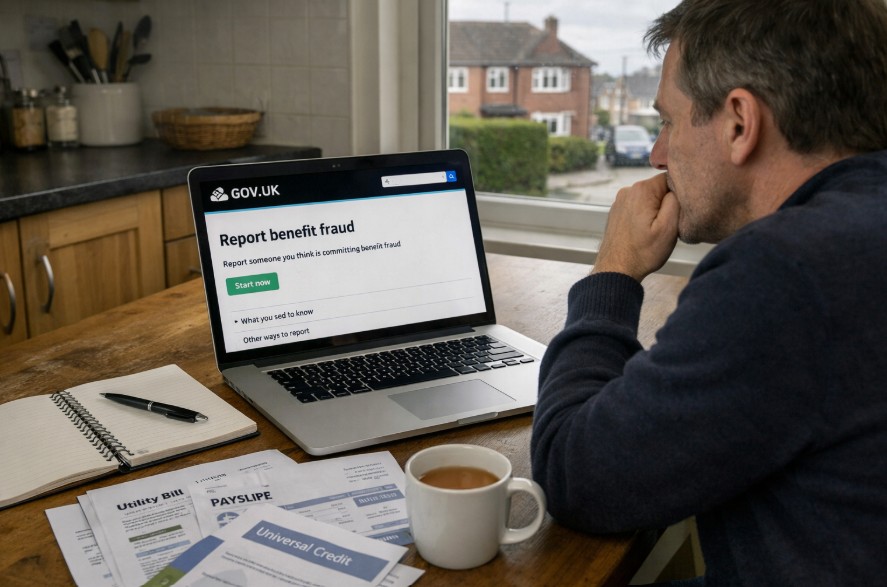
The official GOV.UK form allows you to report someone online. You do not have to give your name or contact details unless you want to.
When completing the form, include as much information as possible, such as:
- the person’s name and address
- the type of work they are doing
- where and when they work
- which benefits they may be claiming
- details of the employer or business
- vehicle details if relevant
The more accurate the information is, the easier it is for the DWP Fraud and Error Service to decide whether the case should be investigated.
Reporting by Phone or Post
If you would prefer not to use the online form, you can contact the National Benefit Fraud Hotline instead. This may be useful if you are not confident using online forms or if you want to explain the situation verbally.
| Reporting Method | Details |
| Online | GOV.UK benefit fraud reporting form |
| Phone | 0800 854 440 |
| Welsh language line | 0800 678 3722 |
| Opening hours | Monday to Friday, 8am to 6pm |
| Post | Mail Handling Site A, Wolverhampton, WV98 2BP |
If the person lives in Northern Ireland, you should use the Northern Ireland Benefit Fraud Hotline on 0800 975 6050.
Reporting to HMRC
If you think the person or their employer is also avoiding tax, you can report the matter separately to HMRC. This is relevant where cash wages are being hidden and no tax is being paid.
An HMRC officer advises:
“For your own safety, do not try to gather extra evidence or tell anyone that you are making a report.”
Instead, provide only the information you already know and allow the authorities to investigate further.
Can You Report Benefit Fraud Anonymously?
Yes. In most cases, you can make an anonymous benefit fraud report. You do not need to provide your name, address, telephone number, or email address.
This is often one of the biggest concerns people have before reporting someone. Many worry about being identified by a neighbour, friend, family member, or employer. However, the DWP and HMRC do not normally reveal who made the report.
That said, anonymous reports are more useful when you provide detailed information. Even if you do not give your own details, you should still include enough facts to help the authorities understand what is happening.
A few years ago, I spoke with a neighbour who had reported somebody living nearby. She said:
“I was worried they would find out it was me, but the report was completely anonymous. I simply gave the details I knew and left it to the DWP.”
Her experience reflects how most reports are handled. The focus is on the information, not on who provided it.
What Information Do You Need to Report Someone?

The more specific your report is, the more likely it is to be useful. Vague claims such as “they work sometimes” are unlikely to help investigators.
Try to provide:
- full name and address
- where they work
- what type of work they do
- the days or times they work
- the employer’s name, if known
- which benefits they appear to be claiming
- how long the situation has been going on
- vehicle details or social media information if relevant
You should avoid guessing or exaggerating. If you are unsure about something, say that you are unsure rather than presenting it as fact.
Should You Also Report Cash in Hand Work to HMRC?
In some cases, yes. If a person is working cash in hand and the employer is not declaring wages or paying tax, HMRC may need to investigate as well.
This often happens where:
- an employer pays workers cash to avoid tax
- a worker hides their earnings from HMRC
- no payslips, contracts, or records are kept
You can report tax evasion online through HMRC’s fraud reporting service. The report can also be made anonymously.
An experienced compliance officer once described the process to me in simple terms:
“When someone reports both the undeclared work and the unpaid tax, it gives us a fuller picture. DWP and HMRC may then look at the case separately.”
For example, a local tradesman was reportedly claiming Universal Credit while working full-time for cash. A former council investigator later said in an interview:
“The person who reported him included the name of the building company and the registration number of the van. That information helped the investigation move much faster.”
Reporting cash in hand work to the appropriate authorities helps ensure fairness in the system and can prevent ongoing fraud or tax evasion from going unchecked.
What Happens After You Report Someone?
After you submit a report, the DWP Fraud and Error Service reviews the information. They may compare it with records already held about the person.
The investigation can include:
- checking employment records
- reviewing bank details
- speaking to employers
- interviewing the person
- surveillance in more serious cases
You will usually not be told the outcome because of privacy rules. Even if you made the report, the authorities cannot normally tell you what action was taken.
Sometimes nothing happens. That does not necessarily mean your report was ignored. It may simply mean there was not enough evidence or the person had already declared the change in their circumstances.
What Penalties Can Someone Face for Benefit Fraud?

If someone is found to have been working cash in hand while claiming benefits and deliberately hiding income, the penalties can be serious.
The Department for Work and Pensions will assess how long the fraud lasted, how much was overpaid, and whether false information was knowingly provided.
Common penalties include:
- Benefit reduction or suspension
- Repayment of overpaid benefits
- Financial (civil) penalties
- Interview under caution
- Possible court action
In more serious cases, the DWP Fraud and Error Service may carry out a formal investigation and interview.
“Where there is clear evidence that someone knowingly hid their earnings, the consequences can include repayment, loss of benefits, and, in serious cases, prosecution,” a DWP investigator explained.
Severe cases involving large sums or repeated fraud may result in a criminal record, fines, or even imprisonment.
Could It Be a Mistake Rather Than Fraud?
Not every case is deliberate fraud. Some people forget to update their circumstances, misunderstand the rules, or delay reporting a change.
For instance, somebody may start a part-time job and assume they do not need to tell Universal Credit because they only work a few hours each week. In reality, they still need to report it, but the mistake may not have been intentional.
Because of this, the authorities investigate before making a decision. They look at whether the person knowingly tried to hide their earnings or whether there was a genuine misunderstanding.
Are the Reporting Rules Different in Scotland, Northern Ireland, or for Council Tax Support?
The process for reporting suspected benefit fraud, such as working cash in hand while claiming benefits, is broadly similar across the UK, but it can vary depending on the benefit and location.
If the issue involves Council Tax Support or Housing Benefit, it should usually be reported to the local council, as they manage these claims rather than the Department for Work and Pensions.
| Area or Benefit Type | Where to Report |
| UK benefits (e.g. Universal Credit) | DWP or GOV.UK |
| Council Tax Support / Housing Benefit | Local council |
| Scottish devolved benefits | Social Security Scotland |
| Northern Ireland claims | Benefit Fraud Hotline (0800 975 6050) |
| War Pension / Armed Forces schemes | Ministry of Defence Fraud Team |
An official from a local authority fraud team explains:
“People often report Council Tax Support fraud to the DWP, but those cases are usually dealt with by the council instead,” a local authority fraud officer explained.
In all cases, reporting to the correct organisation helps ensure the issue is handled quickly and properly.
Conclusion
If you suspect someone is working cash in hand and claiming benefits without declaring their income, you can report it safely and anonymously through GOV.UK, the DWP, your local council, or HMRC.
The most important thing is to provide accurate information and avoid making assumptions. Not every case is fraud, as some people simply misunderstand the rules or fail to report changes on time.
Once a report is made, the relevant authority will investigate and decide whether any further action is necessary.
Frequently Asked Questions
Can you report benefit fraud without proof?
Yes. You do not need proof, but you should provide as much accurate information as possible. The authorities will decide whether there is enough evidence to investigate.
Will the person know that I reported them?
Normally no. Reports can be made anonymously, and your details are not usually shared.
How long does a benefit fraud investigation take?
There is no fixed timescale. Some cases take a few weeks, while more complicated investigations can take several months.
Is working cash in hand always illegal?
No. Working cash in hand is legal if the income is declared to HMRC and the DWP where required.
Can you report someone to both DWP and HMRC?
Yes. If you believe the person is hiding income from benefits and avoiding tax, you may need to report both matters separately.
What if the person is claiming Council Tax Support?
You should report Council Tax Support fraud directly to the local council.
What happens if the report is wrong?
If there is no evidence of fraud, no action may be taken. Making a report in good faith is not usually a problem, but knowingly making false accusations could be.

Blogger & Content creator | An insightful writer sharing practical advice for UK entrepreneurs
Related Articles in Finance
View All →
If I Take Home £1,600 a Month, What Is My Salary in the UK?
If an employee takes home £1,600 per month in the UK, their estimated gross salary is approximately £21,780 per year. This is equal to about £1,815 per month…

Why the Two Year Accounts Rule is Not Actually a Rule?
Ask most new business owners when they can first apply for a mortgage and the answer comes back the same way every time: two years of accounts, minimum,…

Snap-on Franchise Cost: Fees, Investment and Earnings
The Snap-on franchise cost in the UK is currently quoted at £166,597 to £168,487 for the franchise investment, with Snap-on stating that a new franchisee may need to…