
How to Make a Legal Contract Without a Lawyer in the UK (2027 Guide)?


UK Startup Blog Archive
Table of Contents
You can make a legally binding contract without a lawyer in the UK. For many straightforward business transactions, you can write the agreement yourself, use an appropriate template, negotiate the terms and sign it without appointing a solicitor.
However, a contract does not become legally enforceable simply because both parties sign a document. Its enforceability depends on the underlying agreement, the parties’ legal capacity, the certainty of its terms and any formalities required by law.
For UK startup founders, freelancers and small business owners, the bigger question is not whether they can write their own contracts.
It is whether those contracts protect their business against unpaid invoices, unfinished projects, intellectual property disputes and unexpected liabilities.
Our analysis of UK contract law principles, official business guidance and practical startup requirements suggests that many routine commercial agreements can be prepared without full legal drafting.
The potential difficulties arise when businesses overlook payment conditions, termination rights, liability provisions or ownership of the work being delivered.
This guide explains how to make a legal contract without a lawyer, which clauses to include, how to sign it correctly and what businesses should review before entering agreements in 2027.
Can You Legally Make Your Own Contract Without a Lawyer in the UK?
Yes. Individuals and businesses can generally prepare their own legally binding contracts in England and Wales without using a solicitor.
For an ordinary commercial agreement, there is usually no requirement to use a professionally drafted document. In appropriate circumstances, a verbal agreement, email exchange or electronic acceptance can establish a contract.
However, certain transactions require additional formalities. Examples include land transactions, deeds, guarantees and some transfers of intellectual property rights.
Businesses should distinguish between three different questions:
| Question | What It Means |
| Is the contract legally formed? | The necessary requirements for a contract have been satisfied |
| Is the contract enforceable? | A court can recognise and enforce the relevant contractual obligations |
| Does the contract adequately protect the business? | Its clauses properly address payment, operational and commercial risks |
These outcomes are not interchangeable.
For example, a freelance designer could agree by email to create a website for £2,000. The agreement might become legally binding even without a signed document.
However, if the emails do not specify delivery milestones, revision limits or intellectual property ownership, both parties could face considerable uncertainty.
This is why understanding what makes a contract legally binding in the UK is an important starting point.
Our assessment is that DIY contracting is most suitable when the obligations are straightforward, the potential losses are manageable and both parties understand the agreed terms.
What Makes a Contract Legally Binding in the UK?
In England and Wales, an ordinary enforceable contract generally requires agreement through offer and acceptance, consideration, an intention to create legal relations and sufficiently certain terms.
Legal capacity, authority and lawful subject matter also matter.
| Legal Requirement | Meaning | Practical Business Example |
| Offer | One party proposes identifiable terms | A consultant offers a £1,500 service package |
| Acceptance | The other party accepts those terms | The customer accepts the quotation |
| Consideration | Each party provides something of legal value | Services are exchanged for payment |
| Legal intention | The parties intend legally enforceable obligations | Two companies agree on a commercial service |
| Certainty | Essential obligations are sufficiently clear | The scope, fees and deadlines can be identified |
| Capacity and authority | Parties can enter the agreement and act with authority | An authorised director agrees on behalf of a company |
| Lawful purpose | The agreement does not involve prohibited activity | The contract covers lawful commercial services |
These principles are central to ordinary contract formation, although individual transactions may involve additional legal requirements.
Scots contract law differs in important respects, including the fact that consideration is not generally required. Businesses contracting under Scots law should not automatically adopt an England and Wales template.
Does a Contract Need to Be Signed to Be Legally Binding?
Not always.
Many ordinary contracts can be formed through conduct, written communication or verbal acceptance. Nevertheless, signatures provide useful evidence of agreement and help establish which version of the contract was accepted.
A signature is particularly valuable where the document contains important limitations, special conditions or a complex commercial arrangement.
Does a Contract Have to Be Witnessed?
Most ordinary business contracts do not require a witness merely because they are signed.
However, deeds and certain other documents may require witnessing or particular execution procedures. A company executing a document formally under section 44 of the Companies Act 2006 is subject to specific rules.
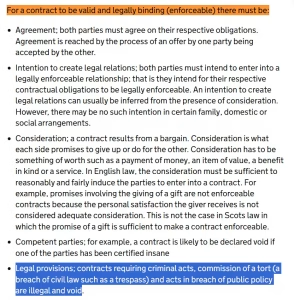
HMRC explains the fundamental requirements for forming a legally enforceable contract.
This HMRC manual was updated on 28 September 2026. It provides useful official background on contract formation, although its context is National Minimum Wage enforcement.
How Do You Write a Legal Contract Without a Lawyer Step by Step?
The safest practical approach is to establish the commercial agreement before drafting legal clauses.
We recommend the following ten-step process for straightforward UK business-to-business contracts.
Step 1: Identify the Parties Entering the Agreement
Begin with the correct legal names of the individuals or businesses involved.
For a limited company, include:
- Full registered company name
- Company registration number
- Registered office address
- Contact details for contractual notices
- Name and position of the person signing
For a sole trader, identify the individual’s legal name and relevant trading name.
For example:
- Service Provider: Example Digital Solutions Ltd, company number 12345678, registered in England and Wales.
- Client: Sample Retail Services Ltd, company number 87654321, registered in England and Wales.
These are illustrative details, not real counterparties.
A founder trading through a limited company should ensure that the correct company is named rather than accidentally entering the agreement personally.
Businesses preparing to register a new company with Companies House should understand that an unincorporated company cannot enter contracts in its own name before it legally exists.
Step 2: Define the Purpose of the Contract
The contract should state exactly what the parties intend to achieve.
Avoid descriptions such as:
“The consultant will provide marketing support.”
Instead, specify the deliverables:
“The consultant will provide a technical SEO audit, keyword analysis covering 100 agreed target keywords and a written implementation report by 30 April 2027.”
The second description provides clearer expectations.
A strong scope of work should identify the services, deliverables, relevant standards, exclusions and dependencies.
For startups offering different packages, the scope can be placed in a separate schedule attached to the main agreement.
Step 3: Agree the Price and Payment Terms
Payment provisions should be precise enough to prevent disputes about how much is owed and when payment becomes due.
Include the total contract value, VAT treatment, deposit, invoicing schedule, payment deadline and treatment of additional work.
Consider a hypothetical £6,000 software development project:
| Payment Stage | Percentage | Amount |
| Contract signing | 30% | £1,800 |
| Completion of agreed development milestone | 40% | £2,400 |
| Final acceptance | 30% | £1,800 |
| Total | 100% | £6,000 |
These percentages illustrate a possible negotiated payment schedule, not a legal requirement.
Milestone payments can reduce the supplier’s exposure if the customer fails to pay later in the project.
The contract should also establish when work may be suspended for non-payment, subject to applicable law and the agreed procedure.
For ordinary qualifying business-to-business debts, statutory late-payment interest may be available at 8 percentage points above the Bank of England base rate, subject to the legislation and any applicable contractual alternative remedy.
The rate and commercial payment rules should be checked at the time of contracting.
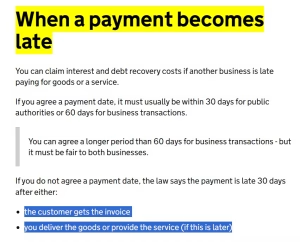
Official guidance explains when commercial payments become late and how statutory payment protections work.
Step 4: Establish the Contract Duration and Deadlines
A contract should clearly explain when it begins and when it ends.
For example:
“This agreement begins on 1 March 2027 and continues until 31 August 2027 unless terminated earlier in accordance with its terms.”
For project contracts, include deadlines for specific deliverables rather than relying on a single completion date.
Businesses should distinguish between binding delivery deadlines and estimated timescales.
If a contract depends on customer input, approvals or access to systems, explain what happens when those dependencies are delayed.
Step 5: Explain Each Party’s Responsibilities
Both parties should understand their obligations.
A marketing agency may be responsible for producing content and reports, while its customer may need to provide branding materials, approve drafts and grant access to relevant systems.
Without clear responsibilities, a missed deadline can become a dispute about which party caused the delay.
This is particularly important when starting a business that depends on freelancers, outside contractors or third-party software.
The agreement should also explain whether subcontracting is permitted and who remains responsible for subcontracted work.
Step 6: Include Confidentiality and Intellectual Property Clauses
A confidentiality clause may restrict the use or disclosure of commercially sensitive information, including client records, pricing strategies, financial forecasts and proprietary technology.
For highly sensitive discussions, businesses may prefer a standalone non-disclosure agreement.
The difference between a confidentiality agreement and an NDA depends mainly on the agreement’s wording and purpose rather than its title.
Intellectual property ownership requires separate attention.
When a freelancer creates content, software, graphics or another copyright-protected work, the freelancer will generally retain the copyright unless there is an effective agreement transferring ownership.
Paying for work does not automatically transfer all intellectual property rights.
A contract should therefore address whether the customer receives ownership, an exclusive licence or a non-exclusive right to use the completed work.
An assignment of UK copyright generally must be in writing and signed by or on behalf of the person transferring the rights.
This issue can materially affect the commercial value of a startup’s website, software or brand assets.
Step 7: Set Out Termination and Cancellation Rights
A well-structured agreement needs a clear exit process.
Businesses should address:
- Termination after a material breach
- Notice required for ordinary termination, if permitted
- Opportunities to remedy breaches
- Fees payable for work already completed
- Refunds of advance payments, where applicable
- Ownership and delivery of unfinished work
- Return of confidential information
- Obligations that continue after termination
For example, a consultancy agreement might allow either party to terminate for convenience by giving 30 days’ written notice.
However, that clause may not suit a contract involving substantial equipment purchases or long-term commitments.
Termination conditions should reflect the actual financial exposure of the arrangement.
Step 8: Allocate Liability and Commercial Risk
The liability clause helps establish which party bears the financial consequences if something goes wrong.
Businesses should consider potential losses arising from service failures, delays, negligence, confidentiality breaches and third-party claims.
A negotiated liability cap might be linked to the contract value or another commercially justified amount.
However, liability restrictions are not automatically enforceable.
For example, a business cannot lawfully exclude liability for death or personal injury caused by negligence. Other attempted exclusions may be prohibited or subject to statutory reasonableness or fairness tests.
Startups should also assess whether their public liability insurance and any professional indemnity policy align with the contractual risks they accept.
An insurer may not cover every obligation voluntarily assumed under a contract.
Step 9: Include a Dispute Resolution Procedure
Contracts should explain how disagreements will be handled before court proceedings become necessary.
A practical provision may require the parties to notify each other of a dispute and attempt good-faith negotiations for a defined period.
The agreement may then provide for mediation, another appropriate dispute procedure or litigation.
It should also identify the governing law and appropriate court jurisdiction.
For cross-border contracts, these clauses deserve particular attention because legal proceedings and enforcement may become significantly more complicated.
Step 10: Review, Approve, Sign and Store the Contract
Before signing, confirm that both parties have received the complete final document.
Check the names, financial figures, dates, referenced schedules and negotiated amendments.
An authorised representative should then sign or otherwise validly accept the agreement.
For electronic agreements, retain the final contract, relevant emails, electronic signature records and a reliable record of when each party accepted.
Where appropriate, keep an audit trail showing the document version and signatories.
The result should be a clear, retrievable record of the obligations that both parties actually agreed to.
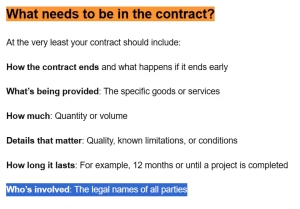
The Small Business Commissioner’s guidance identifies the essential commercial information businesses should record in written contracts.
Which Clauses Should Every Small Business Contract Consider?
Our analysis suggests that the most useful approach is to review contract clauses by the commercial risk they address.
Not every agreement needs every clause. A five-day freelance assignment is different from a five-year technology outsourcing arrangement.
| Contract Clause | Main Purpose | When It Becomes Particularly Important |
| Parties | Identifies who is legally responsible | Every contract |
| Scope of work | Defines what is being supplied | Services, consulting and freelance work |
| Price and VAT | Establishes financial obligations | Paid transactions |
| Payment deadlines | Protects cash flow | Supplier and customer contracts |
| Milestones | Tracks delivery and payment stages | Projects and development contracts |
| Customer responsibilities | Clarifies dependencies | IT, marketing and consulting |
| Intellectual property | Establishes ownership and usage rights | Creative, technology and software |
| Confidentiality | Protects sensitive business information | Commercial discussions and services |
| Data protection | Allocates required data-processing duties | Relevant personal-data processing |
| Liability | Allocates financial exposure | Material commercial arrangements |
| Termination | Establishes exit rights | Ongoing or high-value contracts |
| Force majeure | Addresses specified events beyond reasonable control | Supply chains and longer projects |
| Dispute resolution | Provides a process for disagreements | Most commercial agreements |
| Governing law | Identifies the applicable legal system | Cross-border arrangements |
| Signatures and execution | Records acceptance and required formalities | Written agreements |
One issue that deserves particular attention is the relationship between liability and contract value.
A startup might receive £3,000 for a consulting assignment but agree to unlimited liability for certain losses.
That imbalance could expose the business to claims far greater than the revenue generated by the project.
A commercially sensible contract should consider the seriousness of the risks, available insurance, negotiating position and applicable law.
For companies entering contracts with significant financial consequences, having a business solicitor review the risk-allocation clauses may be more cost-effective than commissioning an entirely new agreement.
What Should a Simple Legal Contract Template Look Like?
The following example illustrates how a straightforward business-to-business service agreement in England and Wales can be structured.
It is an educational starting point, not a complete or universally suitable legal template. The parties must adapt its terms, complete the missing information and obtain legal review when the arrangement carries material risk.
EXAMPLE SERVICE AGREEMENT — ENGLAND AND WALES
1. Parties
This agreement is made on [Date] between:
Service Provider: [Full legal name, company number if applicable, address]
Client: [Full legal name, company number if applicable, address]
2. Services
The Service Provider agrees to supply the services and deliverables described in Schedule A.
Any additional work must be approved in writing by both parties, including any corresponding adjustment to fees or delivery dates.
3. Contract Period
The agreement begins on [Start Date] and continues until [End Date or Completion Event], unless ended earlier in accordance with its terms.
4. Payment
The Client will pay £[Amount], plus VAT where applicable, according to the payment schedule in Schedule B.
Invoices must be paid within [Number] calendar days of receipt, unless a different payment trigger is expressly agreed.
5. Responsibilities
The Service Provider will perform the agreed services with reasonable care and skill.
The Client will provide the information, access and approvals reasonably required to complete the services.
6. Confidentiality
Each party must protect confidential business information received from the other and use it only for the purposes of performing this agreement, subject to agreed exceptions and lawful disclosures.
7. Intellectual Property
Ownership and permitted use of existing materials and newly created deliverables will be governed by Schedule C.
Any intended transfer of copyright must satisfy the applicable legal requirements.
8. Termination
Either party may terminate the agreement following a material breach by the other party that remains unremedied after [Number] days’ written notice, where the breach is capable of remedy.
Any additional termination rights and the financial consequences of termination must be specified in Schedule D.
9. Liability
The parties’ respective liabilities, any agreed limitations and any exclusions from those limitations will be described in Schedule E, subject to applicable law.
10. Disputes
The parties will first attempt to resolve disputes through good-faith discussions between authorised representatives.
If they cannot reach a resolution, either party may pursue available legal remedies.
11. Governing Law
This agreement is governed by the laws of England and Wales. The parties agree that the courts of England and Wales will have [exclusive/non-exclusive] jurisdiction, subject to applicable law.
12. Signatures
For and on behalf of the Service Provider:
Name: __________
Position: __________
Signature: __________
Date: __________
For and on behalf of the Client:
Name: __________
Position: __________
Signature: __________
Date: __________
End of illustrative agreement.
The bracketed items, schedules and liability provisions must be completed before the example can be considered for actual use.
It is especially important not to sign this example without deciding how intellectual property, termination payments, responsibility for losses and contractual notices will operate.
How Should Different UK Startups Adapt Their Contracts?
A generic agreement cannot address every business model.
Our review identifies several contract types that require different commercial protections.
| Business Model | Common Agreement | Main Risk to Address |
| Freelance designer | Freelance services contract | Copyright ownership and revisions |
| Marketing agency | Client services agreement | Scope changes, results and payment |
| SaaS startup | Subscription or software services terms | Access, data, availability and cancellation |
| Ecommerce business | Consumer terms and supplier contracts | Consumer rights, delivery and refunds |
| Business consultant | Consultancy agreement | Deliverables, reliance and professional liability |
| Startup founders | Shareholders’ or founders’ agreement | Ownership, control and exits |
| Recruitment or referral business | Referral agreement | Commission triggers and disclosure |
| Technology developer | Software development agreement | IP, testing, acceptance and support |
A startup considering external investment should not treat a shareholders’ agreement as an ordinary services contract.
Investment transactions can involve share rights, dilution, information rights, governance and founder exit provisions.
These issues are closely connected to getting investors for a business, and professional legal review is particularly important before signing investment documentation.
Similarly, referral businesses need to define when commission becomes payable. A simple introduction is not necessarily equivalent to a completed and paid transaction.
The commercial importance of payment triggers, disclosure and eligibility conditions is illustrated by UK business referral fee arrangements.
For founder and employee share arrangements, an Enterprise Management Incentive scheme can involve detailed tax, valuation and legal documentation that is unsuitable for an unchecked generic template.
Can You Use AI to Create a Legal Contract Without a Lawyer?
AI drafting tools can help businesses organise information and produce initial contract wording.
However, the quality of the result depends on the instructions, applicable jurisdiction, factual accuracy and legal review.
We would distinguish between three tasks:
- Preparing the commercial terms: AI can help organise agreed prices, milestones, delivery obligations and responsibilities.
- Producing a first draft: AI can suggest a document structure and identify clauses worth considering.
- Assessing legal suitability: This requires independent judgment about the transaction, applicable law, unusual risks and enforceability.
The third task is where AI-generated drafting can become unreliable.
For example, a tool might produce a limitation clause based on United States terminology for a contract intended to operate in England and Wales.
Alternatively, it might use an outdated provision or overlook mandatory consumer protection rules.
Businesses should also avoid entering confidential customer information, commercially sensitive negotiations or unnecessary personal data into AI tools without evaluating their privacy and security arrangements.
An efficient workflow is to use technology for preparation, independently check the commercial facts and obtain appropriate legal review for consequential arrangements.
Are Electronic Signatures Legally Valid for UK Contracts?
Yes. Electronic signatures can generally be used to enter ordinary commercial contracts under English law, provided the necessary requirements for the document and the parties’ intention to authenticate it are satisfied.
Electronic acceptance may occur through a specialist signature platform, an appropriate email exchange or another reliable method.
However, different formalities apply to certain documents, including deeds and some property transactions.
A company must also distinguish between ordinary contract formation and formal execution of a document under the Companies Act 2006.
For electronic contracts, businesses should retain evidence of the final wording accepted, the signatory’s authority and the circumstances of signing.
A typed name or electronic signature is not automatically sufficient for every kind of legal document.
For most straightforward startup service agreements, the main operational priority is to establish a reliable record of who accepted what, and when.
What Legal Contract Changes Should UK Businesses Prepare for in 2027?
Businesses planning agreements for 2027 should distinguish between rules already in force, guidance updated in 2026 and legislation that remains subject to parliamentary approval or commencement.
1. Updated Consumer Contract Guidance in 2026
On 22 July 2026, the Competition and Markets Authority updated its unfair contract terms guidance, CMA37.
The guidance emphasises that contracts between businesses and consumers must contain fair and transparent terms.
Businesses should avoid provisions that create significant unfair imbalances, conceal important conditions or improperly restrict statutory rights.
Particular attention should be paid to cancellation conditions, excessive charges, unilateral changes and attempts to exclude liability.
This is important for online retailers, subscription businesses and other startups selling directly to consumers.
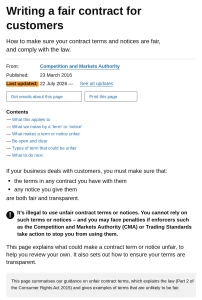
The Competition and Markets Authority updated its guidance on unfair consumer contract terms on 22 July 2026.
2. Commercial Payments Reform Is Progressing
The Commercial Payments Bill was introduced in Parliament in May 2026 and passed its House of Lords third reading on 20 October 2026.
Its proposed reforms include stricter maximum payment terms, mandatory statutory interest, additional protections for suppliers and stronger powers for the Small Business Commissioner.
However, as of 12 November 2026, the Bill is not enacted legislation.
In an official response dated 19 October 2026, the government indicated that most measures were expected to commence in late 2027 or early 2028, subject to parliamentary approval and implementation requirements.
Businesses should not describe the proposed 60-day maximum payment term or mandatory interest provisions as universally operative law before commencement.
Nevertheless, founders negotiating long-term supplier agreements should monitor these proposals.
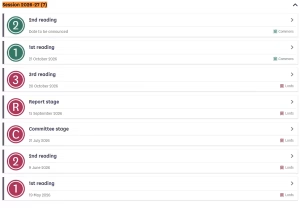
The Commercial Payments Bill could change how UK businesses negotiate payment deadlines and late-payment interest.
3. Consumer Subscription Contracts Face Changes
Subscription businesses should prepare for new consumer protection requirements under the Digital Markets, Competition and Consumers Act 2024 and associated regulations.
The government published detailed guidance on subscription contracts on 19 October 2026.
The planned regime addresses matters including pre-contract information, reminders, cancellation rights and renewal protections.
The government has indicated an anticipated commencement in spring 2027, subject to the implementation process.
For SaaS founders, membership platforms and subscription-based consumer services, the relevant question is whether their customer-facing terms and operational cancellation processes will comply when the new rules take effect.
Business-to-business subscriptions should not automatically be treated as subject to the same consumer-specific requirements.
4. Data Protection Contract Requirements Remain Important
Where a business acts as a controller and uses another organisation to process personal data on its behalf, a compliant written contract or other legal act is required.
Such contracts must address specified responsibilities, including processing instructions, confidentiality, security, subcontractors and assistance with data protection obligations.
The Information Commissioner’s Office has indicated that relevant guidance is under review following the Data (Use and Access) Act.
For 2027 contracts, businesses should check the latest applicable guidance rather than assuming an older template remains complete.
How Much Does It Cost to Make a Legal Contract Without a Lawyer?
Preparing your own contract may reduce the upfront cost of legal documentation, but the overall financial benefit depends on the complexity of the transaction and the risks involved.
The main options are drafting from scratch, adapting a template, using a digital document service or obtaining a solicitor’s review.
Rather than treating all methods as equally suitable, we assessed them using the following editorial criteria:
- Clarity of contractual obligations – 25%
- Ability to address transaction-specific risks – 25%
- Legal review and quality control – 25%
- Cost-efficiency for the intended transaction – 15%
- Practical administration and record-keeping – 10%
The percentages below are our illustrative editorial suitability ratings for business use. They are not measured legal success rates, forecasts of enforceability or guarantees against disputes.
| Drafting Method | Indicative Upfront Cost | Editorial Rating | Most Appropriate Use |
| Draft entirely yourself | Low or no external drafting fee | 69% | Simple, low-risk agreements |
| Adapt a reputable UK template | Free or provider-dependent | 79% | Routine commercial transactions |
| Use a digital document service | Subscription or per-document fee | 81% | Repeatable, standard agreements |
| Prepare a draft and obtain solicitor review | Quotation-dependent | 93% | Important or moderately complex contracts |
| Commission specialist legal drafting | Quotation-dependent | 96% | High-value, regulated or unusual transactions |
A higher rating does not mean the contract will necessarily be legally valid. The rating reflects the suitability of the drafting process for managing commercial risks.
For an early-stage business, the right choice often depends on the possible financial loss rather than the number of pages in the agreement.
Consider a hypothetical consultant earning £2,000 from a routine assignment compared with a software company committing to a three-year enterprise contract involving sensitive data and substantial service obligations.
Both businesses can technically begin with their own drafts.
However, the second arrangement presents a materially different level of risk and may justify specialist review.
Matthew Strain, writing on DIY contract preparation in July 2026, makes an important distinction:
“Legally valid” and “actually protects you” are different things.
That distinction is relevant to cost decisions. A contract can be enforceable while still leaving one party exposed to commercially undesirable obligations.
What Are the Biggest Mistakes When Writing Your Own Contract?
The most damaging mistakes often involve clauses that appear unimportant when the business relationship begins.
- Using the wrong legal entity: An agreement intended for a limited company may accidentally make its founder personally responsible.
- Failing to define deliverables: Vague descriptions create disputes about whether work is complete.
- Leaving payment conditions uncertain: A supplier may struggle to establish when an invoice becomes due or whether a milestone has been accepted.
- Ignoring intellectual property: A customer may pay for creative work without acquiring the rights it expected.
- Accepting unlimited liability: A small commercial contract may expose the supplier to disproportionate financial claims.
- Copying foreign legal terms: Templates written for another jurisdiction may contain unsuitable provisions.
- Overlooking consumer protection: Consumer contracts cannot simply remove statutory rights through restrictive wording.
- Failing to document amendments: Email negotiations may conflict with the signed version, creating uncertainty over the agreed terms.
- Neglecting exit provisions: A business may find it difficult or expensive to terminate a relationship that is no longer commercially viable.
- Assuming the contract replaces insurance: Even a carefully drafted agreement cannot eliminate every operational or legal risk.
These issues can become particularly significant during acquisitions. A buyer reviewing an existing company’s contracts must investigate liabilities, customer obligations, restrictions and the validity of material agreements.
The legal and financial risks involved in buying a limited company demonstrate why substantial transactions require more detailed due diligence.
How Can You Check Whether Your Contract Is Ready to Sign?
We recommend reviewing ten core areas before approving an ordinary commercial agreement.
| Review Item | Check |
| 1. Parties | Correct legal names and contracting entities |
| 2. Authority | The signatories can enter the agreement |
| 3. Scope | Goods, services and deliverables are clearly defined |
| 4. Payment | Price, VAT and payment deadlines are specified |
| 5. Duration | Start, completion and renewal provisions are clear |
| 6. Responsibilities | Each party’s obligations are identifiable |
| 7. Intellectual property and data | Appropriate ownership, use and data-processing terms are included |
| 8. Liability | Relevant financial and legal risks are addressed |
| 9. Termination | Exit rights and consequences are defined |
| 10. Approval and records | The agreed document can be validly accepted and retained |
For internal administration, businesses can use a simple completeness percentage.
Completion Score = (Number of completed review items ÷ 10) × 100
For example, a contract meeting eight of the ten checks has an administrative completeness score of 80%.
A 100% score only means that all ten topics have been considered and recorded as complete. It does not confirm legal validity, fairness or adequacy.
Some agreements will require additional clauses, while others will not need every item.
Before approving a contract, businesses should also consider the counterparty’s financial position and whether the proposed agreement aligns with their startup support and operational requirements.
When Should You Use a Solicitor Instead of Writing Your Own Contract?
Not every contract justifies specialist legal drafting. However, the cost of professional advice becomes easier to justify when a mistake could threaten the business’s financial position or ownership rights.
Situations where professional review is particularly advisable include:
- Shareholder and founders’ agreements
- Company acquisitions and investments
- Property sales, leases and security arrangements
- Personal guarantees and deeds
- International commercial arrangements
- Complex software licensing
- High-value supply and outsourcing agreements
- Employment and restrictive covenant disputes
- Significant liability or indemnity provisions
- Regulated financial or professional services
Employment contracts also require particular care because mandatory statutory rights apply regardless of attempts to contract out of them.
An employer must provide the required written statement of employment particulars in accordance with the relevant statutory timetable.
The distinction between an employment agreement and a statutory written statement is discussed in more detail in our analysis of employment contract agreements.
For an established business, a sensible approach may be to commission a specialist contract for its principal commercial activities and adapt that agreement for similar transactions.
Businesses can then obtain additional reviews when they encounter unusual clients, overseas counterparties or materially different risks.
This provides a balance between controlling legal expenditure and maintaining appropriate professional oversight.
Conclusion
Making a legal contract without a lawyer is possible for many everyday business transactions in the UK.
For founders, freelancers and small business owners, the most important task is to record the commercial agreement clearly, identify the correct parties and anticipate what could happen if the relationship does not proceed as expected.
A practical contract should address the scope of work, payment obligations, responsibilities, intellectual property, termination, liability and dispute procedures.
Businesses preparing for 2027 should also monitor developments in commercial payment legislation, consumer subscription rules and data protection guidance.
The objective is not to produce the longest possible legal document. It is to prepare an agreement that is appropriate to the transaction, reflects the parties’ actual intentions and provides workable commercial protections.
For simple arrangements, a carefully tailored written agreement may be sufficient. Where substantial financial commitments, legal complexity or ownership rights are involved, independent professional review remains the more prudent approach.
This article provides general business and legal information, primarily concerning England and Wales. It is not a substitute for advice on a particular contract or transaction.
Frequently Asked Questions
Can I write a legally binding contract myself in the UK?
Yes. You can generally write your own ordinary business contract without a solicitor, provided the legal requirements for formation are satisfied and no additional formalities apply.
Is a handwritten contract legally binding?
A handwritten contract can be legally binding. Its enforceability depends on the underlying agreement and applicable law, not simply whether it was handwritten or typed.
Can a contract be legally binding without signatures?
Yes. Some agreements can be formed verbally, through emails or by conduct. However, signatures are useful evidence, and certain documents legally require them.
Can I use ChatGPT or another AI tool to write a legal contract?
You can use AI to help prepare a draft, but its output should be checked for factual accuracy, jurisdiction-specific requirements, missing protections and suitability for the transaction.
Does a contract need to be registered to be legal?
Most ordinary commercial contracts do not need to be registered. However, certain transactions, property interests and regulated arrangements may involve registration or filing requirements.
Can I change a contract after both parties sign it?
A contract can often be varied if the parties validly agree to the changes. The original agreement may specify a procedure for amendments, and some changes require additional formalities.
What happens if someone breaks a contract?
The consequences depend on the contractual terms and the nature of the breach. Potential remedies include damages, termination in appropriate circumstances and other legally available relief.
Can I create a contract between two individuals?
Yes. Two individuals can enter a binding agreement where the necessary legal requirements are met. Clear written terms are particularly useful when the arrangement involves money, services or significant obligations.

Blogger | Business Writer | Sharing startup advice on UK business blogs
Related Articles in Startup
View All →
Newscivil Com: Can This Digital News Platform Help UK Startups Spot Emerging Trends?
For startup founders, staying informed is no longer simply about reading the business pages each morning. Artificial intelligence, changing consumer habits, technology developments, government decisions and wider social…

Meet the Startup Turning Screen Time Into a New Way to Make Money
Britain does not exactly have a shortage of side hustles. You can deliver takeaways, sell clothes online, start freelancing, walk dogs, tutor in the evenings or attempt to…

8 Best Coworking Spaces for Bootstrapped London Startups to Launch and Scale in 2026
Bootstrapped founders don’t have the luxury of a fitted-out HQ from day one. What you need is a London coworking space that flexes with you: a hot desk…