
Flight Attendant Salary UK 2026: How Much Cabin Crew Earn


UK Startup Blog Archive
Table of Contents
UK cabin crew typically start on a base salary of around £19,000 to £23,500 a year, while experienced crew can earn a base salary of approximately £24,000 to £28,000. Senior cabin crew base salaries can reach £28,000 to £45,000, depending on the airline, seniority and responsibilities.
Another useful benchmark comes from Indeed, which currently reports an average UK flight attendant base salary of £25,420 per year, based on 217 reported salaries and updated on 12 August 2026.
The important point is that there is no single cabin crew salary that applies across the UK. Flight attendants may receive a combination of basic salary, flight-duty or trip pay, commission, overnight allowances, bonuses and other payments.
For this reason, two crew members with similar basic salaries can end the year with noticeably different total earnings.
Last checked: 1 September 2026
What Is The Average Flight Attendant Salary In The UK In 2026?
There are several credible salary figures available, but they measure slightly different things.
| Source | Published Cabin Crew Salary | What The Figure Actually Measures |
| National Careers Service | £19,000 starter to £28,000 experienced | General occupational salary range |
| Prospects | £19,000–£23,500 starting base salary | Base pay before some variable earnings |
| Prospects | £24,000–£28,000 experienced base salary | Base pay for crew with experience |
| Prospects | £28,000–£45,000 senior base salary | Senior cabin crew base pay |
| Indeed | £25,420 average | Average reported base salary |
| Skills England | £28,733 median | Broader Air Travel Assistants occupation |
Source note: The National Careers Service cabin crew profile gives £19,000 to £28,000, while Prospects’ air cabin crew profile provides separate starting, experienced and senior base-pay ranges. Indeed’s current figure is based on 217 salaries. Skills England reports a £28,733 median for SOC 6213 Air Travel Assistants.
A sensible interpretation is therefore that a person entering UK cabin crew work can expect basic pay around £19,000 to £23,500, while total earnings may become higher after variable payments are added.
Why Do Cabin Crew Salary Websites Give Different Figures?
This is one of the most important things to understand when researching flight attendant pay.
An “average salary”, “median salary”, “basic salary” and “total earnings” are not interchangeable.
Average Versus Median Salary
An average adds all recorded salaries together and divides the total by the number of observations. A small number of unusually high or low salaries can therefore affect the result.
A median identifies the middle salary in a dataset and can sometimes provide a more stable picture.
Skills England currently lists a £28,733 median, but its occupational classification includes flight attendants alongside some other air travel assistants.
Base Salary Versus Total Earnings
Base salary is the guaranteed or contractual salary before certain additional payments.
Prospects, for example, specifically describes its £19,000–£23,500 starting figure as base pay and notes that crew can additionally receive flight rates, performance bonuses, commission and overnight payments.
Total annual earnings could therefore be higher.
Reported Salary Versus Advertised Salary
Salary websites can use employee submissions, job advertisements or other collected data.
Indeed currently reports £25,420 as average base salary from 217 salaries, but its displayed high-paying employer list also includes organisations that are not airlines. That is a useful reminder that job-title datasets can contain noise.
For someone considering a particular airline, the actual employment contract and current airline vacancy should therefore take priority over a general salary website.
How Much Do Flight Attendants Earn At Different Experience Levels?
A more defensible experience comparison for 2026 is:
| Career Stage | Approximate Base Salary |
| New cabin crew | £19,000–£23,500 |
| Experienced cabin crew | £24,000–£28,000 |
| Senior cabin crew | £28,000–£45,000 |
| UK reported average benchmark | £25,420 |
| Broader occupational median | £28,733 |
Source note: Experience ranges are primarily based on Prospects. The average benchmark is from Indeed and the broader occupational median is from Skills England.
These figures should not be interpreted as guaranteed earnings. Airline, contract type, route network, commission, flying activity and seniority can all change what appears on the final payslip.
How Is Cabin Crew Pay Actually Calculated?
Cabin crew are not universally paid using one straightforward hourly wage.
A typical remuneration package can contain several components:
- Basic guaranteed salary
- Flying-hour, flight-duty, sector or trip pay
- Overnight or time-away-from-base allowances
- Inflight-sales commission
- Performance or company bonuses
- Overtime or rest-day payments
- Language allowances
- Pension contributions and travel benefits
British Airways, for example, says its cabin crew pay comprises basic pay, flight-duty pay and, where applicable, HMRC per diems and other related allowances.
Virgin Atlantic describes its package as including base pay, trip pay and commission, with separate cash allowances provided down-route to cover subsistence.
easyJet confirms that cabin crew receive a share of commission from inflight retail sales.
This is why converting a cabin crew salary into one simple hourly figure can be misleading.
What Is The Minimum Hourly Pay For Cabin Crew In 2026?
The previous £9–£15 hourly salary range should not be used for 2026.
From 1 April 2026, the statutory minimum rate is:
| Age | Minimum Hourly Rate |
| 21 and over | £12.71 |
| 18 to 20 | £10.85 |
| Under 18 | £8.00 |
| Apprentice rate | £8.00 |
Source note: Current statutory rates are published by GOV.UK’s National Minimum Wage service.
More detail on the current rates is also available in UK Startup Blog’s coverage of the 2026 National Living Wage rates.
However, the statutory hourly minimum should not be confused with a cabin crew salary quote. Employers must comply with minimum-wage law, but cabin crew remuneration can involve several pay components and working-time rules rather than a simple advertised hourly rate.
How Much Do Flight Attendants Earn Per Month?
Monthly salary should always be labelled as gross or net.
Using the current Prospects base-salary ranges:
| Annual Base Salary | Equivalent Gross Monthly Salary |
| £19,000 | £1,583 |
| £23,500 | £1,958 |
| £24,000 | £2,000 |
| £28,000 | £2,333 |
| £45,000 | £3,750 |
These figures simply divide annual base pay by 12.
They exclude flight pay, commission, bonuses and allowances, so an employee’s actual monthly gross earnings can be different.
They are also not take-home figures. Income Tax, National Insurance, pension contributions, student loans and other deductions may reduce the amount transferred to the employee’s bank account.
How Much Do Cabin Crew Take Home After Tax In 2026/27?
For the 2026/27 tax year, the standard Personal Allowance remains £12,570. Income within the basic-rate band is generally taxed at 20% in England, Wales and Northern Ireland.
Most employees also pay Class 1 National Insurance at 8% on monthly earnings between £1,048 and £4,189, with a 2% rate above the upper threshold.
Using these rules gives the following illustrative figures:
| Gross Taxable Salary | Approximate Monthly Take-Home |
| £19,000 | £1,433 |
| £25,420 | £1,819 |
| £28,000 | £1,973 |
| £45,000 | £2,993 |
Source note: Calculations use the 2026/27 standard Personal Allowance, 20% basic-rate Income Tax and standard employee Class 1 National Insurance. Scottish Income Tax operates under different bands.
These examples exclude workplace pension contributions, student and postgraduate loans, taxable benefits, tax-code adjustments and any genuinely tax-exempt business-expense payments.
Someone trying to understand the deductions shown on their wage statement can also read what PAYE means on a payslip.
What Could A Starter Cabin Crew Payslip Look Like?
Consider a hypothetical new cabin crew member whose annual basic salary is £19,000.
During one particular month, assume the employee receives:
| Payslip Component | Illustrative Amount |
| Basic monthly salary | £1,583 |
| Flight-duty or sector pay | £180 |
| Inflight commission | £90 |
| Taxable gross pay | £1,853 |
| Qualifying subsistence reimbursement | £120 |
| Estimated Income Tax | £161 |
| Estimated National Insurance | £64 |
| Approximate amount received | £1,748 |
This example is illustrative rather than an airline pay quote.
It demonstrates why someone with a £19,000 basic salary can receive a different amount each month when variable payments are added.
The £120 reimbursement is shown separately only to demonstrate how a qualifying business-expense payment could affect cash received. Whether a particular airline payment qualifies for tax exemption depends on HMRC rules and the circumstances.
What Could An Experienced Cabin Crew Payslip Look Like?
Now consider a hypothetical employee with a £28,000 basic salary who receives additional trip and commission payments during a busy month.
| Payslip Component | Illustrative Amount |
| Basic monthly salary | £2,333 |
| Trip or flight-duty pay | £400 |
| Commission | £100 |
| Taxable gross pay | £2,833 |
| Qualifying subsistence reimbursement | £250 |
| Estimated Income Tax | £357 |
| Estimated National Insurance | £143 |
| Approximate amount received | £2,583 |
Again, this is not intended to represent a specific airline.
Actual trip rates, flight-duty payments, commission and allowances are determined by the employer’s contract and remuneration structure.
Are Cabin Crew Overnight Allowances Tax-Free?
Not automatically.
This distinction is important because cabin crew salary discussions sometimes describe allowances or per diems as universally tax-free.
HMRC says some business-travel expenses may qualify for exemptions. However, where an employer pays more than the necessary business-travel costs and an exemption or agreed arrangement does not apply, the excess can count as earnings and PAYE tax and National Insurance may become payable.
The safest wording is therefore that some qualifying subsistence or business-travel payments may receive favourable tax treatment when HMRC conditions are satisfied.
Basic salary, flight pay and ordinary commission should not simply be described as tax-free.
How Much Do Cabin Crew Earn At Different UK Airlines?
Comparing airlines is difficult because they do not all publish remuneration in the same format.
Some disclose salary figures, while others describe the pay components without publishing an amount.
The following comparison therefore avoids combining unrelated Glassdoor-style estimates, monthly salaries and annual salaries.
| Airline | Published Salary Information | Variable Pay Structure | Training / Contract Information | Main UK Base Information |
| British Airways | No universal basic salary figure on current generic cabin crew page | Basic pay + flight-duty pay + applicable per diems/allowances | New entrant training around 4–6 weeks | Heathrow and Gatwick |
| easyJet | Generic careers page does not publish universal UK salary | Inflight retail commission; package varies by contract/base | 4-week training; fixed-term, seasonal and permanent contracts available | Multiple UK bases |
| Virgin Atlantic | Current generic page does not state an exact salary | Base pay + trip pay + commission + down-route subsistence allowances | Terms supplied through recruitment | London Heathrow |
| Jet2.com | Current generic page does not publish basic salary | Performance-based rewards in addition to company benefits | 4-week course; official page currently says training costs £700 | 13 UK bases listed |
| TUI | UK page does not provide one public salary figure | Basic salary + supplements such as flight allowances; commission/incentives may apply | UK apprenticeship is a paid programme; other terms vary by vacancy | Multiple UK airport bases |
| Ryanair | UK recruitment pages describe competitive packages rather than one universal salary | Sales bonuses and base-dependent incentives | Current UK adverts include free training and training allowances/per diems | Stansted, Luton, Edinburgh and other bases |
| Wizz Air UK | £23,450 junior; £26,450 cabin attendant; £33,850 senior target remuneration | Figure incorporates base salary and variable compensation assumptions | Employment contract begins on first day of training | UK recruitment has included Luton and Gatwick |
Source note: Figures and terms were checked against airline careers pages on 1 September 2026. Airline recruitment packages can change by base, intake and vacancy, so applicants should check the specific job advert before accepting an offer.
British Airways Cabin Crew Pay
British Airways does not currently give one universal cabin crew salary number on its generic careers page.
Instead, BA states that cabin crew remuneration combines basic pay, flight-duty pay and applicable HMRC per diems and related allowances.
Its current benefits include staff-travel concessions, a defined-contribution pension, free parking at several BA locations and additional flexible benefits that can depend on the role.
The current BA FAQ says New Entrant Training generally takes four to six weeks.
Applicants should therefore use the actual vacancy or offer letter for the basic salary rather than relying on old estimates such as £16,000–£26,000.
easyJet Cabin Crew Pay
easyJet’s general cabin crew page does not currently publish one UK-wide salary figure.
It does confirm that crew receive a share of inflight retail commission, meaning total earnings can vary with the remuneration package and sales activity.
easyJet offers fixed-term, seasonal and permanent cabin crew contracts across its bases.
New crew complete approximately four weeks of training, and easyJet says accommodation is arranged when trainees need to attend training away from their future base.
Virgin Atlantic Cabin Crew Pay
Virgin Atlantic provides one of the clearest explanations of its pay structure.
Its cabin crew package includes base pay, trip pay and commission, with additional cash allowances provided down-route for subsistence.
Virgin’s cabin crew are currently based at London Heathrow and operate long-haul services.
Published benefits include 28 days of annual leave, travel concessions subject to qualifying conditions, a contributory company pension and dedicated secure parking while on duty.
Jet2 Cabin Crew Pay
Jet2’s current generic cabin crew page does not publish a standard annual basic salary.
It does say that crew can receive performance-based rewards in addition to company-wide benefits.
One particularly important cost for applicants is training. As checked on 1 September 2026, Jet2’s official cabin crew careers page states that its four-week training course costs £700. Applicants should confirm that this remains applicable to the specific recruitment intake before committing financially.
Jet2 lists UK cabin crew bases including Belfast, Birmingham, Bournemouth, Bristol, Edinburgh, East Midlands, Glasgow, Leeds Bradford, Liverpool, Luton, Manchester, Newcastle and London Stansted.
TUI Cabin Crew Pay
TUI says cabin crew salary can contain several elements, including gross basic salary plus additional payments such as flight allowances and other supplements. Exact remuneration is provided during the application process rather than through one universal public salary figure.
For UK airline colleagues, TUI publishes benefits including a company pension, employee travel concessions and a performance-related bonus scheme. Cabin crew may also participate in commission and incentive arrangements.
TUI’s 2026 UK Cabin Crew Apprenticeship is explicitly a paid nine-month programme, although successful completion does not guarantee a permanent cabin crew role.
Ryanair UK Cabin Crew Pay
Ryanair’s current UK recruitment material describes its packages as highly competitive but does not provide one nationwide basic salary figure.
Current recruitment pages confirm uncapped sales bonuses, discounted staff travel and free cabin crew training. Some UK recruitment adverts also include paid training allowances or per diems.
For example, a current Stansted recruitment event advertises a £28 daily training per diem, a £1,200 new-joiner bonus and an additional London-base incentive under that particular campaign.
These should not be treated as permanent nationwide benefits because recruitment offers can change by base and intake.A current Luton vacancy also states that employment can be through a direct or agency contract depending on the base.
Wizz Air UK Cabin Crew Pay
Wizz Air is unusually transparent about indicative UK remuneration.
Its current cabin crew careers page gives the following target figures:
| Wizz Air UK Rank | Target Annual Remuneration |
| Junior Cabin Attendant | £23,450 |
| Cabin Attendant | £26,450 |
| Senior Cabin Attendant | £33,850 |
The airline states that these figures assume an average of 18–28 flights per month and are not guaranteed salaries. They are calculated using predominantly applied base salaries together with typical variable compensation.
Wizz also states that for Wizz Air UK employees, the employment contract is valid from the first day of the training session.
This makes Wizz’s published figure more useful than an unsupported salary estimate, but applicants should still examine their individual contract.
Do Long-Haul Cabin Crew Earn More Than Short-Haul Crew?
Sometimes, but long-haul does not automatically mean a higher basic salary.
The difference often comes from how an airline’s remuneration system works.
Long-haul operations are more likely to involve nights away from home, longer trips and down-route subsistence expenses. An airline that pays trip rates, time-away allowances or per diems may therefore produce higher variable earnings during some long-haul months.
Prospects notes that short-haul crew are commonly back home on the same day, while long-haul operations require nights away from home.
Virgin Atlantic provides a useful example because it operates long-haul cabin crew from Heathrow and specifically combines base pay with trip pay, commission and down-route allowances.
By contrast, short-haul operators may offer frequent sectors and inflight-sales commission.
The correct comparison is therefore total annual compensation under the actual contract, not simply “long-haul versus short-haul”.
How Do Seasonal, Fixed-Term And Permanent Contracts Affect Pay?
Contract type can materially affect annual income.
Cabin crew employment can be:
| Contract Type | Potential Effect |
| Permanent | More predictable annual employment and benefits |
| Fixed-term | Employment ends on a specified date unless renewed |
| Seasonal | Work concentrated around peak travel periods |
| Part-time | Lower annual basic earnings but reduced contracted hours |
| Agency | Pay and benefits may differ from directly employed crew |
easyJet explicitly states that it uses fixed-term, seasonal and permanent contracts across its bases.
Prospects also notes that seasonal cabin crew opportunities are common and that some workers may spend several seasons in temporary work before obtaining a permanent position.
Ryanair’s current Luton recruitment material additionally says contracts can be direct or agency-based depending on the base.
A £25,000 annualised salary on a temporary contract should therefore not automatically be interpreted as £25,000 of income actually received during that calendar year.
How Are Standby, Delays, Sickness And Cancelled Flights Paid?
There is no universal UK cabin crew rule saying every standby hour, disrupted flight or sickness day attracts the same airline payment.
These arrangements depend on the employment contract, collective agreements where applicable, roster rules and employer policies.
Cabin crew should check how their contract treats:
Standby: whether standby attracts normal salary only or an additional payment.
Extended duty: whether overtime, additional flying or rest-day working attracts supplements.
Cancelled or delayed return journeys: Prospects notes that crew may occasionally have to work or remain flexible on days off when a return journey is cancelled or delayed and says compensation can apply.
Sickness: the employee’s contract should explain occupational sick pay and any statutory entitlement.
This is another reason salary comparisons based solely on basic annual pay can be misleading.
Does Airport Base Affect Cabin Crew Salary?
Airport base can influence the overall financial value of the job, but there is not enough reliable evidence to say that Heathrow or Gatwick cabin crew automatically receive higher salaries simply because they are based in London.
A better comparison considers:
- Basic salary for that particular base
- Flight or sector payments
- Airport parking costs
- Public transport availability during early and late shifts
- Required distance from base
- Rent and housing costs
- Whether relocation is necessary
- Staff parking or transport concessions
easyJet, for example, requires candidates to live within 90 minutes of their chosen base or be willing to relocate.
Jet2’s cabin crew information also highlights early starts, standby duties and the practical requirement to travel to the airport.
British Airways currently offers free parking at several BA locations and a 75% discount on certain Heathrow Express tickets.
Virgin Atlantic lists dedicated secure car parking while crew are on duty.
These benefits can materially affect disposable income even when the headline salary is unchanged.
What Joining Costs Should Prospective Cabin Crew Consider?
Applicants should look beyond salary when evaluating an offer.
Potential costs can include airport commuting, relocation, parking, passport renewal, medical or vetting requirements and any airline-specific training arrangements.
Uniform costs also vary by airline. Some provide uniform directly, while others have different policies or allowances.
Training arrangements are particularly important.
Jet2 currently states that its four-week training course costs £700.
Ryanair advertises free internationally recognised training and training allowances in current UK recruitment campaigns.
easyJet provides a four-week training programme and says accommodation will be arranged when training takes place away from the employee’s future base.
Wizz Air UK states that the employment contract starts on the first day of training.
Applicants should always confirm the latest arrangements in writing because recruitment terms can change between intakes.
What Benefits Do UK Flight Attendants Receive?
Benefits should be attributed to individual airlines rather than described as universal cabin crew entitlements.
British Airways
Current BA cabin crew benefits include staff-travel concessions and a defined-contribution pension. BA also lists flexible benefits such as life insurance and private medical insurance, but specifically states that availability can depend on the role.
Virgin Atlantic
Virgin Atlantic currently lists travel concessions, a contributory pension, annual leave, roster flexibility, secure duty parking and several discounts. Some benefits apply only after a qualifying period.
easyJet
easyJet offers discounted staff travel and other employee benefits that can vary according to location. Cabin crew also share commission from inflight retail sales.
TUI
TUI says UK airline colleagues can receive a company pension with matched contributions, travel benefits and, depending on performance and role, bonus and incentive arrangements. Its UK airline benefits page also describes medical and wellbeing benefits for airline colleagues.
Ryanair
Current UK cabin crew adverts list discounted staff travel, free first-year uniform and uncapped sales bonuses among the benefits.
The exact package should always be checked against the individual employment offer.
How Does Career Progression Increase Cabin Crew Salary?
Cabin crew earnings can increase significantly through promotion.
A typical progression route can look like:
Cabin Crew → Senior Cabin Crew → Purser or Cabin Supervisor → Inflight Manager or Cabin Service Manager
Prospects says senior cabin crew base pay can reach approximately £28,000–£45,000.
It also explains that cabin crew can progress into purser or chief-purser positions, senior cabin supervision, training, recruitment and ground-based airline operations.
Virgin Atlantic, for example, identifies Cabin Service Supervisor and Flight Service Manager as progression roles within its cabin operation
Some experienced crew move into training, recruitment, crew planning, passenger services, safety roles or management.
What About Corporate And VVIP Cabin Crew?
Corporate or VVIP cabin crew should be considered separately from ordinary scheduled-airline cabin crew.
These roles involve private or business aircraft and can require previous premium-cabin experience, very high service standards and greater flexibility.
Prospects identifies corporate, executive and VVIP cabin attendant work as a separate career option for experienced crew.
There is no reliable single UK salary range that should be applied to the entire VVIP market because packages can be individually negotiated and may involve international bases, irregular schedules and specialised requirements.
It is therefore better to treat VVIP cabin crew as a senior niche rather than adding isolated private-jet salaries to a normal airline comparison table.
How Does Cabin Crew Pay Compare With Other Aviation Jobs?
The previous version of this article mixed an airline salary table into a section supposedly comparing different aviation occupations.
A genuine comparison using National Careers Service ranges is more useful:
| Aviation Role | Indicative Annual Salary |
| Cabin crew | £19,000–£28,000 |
| Airport information assistant | £20,000–£24,000 |
| Airline customer service agent | £25,000–£30,000 |
| Airline pilot | £47,000–£150,000 |
Source note: These are broad occupational guides rather than guaranteed employer salaries.
Pilots have substantially higher earning potential, but becoming a commercial airline pilot also requires considerably more technical training, licensing, medical certification and financial investment.
Cabin crew can therefore offer a comparatively accessible route into aviation without requiring a university degree or commercial pilot training.
What Qualifications Are Required To Become Cabin Crew In The UK?
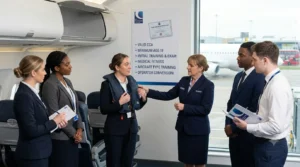
Anyone working as cabin crew in UK commercial air transport must meet aviation safety requirements.
The UK Civil Aviation Authority states that commercial cabin crew must hold a valid Cabin Crew Attestation (CCA). Applicants must be at least 18 and must successfully complete the required initial training and examination.
CCA holders must also complete relevant aircraft-type and operator-conversion training and comply with medical fitness requirements.
Airlines can impose additional recruitment requirements relating to swimming ability, reach, passport validity, right-to-work status, background checks and ability to travel to the assigned base.
A degree is normally unnecessary.
Prospects also notes that private introductory cabin crew courses can demonstrate interest but are not generally required by airlines and do not guarantee employment.
Candidates should therefore be cautious about paying significant amounts for private preparation courses unless they understand exactly what qualification is being provided.
Is Being A Flight Attendant Financially Rewarding?
Cabin crew should not be judged solely by one advertised salary number.
Starting base salaries of around £19,000–£23,500 are relatively modest, but variable flight payments, commission, allowances and promotion can increase total remuneration.
At senior level, Prospects indicates base salaries can rise as high as approximately £45,000.
Travel concessions and other airline benefits can also have substantial value to employees who use them.
However, early starts, irregular hours, airport commuting, nights away from home, seasonal contracts and the cost of living close to major airports should be considered when assessing the financial value of a cabin crew career.
The best comparison is therefore:
guaranteed salary + realistic variable earnings + benefits − employment and commuting costs.
That produces a much more useful figure than comparing headline salary ranges alone.
Frequently Asked Questions
What Is The Average Flight Attendant Salary In The UK?
Indeed currently reports an average UK flight attendant base salary of £25,420 per year, based on 217 salaries and updated on 12 August 2026. Other sources use different methodologies, so this should not be interpreted as a guaranteed airline salary.
What Is The Starting Salary For Cabin Crew In The UK?
Prospects gives a starting base salary of approximately £19,000 to £23,500 per year. Additional flight pay, allowances or commission can increase total earnings.
How Much Can Senior Cabin Crew Earn?
Prospects reports senior cabin crew base salaries of approximately £28,000 to £45,000. Actual remuneration varies by airline and position.
How Much Do Flight Attendants Earn Per Hour?
There is no reliable universal hourly cabin crew rate because many airlines use base salary plus flight-duty pay, trip pay, commission and allowances.
Employees must nevertheless receive at least the applicable statutory minimum wage when minimum-wage rules are applied to their working time.
Do Long-Haul Flight Attendants Earn More?
Not necessarily in terms of basic salary. Long-haul crew may receive additional trip or subsistence payments because they spend more time away from base, but the exact difference depends on the airline’s pay structure.
Is Cabin Crew Training Paid?
It depends on the airline and recruitment programme.
Ryanair currently advertises free training with allowances in some UK campaigns, Wizz Air UK says the employment contract starts on the first day of training, while Jet2’s current careers page says its four-week training course costs £700. Applicants should check the specific vacancy.
Are Cabin Crew Allowances Tax-Free?
Not automatically. Some qualifying business-travel and subsistence payments can fall within HMRC exemptions, but ordinary earnings or payments above permitted business costs may be taxable.
How Much Does Wizz Air UK Pay Cabin Crew?
Wizz currently publishes target remuneration of £23,450 for Junior Cabin Attendants, £26,450 for Cabin Attendants and £33,850 for Senior Cabin Attendants.
Wizz stresses that these figures are indicative rather than guaranteed and assume typical variable compensation and 18–28 flights per month.
Do Flight Attendants Need A Cabin Crew Attestation?
Yes. The UK CAA says anyone working as cabin crew in UK commercial air transport must hold a valid Cabin Crew Attestation and meet the relevant training and medical requirements.
How Was This Flight Attendant Salary Article Researched?
This article was last checked on 1 September 2026.
Salary figures were compared rather than relying on one database. The research included the National Careers Service, Skills England, Prospects and Indeed.
Airline-specific statements were checked against current career and recruitment information published by British Airways, easyJet, Virgin Atlantic, Jet2.com, TUI, Ryanair and Wizz Air.
Income Tax and National Insurance calculations use the 2026/27 rates published by GOV.UK. HMRC guidance was used to distinguish ordinary earnings from potentially exempt business-travel and subsistence payments.
UK Civil Aviation Authority guidance was used for Cabin Crew Attestation and medical-training requirements.
Salary figures have been labelled as base salary, total remuneration, target remuneration or illustrative calculations wherever those distinctions are material.
Airline recruitment packages change frequently, so airline-specific salary, bonus, training and contract information should be rechecked whenever a new recruitment campaign is published.

Expert Blogger | Strategic thinker anticipating future directions for UK business
Related Articles in Business
View All →
Is Raising Cane’s Opening in the UK? | London Locations Revealed
Yes, Raising Cane’s is officially coming to the UK. The American chicken restaurant brand plans to open its first UK restaurant at 22 Coventry Street in London’s West…
Best Parking App UK: 10 Startup-Led Parking Apps Compared for 2026
For most drivers, JustPark is the best parking app UK users can consider in 2026 because it combines parking search, advance booking and app-based payments in one platform.…
Cardzone UK Store Closures: Full List and Latest 2026 Update
Cardzone UK store closures are continuing in 2026, with several branches already gone from high streets and further shops now preparing to shut. The latest confirmed closures include…