
How to Start a Property Management Business in the UK in 2027?: Costs, Licences and Profit Potential


UK Startup Blog Archive
Table of Contents
Starting a property management business in the UK in 2027 can provide an opportunity to build recurring revenue without purchasing properties yourself.
However, success depends on more than finding landlords and collecting rent. New entrepreneurs must understand property legislation, client money protection, operating costs, tenant management and the financial risks involved in looking after other people’s investments.
One of the biggest changes came on 1 May 2026, when major provisions of the Renters’ Rights Act 2025 took effect in England.
Further changes, including the regional rollout of the new rental-property registration service from December 2026 through November 2027, are reshaping the responsibilities of landlords and property management companies.
Our analysis of the UK property management market, available industry guidance and different agency operating models indicates that a focused business with efficient systems may be more commercially sustainable than an agency offering every service from its first day.
A property management company can potentially start with approximately £4,000–£15,000 in available capital, depending on its services, location, staffing and working-capital requirements. This is an illustrative planning range, not an industry-wide average.
In this guide, we explain how to start a property management business in the UK, what legal requirements apply, how much you might spend, how to price your services and how to develop a profitable management portfolio in 2027.
What Is a Property Management Business and How Does It Work?
A property management business is a company that oversees residential or commercial properties on behalf of landlords, investors, developers, freeholders or other property owners.
Unlike a property investment business, a management company does not generally need to own the properties it manages.
Instead, it earns revenue by providing professional services under a management agreement.
These services can include finding tenants, collecting rent, arranging repairs, conducting inspections, coordinating contractors, keeping compliance records and communicating with landlords.
For example, an investor who owns five rental properties may not have the time to handle maintenance requests, rental payments and tenancy administration.
A property management company can undertake some or all of those responsibilities in exchange for a monthly fee.
Property managers therefore provide an operational service, while property investors generate returns primarily through ownership, rental income and changes in property value.
Investors interested in ownership structures can separately explore buying property through a limited company.
This is a different business model from managing properties for external clients.
What Services Can a Property Management Company Offer?
| Property management service | Main responsibility | Revenue opportunity |
| Tenant finding | Advertising, viewings and applicant screening | One-off landlord fee |
| Rent collection | Payment monitoring and landlord statements | Monthly service fee |
| Full property management | Tenancy administration, inspections and maintenance | Recurring percentage fee |
| Maintenance coordination | Arranging approved repairs and contractors | Included or agreed additional charge |
| HMO management | Managing shared houses and complex occupancy | Higher-value management contract |
| Block management | Communal areas, service charges and building maintenance | Annual or monthly management contract |
| Short-let management | Guest operations, cleaning and bookings | Percentage of booking revenue |
| Commercial management | Business tenancies and property operations | Contract-specific fees |
For a first-time entrepreneur, residential lettings management is often easier to understand than complex commercial or multi-occupancy property management.
However, even a small residential agency must have appropriate compliance systems before accepting clients.
Is Starting a Property Management Business Profitable in 2027?
A property management company can be profitable because management fees generate recurring income, while the business does not normally need to purchase the properties it operates.
The challenge is that the fee earned from each property may be modest relative to the time required for administration, tenant communication, inspections and emergencies.
For example, consider a company managing 25 residential properties.
If the average monthly rent is £1,200 and the company charges a management fee of 10%, it earns:
25 properties × £1,200 × 10% = £3,000 monthly management revenue.
Annualised, this represents £36,000 in recurring revenue before VAT, operating expenses and tax.
At 50 properties under the same assumptions, annual management revenue increases to £72,000.
But revenue does not equal profit. Staffing, software, marketing, insurance, travel, accounting and legal costs must be deducted.
The greatest financial advantage comes from building a portfolio where recurring fees comfortably cover the ongoing costs of providing the service.
Which Property Management Business Model Is Best for Beginners?
We compared five property management models using entry costs, complexity, recurring revenue potential, compliance requirements and suitability for a small founder-led operation.
| Business model | Our beginner suitability rating | Financial assessment |
| Residential long-term rental management | 85% | Strong recurring-revenue potential |
| Rent collection and administration | 82% | Lower service complexity, but smaller fees |
| Short-let property management | 74% | Revenue opportunity with higher operational intensity |
| Residential block management | 67% | Recurring contracts but significant technical and legal responsibilities |
| HMO and specialist management | 61% | Potentially higher fees with additional compliance and workload |
These are our editorial suitability scores, not measured business success rates or verified investment returns. They are intended to compare the relative difficulty of launching each model.
For entrepreneurs with limited capital, a focused residential management operation may provide the clearest starting point.
Short-term rental operators can also examine the Pass the Keys franchise cost to understand how a supported franchise model differs financially from an independent management company.
How Do You Start a Property Management Business Step by Step?
A successful launch involves developing a viable service, establishing the business legally and building operational systems before taking responsibility for tenants or client funds.
Step 1: Choose Your Property Management Niche
Begin by identifying the type of property and landlord you want to serve.
Potential customer groups include individual buy-to-let landlords, portfolio landlords, overseas property owners, property investors, developers, resident management companies and commercial property owners.
Your business can specialise in a specific location, property type or customer problem.
For example, an agency might focus on landlords with three to ten residential properties who require comprehensive management but do not want to employ an in-house property manager.
That is a more specific proposition than marketing a general property service to everyone.
We would prioritise a geographical area where properties can be visited efficiently.
Managing 20 properties within a compact area may be operationally easier than managing the same number across several distant towns.
The concentration of managed properties affects travel expenses, response times and the ability to supervise contractors.
It also helps to understand your competitive position against digital letting platforms.
The operating model described in our OpenRent review illustrates how online services can reduce the administrative work associated with advertising and letting properties.
A local management agency must demonstrate additional value through ongoing service, compliance, responsiveness and accountability.
Step 2: Research the Local Rental Market
Before launching, analyse the number and type of rental properties in your intended location.
Study existing letting agents, property management companies, advertised management fees, landlord requirements and opportunities for service improvement.
Important factors include rental demand, property concentration, average rents, competition, housing condition and local licensing requirements.
Landlord dissatisfaction can also reveal service gaps.
Reviews of competing businesses may identify concerns about delayed repairs, poor communication, unclear charges or inaccurate financial statements.
An entrepreneur could position a new agency around transparent reporting and fast maintenance coordination rather than simply competing on price.
For example, a proposed 10% management fee may be more attractive to landlords if it includes clear inspection schedules, digital statements and defined maintenance response procedures.
However, those promises must be costed before they become part of a contractual offer.
Step 3: Write a Property Management Business Plan
A business plan should explain how the agency will attract clients, operate legally and earn enough money to cover its expenses.
We recommend following a structured business plan process rather than beginning with optimistic revenue forecasts.
Your plan should cover the geographical market, target landlords, services, pricing, startup costs, legal compliance, staffing, technology, marketing and financial projections.
A useful business model would look like this:
| Business plan component | Example strategy |
| Business type | Residential property management |
| Target market | Individual landlords and small portfolios |
| Location | One town and surrounding neighbourhoods |
| Core service | Full management of long-term rentals |
| Management fee | 10% of rent collected |
| Initial portfolio target | 10 managed properties |
| Twelve-month portfolio ambition | 30–40 properties |
| Customer acquisition | Local search, referrals and direct outreach |
| Main expenses | Insurance, software, accounting, marketing and travel |
| Competitive advantage | Transparent reporting and responsive property care |
These targets are illustrative. The number of properties a business can acquire will depend on its local market, sales ability and landlord retention.
The business plan should also include a downside scenario.
For example, calculate what happens if landlord acquisition takes twice as long as expected or average management fees are lower than forecast.
A business that only survives under its most optimistic forecast is financially vulnerable.
Step 4: Register Your Property Management Company
You can generally establish a property management business as a sole trader, partnership or limited company, subject to meeting the regulatory requirements for the work undertaken.
A sole trader structure is administratively simpler but does not create legal separation between the owner and the business.
A limited company is a separate legal entity and can be appropriate where the owner plans to employ staff, obtain finance or build a larger organisation.
| Feature | Sole trader | Limited company |
| Initial administration | Usually simpler | More formal requirements |
| Legal identity | Owner and business are not separate legal persons | Company is a separate legal person |
| Liability | Generally unlimited personal liability | Normally limited shareholder liability, subject to exceptions |
| Tax | Income Tax on taxable profits | Corporation Tax on taxable company profits |
| Accounts | Self-employed records and tax reporting | Statutory company accounts and tax reporting |
| Growth | Suitable for small operations | Often convenient for expansion and investment |
A limited company can be incorporated through Companies House. As of November 2026, the standard online incorporation fee is £100.
The application requires information such as the company name, registered office, directors, shareholders and relevant Standard Industrial Classification code.
Identity verification requirements introduced through the Companies House reforms must also be considered.
The process is explained in more detail in our guide to registering a new company with Companies House.
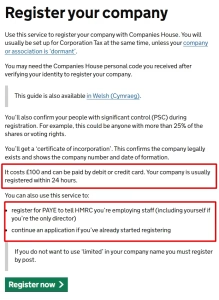
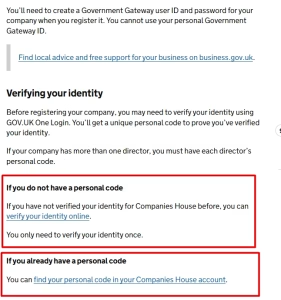
Companies House registration requirements and the £100 online incorporation fee.
Step 5: Understand Property Management Licences and Legal Requirements
Property management is not regulated in exactly the same way across all four UK nations.
One of the most important mistakes a new agency can make is assuming that company incorporation automatically gives it permission to undertake every type of property management work.
Company registration and property-sector compliance are separate matters.
| UK nation | Main agency requirements |
| England | Approved redress scheme; client money protection if handling relevant client funds; compliance with letting and property management rules |
| Wales | Rent Smart Wales agent licensing where applicable, required training, approved redress membership and relevant client money protection |
| Scotland | Scottish Letting Agent Register, required standards and training, and compliance with the Letting Agent Code of Practice |
| Northern Ireland | Applicable agency, landlord, housing, deposit and consumer protection requirements; check the exact services provided |
England: Letting agents and qualifying property managers must belong to a government-approved redress scheme.
An independent agency does not generally need a single universal letting-agent licence equivalent to the mandatory Scottish registration system, but other legal obligations still apply.
Wales: An agent carrying out letting or management activities covered by the Housing (Wales) Act 2014 must meet the Rent Smart Wales licensing requirements.
Scotland: Qualifying letting agents must register and meet the statutory Code of Practice. Registration involves checks and training requirements.
Northern Ireland: Property managers should assess applicable landlord registration, tenancy, deposit protection and trading requirements. Rules should not be assumed to match England.
An agency working across national borders should verify the relevant rules separately for each property and business activity.
Step 6: Join a Government-Approved Redress Scheme
For qualifying letting and property management work in England, redress scheme membership is mandatory.
Two approved schemes are:
- The Property Ombudsman
- The Property Redress Scheme
These schemes provide a process for handling complaints that the agency has not resolved directly with its customer.
A redress scheme is not the same as professional indemnity insurance, an industry membership or a client money protection scheme.
Before joining, compare the scheme’s current membership fees, eligibility conditions, complaint procedures and membership obligations.
The business must have an effective internal complaints procedure and communicate the appropriate redress details to customers.
Failure to join where required can result in enforcement action.
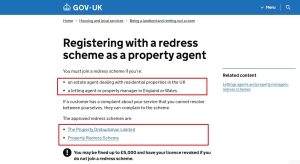
Government-approved property redress schemes required for qualifying letting agents and property managers.
Step 7: Arrange Client Money Protection and Suitable Banking
If your agency holds clients’ money while carrying out relevant letting or property management work in England’s private rented sector, you generally need membership of an approved Client Money Protection (CMP) scheme.
Client money may include rent received on behalf of landlords or other sums held for clients.
CMP protects eligible clients when an agent cannot repay money that it should hold for them.
It is different from tenancy deposit protection.
Under the English rules, failure to belong to a required CMP scheme can result in a financial penalty of up to £30,000.
An agency covered by these requirements must also comply with the rules on client bank accounts, membership certificates and disclosure.
For financial control, the agency should clearly separate:
- Money belonging to landlords and tenants.
- Money earned by the business as management fees.
- Operating funds used to pay salaries, suppliers and business expenses.
Client accounts should be reconciled regularly, with documented records of every receipt, deduction and payment.
An agency should never treat rent belonging to landlords as available working capital.
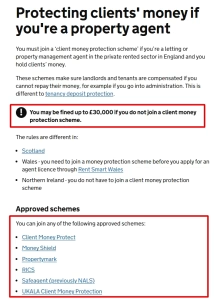
Client Money Protection rules for property agents holding landlord and tenant funds.
Step 8: Arrange Property Management Business Insurance
Insurance should reflect the services provided and the risks created by managing other people’s properties.
Professional indemnity insurance is particularly relevant because mistakes in administration, advice or professional services may cause financial loss.
Our separate analysis of professional indemnity insurance explains why cover limits should be selected according to contractual obligations and potential claims rather than price alone.
| Insurance type | Main purpose |
| Professional indemnity | Protection against covered professional errors and negligence claims |
| Public liability | Covered claims relating to public injury or property damage |
| Employers’ liability | Required for most employers, subject to exemptions |
| Cyber insurance | Protection against certain cyber incidents and data-related losses |
| Office and equipment cover | Protection for business premises and equipment |
| Legal expenses cover | Assistance with certain covered legal disputes |
Where employers’ liability insurance is compulsory, the minimum required cover is generally £5 million.
Insurance policies must also be checked for exclusions involving client funds, subcontractors, block management, vacant properties and other specialist risks.
Landlord building insurance is normally separate from the property management company’s own business insurance.
Step 9: Build Your Property Management Operating System
Modern property management depends heavily on record keeping, communication and financial administration.
A small agency does not necessarily need expensive software, but it must have a reliable way to monitor every property.
Its operating system should be able to record landlord details, tenant information, tenancy dates, rent payments, maintenance requests, property inspections and compliance deadlines.
A property management software package may include:
| Software function | Why it matters |
| Rent tracking | Identifies late or missing payments |
| Landlord statements | Supports clear financial reporting |
| Maintenance tickets | Records requests and work completed |
| Document storage | Keeps tenancy and compliance records organised |
| Inspection scheduling | Supports regular condition monitoring |
| Contractor records | Tracks supplier performance and insurance |
| Accounting integration | Helps maintain accurate business records |
| Client communication | Reduces missed messages and disputes |
A property management company will process personal data relating to landlords, tenants and prospective applicants.
It must therefore assess UK GDPR obligations, privacy notices, data security and whether an ICO data protection fee applies.
For a small business, operational efficiency is often more valuable than purchasing a system with unnecessary features.
Step 10: Build a Reliable Maintenance Contractor Network
Property management companies frequently depend on external tradespeople to deliver repairs and maintenance.
Potential contractors include plumbers, electricians, gas engineers, roofers, locksmiths, cleaners and general maintenance providers.
The contractor network should be established before the agency begins accepting fully managed properties.
We recommend checking qualifications, insurance, service availability, quotations and response arrangements.
Understanding how to check if a tradesman is insured is particularly useful when establishing a maintenance supplier network.
A good contractor process should distinguish genuine emergencies from routine repair requests.
For example, an uncontrolled water leak requires a different response from a cosmetic maintenance issue.
Every instruction should be recorded, together with the landlord’s authorisation where necessary.
The management agreement should explain how repairs are approved and whether the agency may authorise emergency expenditure up to a specified limit.
How Have Property Management Rules Changed for 2027?
Property management companies entering the market in 2027 must account for significant legal changes introduced during 2026.
The most important developments concern tenancy structures, possession procedures, rent increases, tenant protections, landlord registration and certain financial compliance obligations.
What Changed Under the Renters’ Rights Act in May 2026?
Major provisions of the Renters’ Rights Act 2025 came into effect for England’s private rented sector on 1 May 2026.
For affected assured tenancies, these reforms changed several established letting practices.
| Regulatory area | Position following the May 2026 reforms |
| Tenancy structure | Most affected assured tenancies operate on a periodic basis |
| Section 21 | No-fault Section 21 possession procedure abolished for affected tenancies |
| Rent increases | Statutory process with restrictions on frequency |
| Rental bidding | Landlords and agents cannot accept offers above the advertised rent |
| Rent in advance | New restrictions on advance payments |
| Tenant discrimination | Prohibitions affecting applicants with children or receiving benefits |
| Pets | Tenant requests must be considered under the applicable rules |
| Possession | Landlords must rely on lawful grounds and relevant procedures |
These reforms have increased the importance of accurate documentation and tenancy management.
For example, a new property manager should not rely on an outdated fixed-term assured shorthold tenancy template without checking whether it remains appropriate.
Likewise, an agency cannot assume that a landlord can regain possession through an old Section 21 process.
Rent increases, tenancy termination and possession proceedings must follow the applicable legal requirements.
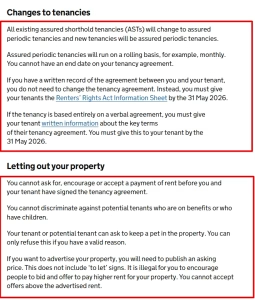
Renters’ Rights Act reforms affecting private landlords and property management businesses from 1 May 2026.
What Is the New Landlord Registration Requirement for 2027?
Another important development is England’s new Register your rental property service.
The government is introducing registration regionally, beginning in the West Midlands on 15 December 2026.
The rollout continues throughout 2027.
| Region | Registration opens | Registration deadline |
| West Midlands | 15 December 2026 | 14 March 2027 |
| East of England | 15 January 2027 | 14 April 2027 |
| East Midlands | 15 February 2027 | 14 May 2027 |
| South East | 15 March 2027 | 14 June 2027 |
| Yorkshire and Humber | 15 April 2027 | 14 July 2027 |
| North West | 15 May 2027 | 14 August 2027 |
| North East | 15 June 2027 | 14 September 2027 |
| London | 15 July 2027 | 14 October 2027 |
| South West | 15 August 2027 | 14 November 2027 |
During the initial rollout, the registration requirements apply to properties covered by the scheme that are occupied under relevant tenancies or become let during the rollout.
Landlords remain legally responsible for starting the registration process, providing the required information and paying the applicable annual registration fee.
However, letting agents and property managers may be authorised to provide or update certain property details on a landlord’s behalf.
These can include occupancy information, rent details, licensing records and compliance certificates.
This creates a practical service opportunity for management companies.
An agency could offer registration administration and compliance record preparation as part of its agreed service package.
However, it should not suggest that an agent can independently complete every legal step on the landlord’s behalf.
Future requirements involving the registration of unoccupied properties before advertising, and the display of registration numbers in adverts, should not be treated as already in force during the initial rollout.
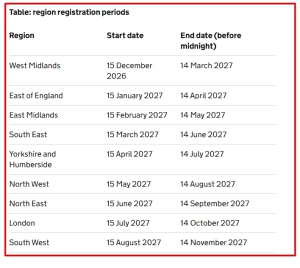
Official 2026–2027 regional deadlines for England’s rental-property registration service.
What Other Compliance Changes Must Agents Understand?
Anti-money-laundering supervision is another area where 2026 information matters.
From 30 June 2026, the relevant monthly rent threshold for qualifying letting agency business activity under the Money Laundering Regulations changed from €10,000 to £10,000.
Qualifying letting agency work involving agreements of at least one month and monthly rent of £10,000 or more can require HMRC anti-money-laundering supervision.
The threshold applies to individual rental arrangements as defined in the regulations, not simply the agency’s total rent collection.
Importantly, the financial sanctions reporting obligations applicable to letting agents have a different scope and do not use that £10,000 threshold.
A property management company should have appropriate checks and reporting processes for the activities it undertakes.
How Much Does It Cost to Start a Property Management Business in the UK?
Property management is generally less capital-intensive than purchasing rental properties because the agency earns fees from managing assets owned by other people.
However, a professional business must still budget for registration, compliance, insurance, technology, marketing and working capital.
Our illustrative startup budget for a small, home-based agency is:
| Startup expense | Illustrative budget |
| Limited company incorporation | £100 |
| Redress scheme membership | £200–£600 |
| Client money protection, where required | £200–£800 |
| Business insurance | £300–£1,200 |
| Website, branding and domain | £300–£2,000 |
| Initial software and IT setup | £150–£750 |
| Professional accountancy/legal setup | £300–£1,000 |
| Initial marketing | £300–£1,500 |
| Equipment and miscellaneous setup | £250–£1,000 |
| Working capital reserve | £3,000–£6,000 |
Figures other than the stated Companies House fee are illustrative budgeting assumptions, not verified market averages or guaranteed quotations.
Some schemes, insurers and software providers may charge substantially more, particularly for larger or specialist agencies.
This produces an illustrative total of approximately £5,100–£15,050, although actual costs can be lower or higher.
A founder who already has a suitable laptop, website skills and professional contacts may need less capital for equipment and marketing.
Conversely, an agency opening a high-street office or employing staff from the start may need significantly more.
We recommend separating one-off startup spending from monthly operating expenses.
A company might spend £5,000 establishing itself but still require enough working capital to survive several months before management revenue becomes reliable.
For a broader examination of financing options, our guide on how to get money to start a business covers funding routes and the importance of cash-flow planning.
How Much Should a Property Management Company Charge?
Pricing must balance competitiveness, service complexity, landlord expectations and the agency’s operating costs.
Property management companies commonly use percentage-based fees, fixed monthly charges or negotiated service contracts.
For illustration, an agency could assess the following pricing models:
| Service | Illustrative pricing approach |
| Tenant-find only | One-off fee agreed with landlord |
| Rent collection | Approximately 4%–7% of collected rent |
| Full residential management | Approximately 8%–15% of collected rent |
| HMO management | Higher percentage or specialist fixed fee |
| Short-let management | Percentage of booking revenue |
| Block management | Contracted annual fee or per-unit arrangement |
| Additional inspections | Agreed fixed charge |
| Compliance administration | Included in package or separately agreed |
These percentages are example planning ranges, not a surveyed national fee schedule. Local competitor research and actual quotations should determine the business’s final pricing.
Suppose a property rents for £1,500 per month.
At an 8% management fee, the business generates £120 per month.
At 10%, it generates £150.
At 12%, it generates £180.
The difference between 8% and 12% appears small for one property, but it becomes significant across a large portfolio.
At 50 properties renting for £1,500 each, moving from an 8% to a 12% fee changes monthly management revenue from £6,000 to £9,000.
However, higher fees must be justified by the services actually provided.
The business must also communicate whether quoted fees include or exclude VAT.
In England, tenant charges are restricted by the Tenant Fees Act. A management company must not attempt to improve its margins by charging tenants prohibited fees.
How Much Money Can You Make Managing 10, 25, 50 or 100 Properties?
The most useful financial measure is recurring management revenue after the direct cost of servicing each property.
We modelled four portfolio sizes using the following assumptions:
- Average monthly rent: £1,200 per property.
- Management fee: 10% of rent collected, excluding VAT.
- Monthly management revenue: £120 per property.
- Illustrative direct service cost: £20 per property per month.
- All properties are occupied and rent is fully collected in the model.
| Managed properties | Monthly revenue | Annual revenue | Monthly contribution before central overheads |
| 10 | £1,200 | £14,400 | £1,000 |
| 25 | £3,000 | £36,000 | £2,500 |
| 50 | £6,000 | £72,000 | £5,000 |
| 100 | £12,000 | £144,000 | £10,000 |
The contribution column deducts the assumed £20 direct service cost per property. It does not represent net profit.
From this contribution, the company still needs to pay central overheads, founder remuneration, additional staffing, accounting, insurance, software, marketing and other expenses.
At 100 properties, the agency may require a substantially larger team and more sophisticated systems than at 10 properties.
Therefore, costs should not be assumed to remain unchanged as the portfolio expands.
What Is the Break-Even Point for a Property Management Business?
Break-even is the point where recurring revenue covers the costs of operating the business.
Consider a small agency with:
- Monthly fixed overheads: £2,000.
- Management fee per property: £120.
- Direct service cost per property: £20.
The contribution from each managed property is £100.
Break-even portfolio = £2,000 ÷ £100 = 20 properties.
Under this scenario, the business needs approximately 20 fully paying managed properties to cover the assumed fixed overheads.
If the £2,000 overhead does not include a commercially realistic payment for the founder’s work, it is only an operating break-even calculation rather than evidence of a sustainable owner income.
This distinction is especially important for small agencies.
A founder may initially work long hours without paying themselves a salary. That can make the accounts appear more profitable than the underlying business model actually is.
Our preferred approach is to include a reasonable allowance for the founder’s labour before deciding whether the business has become sustainably profitable.
What Financial and Tax Requirements Apply to Property Management Companies?
A property management business must keep accurate accounting records and meet the tax obligations associated with its legal structure.
A sole trader generally pays Income Tax on taxable business profits, while a limited company pays Corporation Tax on its taxable profits.
Directors and shareholders may have additional personal tax obligations when withdrawing funds.
The agency should also assess VAT.
As of November 2026, the UK VAT registration threshold is £90,000 in taxable turnover, subject to the relevant registration rules.
For a property management agency, an important distinction is that rent collected for landlords is not automatically the agency’s own turnover.
The accounting treatment depends on whether the business is acting as an agent or principal and on the arrangements involved.
Management fees and other taxable services must be assessed separately from money merely held on behalf of landlords.
For instance, collecting £100,000 in landlords’ rent does not automatically mean the agency has generated £100,000 of management-service turnover.
Businesses approaching VAT registration should obtain appropriate tax advice.
New founders can also review accountancy costs when planning bookkeeping, statutory accounts, payroll and tax-return expenses.
Sole traders should pay attention to Making Tax Digital requirements. The Making Tax Digital rules expanded from April 2026 and are scheduled to cover more qualifying self-employed individuals from April 2027.
How Can You Find Your First Property Management Clients?
Finding landlords is one of the greatest commercial challenges for a new property management company.
A small agency may have a technically sound operating model but struggle because potential clients do not know it exists or have no reason to move away from an established provider.
The most effective marketing strategy should therefore focus on building credibility and generating qualified landlord enquiries.
Start With Local Visibility
Create a professional website showing the services offered, geographical coverage, contact information, compliance credentials and pricing approach.
Where eligible, establish a Google Business Profile and publish accurate contact details.
Build location-specific service pages that explain how the agency helps landlords in each area.
Examples of relevant search phrases include:
- Property management company in Birmingham.
- Rental property management in Manchester.
- Letting agents for landlords in Leeds.
- Full property management in Nottingham.
- HMO management services in Liverpool.
Avoid publishing dozens of identical city pages with only place names changed.
Each page should provide genuinely useful information about the local rental market and services available.
A broader business advertising strategy can support search visibility, lead generation and conversion.
Build Professional Referral Partnerships
Local accountants, mortgage brokers, estate agents, property investors and maintenance businesses may encounter landlords who need management assistance.
Professional networking can help develop referral relationships, provided fees, conflicts of interest and disclosure requirements are handled appropriately.
A new agency could also arrange informative sessions for landlords explaining the Renters’ Rights Act changes and their property compliance responsibilities.
This offers a practical opportunity to demonstrate expertise without relying entirely on paid advertising.
Offer a Landlord Portfolio Review
Rather than immediately trying to sell a management package, a founder could offer an initial assessment of a landlord’s existing property administration.
This might consider:
- Maintenance and inspection records.
- Compliance document organisation.
- Current property management costs.
- Rental payment reporting.
- Upcoming certification deadlines.
- Communication and contractor arrangements.
The assessment must remain within the founder’s competence and should not promise legal compliance without adequate verification.
Its commercial purpose is to identify where a professional management service could provide measurable value.
What Should a Property Management Agreement Include?
A written management agreement is one of the most important documents in the business.
It establishes the services the agency will perform and the authority delegated by the landlord.
The agreement should clearly address:
| Contract area | What should be defined |
| Parties | Legal identities of landlord and management company |
| Property | Address and precise scope of management |
| Services | Work included in the contract |
| Charges | Management fees, VAT and additional costs |
| Rent handling | Payment, reconciliation and remittance processes |
| Maintenance | Contractor approval and spending limits |
| Emergencies | Authority to act when the landlord cannot be reached |
| Compliance | Allocation of administrative and legal responsibilities |
| Complaints | Internal process and applicable redress scheme |
| Termination | Notice periods and handover responsibilities |
| Records | Documents and client data to be provided at the end of the agreement |
A landlord can delegate operational work without necessarily transferring every statutory obligation.
This means the agency should document precisely who is responsible for organising safety checks, deposit protection, right-to-rent checks where applicable and property licensing.
Contracts should be professionally reviewed before use.
The management company should not depend on vague verbal instructions for decisions involving rent, tenant funds or substantial maintenance expenditure.
How Do You Manage Tenants, Maintenance and Compliance Professionally?
Once the business signs its first management agreements, operational consistency becomes essential.
A standard landlord onboarding process should gather property ownership information, relevant licensing details, safety documentation, current tenancy terms, insurance information and maintenance history.
It should also establish whether the landlord’s mortgage or lease imposes any restrictions relevant to the letting.
Before marketing or managing a property, the agency should understand which responsibilities it has accepted.
For an English residential property, records may include the EPC, gas safety certificate where applicable, electrical safety documentation, deposit protection information and property licence details.
Where a deposit is received for a tenancy covered by the relevant English rules, it must generally be protected within 30 days, with the required information supplied.
Tenancy deposit protection is not the same as client money protection.
Similarly, houses in multiple occupation can require special licensing and additional safety procedures.
Large HMOs in England generally require mandatory licensing when occupied by five or more people forming more than one household, subject to the legal definition.
Local councils may also operate additional or selective licensing schemes.
A new agency should not begin managing specialist properties without understanding these requirements.
What Service Standards Should the Agency Track?
We recommend measuring performance using practical operational indicators.
| Performance indicator | Suggested internal management target |
| Emergency maintenance response | Defined immediate escalation procedure |
| Routine tenant acknowledgement | Within one working day |
| Monthly landlord statements | Issued on a consistent monthly schedule |
| Client money reconciliation | Regular reconciliation with documented review |
| Compliance certificate monitoring | Advance alerts before expiry |
| Landlord retention | Monitor annual cancellations and reasons |
| Complaints | Track resolution times and root causes |
| Vacancy periods | Record average vacant days per property |
These are proposed management standards, not statutory response deadlines or verified industry averages.
A business should define its actual response commitments according to staffing, contracts, the nature of the problem and legal requirements.
Can You Start a Property Management Business With No Money?
Starting a professional property management business with literally no money is generally unrealistic.
Even a home-based operation may have compulsory compliance costs, insurance premiums, administrative expenses and software requirements.
However, a founder can reduce initial spending considerably.
For example, they could begin without a high-street office, use affordable software, concentrate on a small geographical area and avoid employing staff before recurring revenue supports the expense.
They may also start with a narrowly defined service such as administrative support, provided the activity remains within their competence and all applicable agency requirements are satisfied.
It is important not to assume that describing work as consultancy or administration removes legal obligations if the business is actually carrying out regulated letting or management activities.
A more financially cautious approach is to secure sufficient startup capital, maintain a working-capital reserve and acquire clients gradually.
Business finance may help in some circumstances, but borrowing should be supported by realistic cash-flow forecasts.
It is better to build a small compliant agency than to accept landlord money before the business has the necessary legal and financial safeguards.
What Is the Best 90-Day Launch Plan for a Property Management Business?
We recommend breaking the launch into three operational phases.
| Period | Main priorities | Target outcome |
| Days 1–30 | Market research, business plan, legal structure and regulatory assessment | Business model and compliance requirements established |
| Days 31–60 | Insurance, banking, systems, contractor network and agreements | Operating infrastructure ready |
| Days 61–90 | Marketing, landlord consultations, onboarding and initial contracts | First appropriately managed client portfolio |
During the first month, the founder should identify the intended market and obtain accurate quotations for setup costs.
The second month should concentrate on operational readiness, including procedures for client funds, property records, contractor approval and complaints.
The third month should focus on acquiring landlords and delivering the promised service properly.
Not every agency will reach launch readiness or secure its first properties within 90 days.
Licensing, banking and regulatory applications may take longer, and the company must not undertake activities before meeting the requirements that apply.
For the first year, a sensible priority is to establish consistent service quality and a financially sustainable portfolio rather than maximise property numbers at any cost.
What Are the Biggest Risks of Starting a Property Management Business?
The property management market offers recurring revenue opportunities, but several risks can undermine profitability.
- Compliance failures are particularly serious because a business can face complaints, penalties and legal claims.
- Client money errors create financial and reputational risks that may be greater than the income earned from an individual property.
- Underpricing can lead to excessive workloads and insufficient contribution to pay staff or cover central costs.
- Poor contractor management can increase repair costs, delay maintenance and damage relationships with landlords and tenants.
- High client concentration is another concern. An agency that earns most of its management fees from one investor may lose a significant share of revenue if that investor sells their portfolio.
A business can reduce these risks through documentation, appropriate insurance, financial controls, clear contracts and regular performance reviews.
Our assessment is that long-term landlord retention is likely to be more commercially valuable than continually acquiring new properties while losing existing customers.
A smaller portfolio of profitable, well-serviced properties can be more sustainable than a larger portfolio generating frequent complaints and unplanned operating costs.
Conclusion
Starting a property management business in the UK in 2027 requires a combination of commercial planning, regulatory knowledge and strong operational controls.
The 2026 reforms have made it particularly important for new agencies to understand tenancy arrangements, landlord registration, client money protection and property compliance before accepting management contracts.
From a financial perspective, the strongest business model is not necessarily the one with the most properties.
It is the one that earns sustainable management fees, maintains appropriate cost controls and consistently delivers value to landlords and tenants.
A founder who begins with a clear niche, realistic startup budget, reliable contractor network and disciplined financial reporting can establish a foundation for long-term growth.
The priority should be to create a business that landlords can trust with their properties, money and legal responsibilities not simply an agency that promises to manage everything at the lowest price.
Frequently Asked Questions
Do I Need a Licence to Start a Property Management Business in the UK?
Requirements depend on location and services.
England requires qualifying agents to meet redress and client money protection obligations, while Wales and Scotland have additional agent registration or licensing systems.
How Much Money Do I Need to Start a Property Management Company?
A small home-based operation might plan for approximately £4,000–£15,000 in startup capital, but costs vary considerably.
Compulsory registrations, insurance, software and working capital should be included.
Can I Start a Property Management Business Without Owning Property?
Yes. Most independent property management companies earn fees for managing properties on behalf of landlords rather than purchasing the properties themselves.
What Percentage Do Property Management Companies Charge in the UK?
Fees depend on the location and services provided. An illustrative full-management budget might assume 8%–15% of rent, but individual agencies may quote outside this range.
How Many Properties Do I Need to Manage to Make a Profit?
There is no universal number.
Under one illustrative model with £100 monthly contribution per property and £2,000 fixed overheads, the operating break-even point is 20 properties.
Can I Run a Property Management Company From Home?
Yes, a home-based model may be practical if the business meets its legal, operational, insurance and data protection requirements.
It must still provide adequate communication and property services.
Is Property Management a Good Business to Start in 2027?
It can be attractive because of recurring service fees and relatively low property ownership costs.
Profitability depends on landlord acquisition, retention, pricing, compliance and operating efficiency.

Expert Blogger | Strategic thinker anticipating future directions for UK business
Related Articles in How To Start
View All →
Starting a Business in London: How to Identify Market Trends and Emerging Opportunities
London remains one of the UK’s most attractive destinations for entrepreneurs, offering access to international markets, skilled professionals, diverse communities and a thriving business ecosystem. However, starting a…

Amazon Delivery Franchise Cost UK: Investment, Profit, Fees and Requirements
The Amazon delivery franchise cost in the UK starts from approximately £10,000, while prospective business owners are generally expected to demonstrate at least £25,000 in liquid assets. This…

How to Start a Business in the UK?
Starting a business in the UK means turning an idea into a legal, financial and operational setup that can sell products or services, keep proper records, pay the…